← All women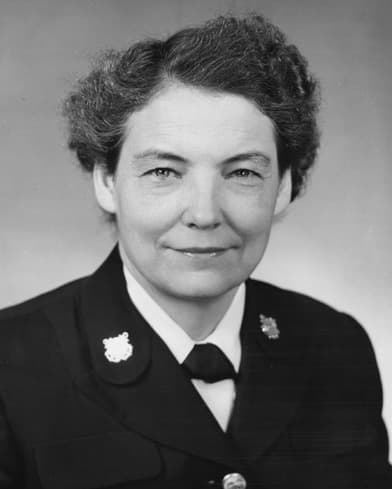
American · Aviation · Activism
Dorothy C. Stratton
March 24, 1899 – September 17, 2006
Early Life and Background
Dorothy Constance Stratton was born on March 24, 1899, in Brookfield, Missouri, to Reverend Richard L. Stratton and Anna (Troxler) Stratton.[1][2][6][9] She grew up in a Midwestern Protestant household that moved frequently across Missouri and Kansas as her father accepted calls to different congregations.[6][9] This itinerant childhood exposed her to a range of small-town communities and instilled an ethic of service, discipline, and adaptability that would later characterize her administrative style.
Little is recorded about her early schooling, but sources agree that Stratton pursued higher education at a time when relatively few women attended college.[1][2][6][9] She enrolled at Ottawa University in Kansas, completing her undergraduate degree there around 1920.[2][6] Subsequent accounts from Purdue University note that she undertook graduate work at several institutions, including Northwestern University, the University of Washington, the University of California, Los Angeles (UCLA), and the University of California, Berkeley, before consolidating her formal credentials with advanced degrees in psychology and student personnel administration.[9]
Stratton earned a Master of Arts in psychology from the University of Chicago, followed by a Ph.D. in student personnel administration from Teachers College, Columbia University.[2][6][9] This combination of psychology and emerging student-affairs theory placed her at the forefront of professional approaches to university administration, just as colleges were beginning to think systematically about student guidance and welfare.
Career Beginnings and Academic Work
Before entering higher education administration, Stratton worked as a secondary-school teacher, teaching in public high schools in Brookfield, Missouri; Renton, Washington; and San Bernardino, California.[2] These early teaching posts gave her direct experience with classroom instruction and adolescent development, reinforcing the psychological training she had obtained.
After completing her graduate studies, Stratton moved into higher education. She joined Purdue Universityassistant professor of psychology, a role that reflected her academic specialization and her growing interest in student guidance.[2][6] At Purdue she became known for her attention to student needs beyond the classroom, an orientation that would lead directly to her most significant academic appointment.
In 1933, soon after earning her doctorate at Columbia, Stratton was named Purdue University’s first full-time Dean of Women.[1][6][9][11] She held the position until 1942, taking a leave of absence during World War II. As dean, she worked in an era when women at land‑grant universities were often steered almost exclusively toward home economics and teacher training. Stratton instead advocated for broader educational possibilities, using her administrative authority to reshape expectations about women’s place in higher education.
Purdue Deanship and Expansion of Women’s Opportunities
Stratton’s tenure as Dean of Women at Purdue marked a turning point in the institution’s history. According to Purdue’s Veteran and Military Success Center, she "forged a path for women wanting to study more than home economics" and saw the fruits of this effort in a dramatic increase in enrollment.[11] During her nine-year tenure, the number of women students nearly tripled, rising from approximately 500 to more than 1,400.[11]
She championed the creation of experimental curricula for women in fields beyond traditional domestic subjects, encouraging female students to consider careers in science, engineering, business, and other professional paths.[9][11] In addition to curricular innovation, Stratton established Purdue’s first women’s employment placement center, designed to ensure that women graduates had practical routes into the labor market.[9] This initiative reflected her belief that the value of education lay not only in intellectual development but also in meaningful vocational outcomes.
In the broader context of the 1930s, Stratton’s work confronted entrenched social norms. The Great Depression had tightened competition for jobs and often reinforced conservative views about women’s employment. By pushing for expanded opportunities for women at Purdue, she aligned herself with the progressive wing of higher education administrators who saw universities as vehicles of social change.
Her success as dean made her a prominent figure in women’s higher education and drew the attention of national actors when the United States began mobilizing for World War II. Her combination of organizational skill, psychological insight, and commitment to women’s advancement proved decisive in her recruitment to military service.
World War II Service and Creation of SPARS
With U.S. entry into World War II, Stratton left Purdue in 1942 to join the burgeoning war effort.[1][11] She was initially commissioned as a senior lieutenant in the U.S. Navy, serving in the WAVES (Women Accepted for Volunteer Emergency Service), the Navy’s women’s reserve program.[2][11] Her performance and administrative background soon led to a reassignment that would define her historical legacy.
In 1942, following President Franklin D. Roosevelt’s authorization of the Coast Guard Women’s Reserve, Stratton was transferred from the Navy to the U.S. Coast Guard to organize and lead the new unit.[1][2][5][11] On November 24, 1942, she was sworn in as the first director of the Women’s Reserve and, in the process, became the first woman commissioned an officer in Coast Guard history.[1][5][11] This dual milestone placed her at the forefront of women’s integration into a U.S. sea service.
Stratton gave the Women’s Reserve a distinctive identity by coining the acronym SPARS from the Coast Guard motto Semper Paratus ("Always Ready").[1][11] The name captured both the nautical character of the unit and its readiness for wartime tasks. Under her leadership, SPARS recruited and trained thousands of women to perform duties that freed male Coast Guardsmen for combat and other frontline responsibilities.
SPARS personnel served in communications, clerical work, port security, logistics, and specialized technical roles. The National Park Service notes that Stratton’s leadership "worked to integrate women into home front military posts and gain respect from their male colleagues," emphasizing her role in both operational planning and cultural change within the service.[6]
Promotions and Military Leadership
Stratton’s wartime responsibilities were matched by rapid advancement in rank. The Purdue Veteran and Military Success Center notes that after founding the Women’s Reserve she "climbed in rank to lieutenant commander and then to commander in January 1944, then to captain one month later."[11] French-language sources specify that she became the first woman Coast Guard commander on January 1, 1944 and the first woman Coast Guard captain on February 1, 1944.[4]
As director of SPARS, Stratton’s command responsibilities included nationwide recruitment, training, and assignment of personnel, as well as coordination with the Navy and War Department. Her work was both logistical and symbolic: by occupying senior ranks, she demonstrated that a woman could hold substantive command in a uniformed service, challenging prevailing assumptions about women’s military capabilities.
At the conclusion of World War II, Stratton managed the demobilization of SPARS. The program was formally disbanded on June 30, 1946, a date that also marked the end of her directorship.[1][5] She supervised the orderly release of thousands of women from service and worked to ensure they received appropriate recognition and assistance in returning to civilian life.
For her wartime achievements, Stratton received the Legion of Merit, one of the United States’ higher military decorations, awarded "as a brilliant organizer and administrator" whose work contributed to the successful prosecution of the war.[9][10][11] The citation acknowledged both her organizational skill and the broader significance of SPARS in U.S. operations.
Postwar International and Civic Leadership
After leaving active military service, Stratton transitioned to international and civic roles that extended her influence beyond the armed forces. In 1946, she became the first director of personnel at the International Monetary Fund (IMF), then a newly established institution created to stabilize the global financial system in the aftermath of World War II.[1][8] In this capacity, she oversaw staff recruitment and personnel policies during the IMF’s formative years.
Her appointment to the IMF represented a significant step for women in international organizations, positioning a woman in a key administrative role within a major multilateral institution at a time when such positions were overwhelmingly dominated by men.
In 1950, Stratton took on another influential position as national executive director of the Girl Scouts of the USA, a role she held for roughly a decade.[1][5][6][13] Leading the Girl Scouts allowed her to apply her expertise in education, youth development, and organizational management to a nationwide network of girls’ troops.
During her tenure, she guided programmatic growth and modernization within the organization. Though detailed program specifics are sparse in the major biographical sources, her leadership is consistently cited as a period of expansion and strengthened organizational capacity.[1][5][6] Through the Girl Scouts, Stratton influenced generations of girls, promoting leadership, outdoor skills, community service, and citizenship.
Major Works, Contributions, and Recognition
Stratton’s most notable contributions were institutional rather than literary or scientific. She did not leave a widely cited body of published research, but she transformed multiple organizations through policy, structure, and culture.
- Purdue University: As first full-time Dean of Women, she broadened curricula, increased female enrollment, and instituted employment placement services for women.[9][11]
- U.S. Coast Guard: She founded and directed SPARS, coined its name, and oversaw the integration of women into key home-front roles, becoming the first woman commissioned officer and the first woman to hold commander and captain ranks in Coast Guard history.[1][4][5][11]
- International Monetary Fund: As the IMF’s first director of personnel, she shaped staffing practices in a crucial early phase of the institution’s development.[1][8]
- Girl Scouts of the USA: As national executive director, she influenced the organization’s mid‑century evolution, expanding programs that encouraged leadership and civic engagement among girls.[1][5][6]
Her decorations and honors include the Legion of Merit for wartime service, as mentioned by Purdue sources and institutional histories of SPARS.[9][10][11] Later commemorations also underscore her impact. In the early 21st century, the U.S. Coast Guard named a Legend‑class National Security Cutter in her honor—the USCGC Stratton (WMSL‑752).[1] On July 23, 2012, First Lady Michelle Obama christened the vessel, noting that it was the first National Security Cutter named for a woman and the first Coast Guard cutter sponsored by a First Lady.[1][3]
Personal Life
Biographical sources on Stratton focus largely on her professional and institutional roles; relatively little is recorded about her private life. None of the major references—Wikipedia in multiple languages, Purdue institutional pages, the National Park Service biography, or the Navy Memorial entry—mention marriage, children, or long-term domestic partnerships.[1][2][3][6][8][9][11] This silence may reflect either a lack of documentation or a conscious focus on her public achievements.
What can be discerned is that Stratton’s life was deeply oriented toward service and administration. She remained closely associated with institutions she had shaped—particularly Purdue and the Coast Guard—and maintained ties to West Lafayette, Indiana, later in life.[1][11] Her longevity allowed her to witness and sometimes be honored by the organizations that had benefited from her leadership.
Legacy and Historical Impact
Stratton’s legacy is multi-layered, spanning higher education, military history, international institutions, and youth development.
In women’s higher education, she stands as a key figure in the professionalization of the Dean of Women role and the expansion of women’s academic opportunities at land-grant universities. Her work at Purdue is frequently cited in institutional histories as foundational, particularly the near tripling of female enrollment during her tenure and the establishment of employment placement services for women.[9][10][11]
In military history, Stratton is best known as the first woman commissioned officer in the U.S. Coast Guard and the founding director of SPARS.[1][5] Her leadership demonstrated that women could be organized into an effective, disciplined reserve force and contribute meaningfully to wartime operations, particularly on the home front. SPARS is now remembered as one of the crucial steps in the broader process of integrating women into the armed services, and Stratton’s promotions to commander and captain broke symbolic barriers that later women officers would build upon.
Her postwar role as the IMF’s first director of personnel placed a woman in a formative position within a major global financial institution, contributing to the slow diversification of leadership in international organizations.[1][8] Her decade as national executive director of the Girl Scouts of the USA reinforced her commitment to youth education and leadership, helping shape an organization that remains central to girls’ civic and outdoor experiences.
Commemoratively, the naming and 2012 christening of the USCGC Stratton by First Lady Michelle Obama further cemented her status in U.S. collective memory.[1][3] The cutter’s name ensures that Stratton’s contributions are recognized not only in historical texts but also in the operational fleet, symbolizing the enduring connection between her pioneering service and contemporary Coast Guard missions.
Later Life and Death
After completing her major leadership roles, Stratton lived a long retirement, remaining associated with institutions she had served and residing in West Lafayette, Indiana.[1][11] Her longevity—she lived to 107—made her a living link to the early 20th century and the World War II era for much of the postwar period.
Stratton died on September 17, 2006, in West Lafayette.[1][2][3][5][11] Obituaries, including one in the Los Angeles Times, emphasized her role as the first woman commissioned officer in the Coast Guard and her leadership of SPARS during World War II, as well as her contributions to Purdue, the IMF, and the Girl Scouts.[1][3][11] Purdue and Coast Guard commemorations continue to mark her birthday and highlight her achievements, ensuring that new generations of students and service members encounter her story.[6][9][11]
Stratton’s life illustrates the power of administrative leadership in women’s history. Without commanding combat units or holding elected office, she fundamentally reshaped the structures through which women accessed education, military roles, international employment, and youth leadership. Her career offers an example of how organizational design and policy implementation can serve as vehicles of social transformation, making her a central figure in any almanac of women’s historical achievements.
Dated achievements
8 indexed.
- Mar241899Activism
Birth of Dorothy C. Stratton
Dorothy Constance Stratton was born in Brookfield, Missouri, later becoming an educator, Coast Guard officer, and federal official.
View details Dorothy C. Stratton - Wikipedia - Jan011933Activism
Becomes Purdue University's first full-time Dean of Women
Stratton became Purdue's first full-time Dean of Women in 1933, expanding academic opportunities and enrollment for women students.