← All women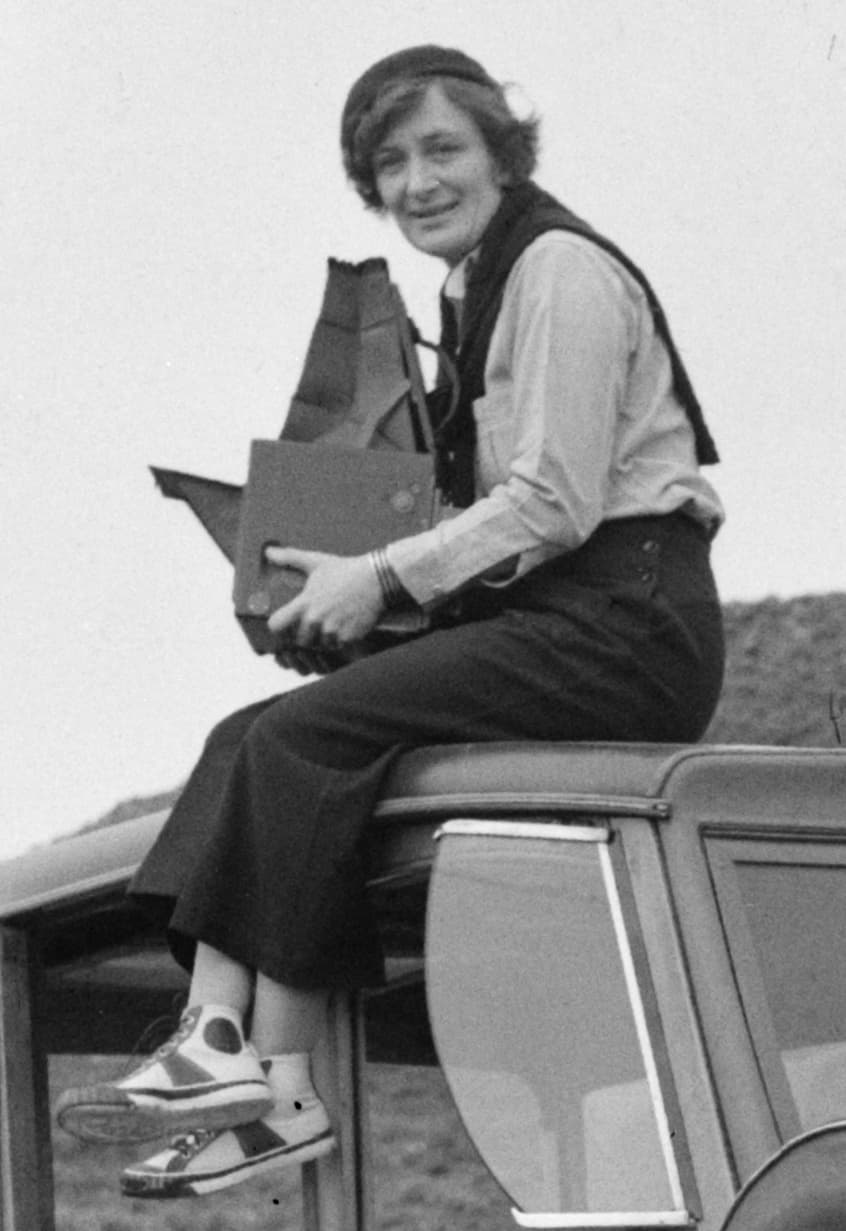
American · Arts · Activism
Dorothea Lange
May 26, 1895 – October 11, 1965
Early Life and Background
Dorothea Margaretta Nutzhorn, later known as Dorothea Lange, was born on May 26, 1895, in Hoboken, New Jersey, to Henry Nutzhorn and Johanna Lange, a German American family living across the Hudson River from New York City.[2][4][10] Hoboken’s busy docks and immigrant neighborhoods formed the backdrop of her childhood, exposing her early to urban diversity and economic precariousness.
Two events in Lange’s youth profoundly shaped her life and vision. At age seven she contracted polio, an illness that left her with a permanent limp.[14] She later described how the disability taught her to "watch" rather than to be watched, fostering a quiet, observant presence that would become central to her work as a photographer. Around age twelve, her parents’ marriage dissolved; her father left the household, and Dorothea subsequently adopted her mother’s maiden name, Lange, as her own surname.[4][14] The combination of physical disability and family disruption heightened her empathy for people experiencing loss and marginalization.
Despite limited financial means, Lange attended public schools in New York City and spent considerable time walking the streets, observing people from many backgrounds.[6] She showed little interest in formal academic achievement but developed a strong attraction to visual imagery. As a teenager, she resolved that she would become a photographer, a bold ambition for a young woman in the early twentieth century.[5][6] Her mother helped arrange a position as an office assistant at a photographic studio, where Lange began to learn about cameras, printing, and the business of portraiture.
Her early education in photography continued through informal apprenticeships. In 1914, she worked at the studio of pictorialist photographer Arnold Genthe, absorbing lessons in lighting and composition.[5] She later studied at the Clarence H. White School of Photography, associated with Columbia University, one of the few institutions at the time offering serious artistic training in photography.[5][13] Although she did not complete a formal degree, these experiences gave her technical skills and professional contacts that would prove crucial when she moved west.
Move to California and Career Beginnings
In 1918, Lange and a friend set out to travel around the world, intending to work along the way to support themselves.[6] Their plans were abruptly derailed when their savings were stolen in a robbery shortly after they reached San Francisco, California. Stranded without resources, Lange decided to remain in the city. This forced stay became a turning point: she established herself in San Francisco and built the foundations of her career.
Lange soon found work in leading photography studios and by the early 1920s opened her own portrait studio catering to the city’s affluent families and artistic circles.[4][6][12] Her commercial work emphasized careful composition and a respectful representation of sitters, qualities that would later translate into her documentary practice. In 1920, she married the Western landscape painter Maynard Dixon, a well-known figure in California’s art community.[4][6] The couple had two sons and moved in circles that included painters, writers, and bohemians.
Throughout the 1920s, Lange was considered a successful studio photographer. Yet she was quietly restless, aware of the gap between the privileged world of her clients and the growing economic difficulties faced by working-class people. The stock market crash of 1929 and the onset of the Great Depression sharply reduced demand for luxury portraits. As her business dwindled, Lange began to take her camera outside the studio, photographing unemployed men and breadlines on San Francisco’s streets.[7][12]
Around 1933, she made the photograph White Angel Breadline, San Francisco, showing a lone man among a crowd at a soup kitchen run by a woman known as the "White Angel."[4][14] The image, often regarded as her first major documentary work, attracted attention from local photographers and officials and marked her transition from commercial portraiture to socially engaged documentary photography.
New Deal Work and the Great Depression
Lange’s shift toward documenting hardship coincided with federal efforts to respond to the Depression. In 1934, she held her first exhibition of photographs in San Francisco, which established her reputation as a skilled documentary photographer.[4][7] Critics recognized the emotional power of her images of unemployed men and urban poverty, helping bring her to the attention of New Deal agencies.
In 1935, Lange was hired by the federal Resettlement Administration, soon renamed the Farm Security Administration (FSA), to photograph the conditions of migrant workers and rural communities affected by economic collapse and environmental disasters.[4][5][6] Under the direction of Roy Stryker, the FSA photography unit aimed to build a visual record of American life and to support policy interventions. Lange’s assignments took her throughout California and other western states, where she created thousands of images of "Okies" and other displaced families seeking work.
Her photographs from this period, such as families huddled in makeshift tents, fields of workers bent over crops, and children playing in dusty camps, combined clear composition with an intense focus on faces and gestures. Lange often recorded the words of her subjects, pairing images with their own statements, which were used in captions and reports.[7] This practice helped preserve the agency and voices of people who were otherwise marginalized in official records.
In early March 1936, while on assignment in California, Lange visited a pea-pickers’ camp near Nipomo.[3][12][14] There she encountered Florence Owens Thompson, a mother of several children living in a lean-to and uncertain of her next meal. Lange took a series of photographs, the most famous of which became known as Migrant Mother, Nipomo, California. The image shows Thompson gazing anxiously into the distance as two children lean into her shoulders, their faces turned away from the camera.
Distributed through the Resettlement Administration and published in newspapers, Migrant Mother quickly became an icon of the Great Depression.[3][4][12] According to later accounts, within days of the photograph’s appearance, authorities sent significant food and medical aid—estimated at approximately $200,000—to the camp, underscoring the direct impact of Lange’s work in prompting relief.[3] Although many of the workers had already moved on by the time the aid arrived, the episode demonstrated the capacity of documentary photography to influence public policy.
By the late 1930s, Lange was widely recognized as one of the foremost chroniclers of Depression-era America. In August 1939, she toured Washington State, photographing migrant farmworkers in regions such as the Yakima Valley for New Deal agencies.[1] Her images from this tour expanded the geographic scope of her documentation, revealing similar patterns of precarity among workers in the Pacific Northwest.
An American Exodus and Collaborative Work
Lange’s professional and personal life intersected in her collaboration with economist Paul Schuster Taylor. Taylor, a professor at the University of California, Berkeley, studied agricultural labor and migration, and he met Lange while both were working on New Deal projects.[12] Together, they traveled extensively through California’s valleys, recording interviews with workers while Lange photographed.
Their combined work culminated in the 1939 book An American Exodus: A Record of Human Erosion, which paired Taylor’s text and statistical analysis with Lange’s photographs.[4][12] The book examined the displacement of rural families and the social consequences of economic and environmental crises. It is often cited as a foundational example of integrated visual and social-scientific documentation.
During this period, Lange’s marriage to Maynard Dixon deteriorated, strained by financial pressures and differing commitments. The couple divorced, and Lange later married Taylor, with whom she would remain for the rest of her life and continue to collaborate on photo-essays and international projects.[4][6]
Guggenheim Fellowship and World War II
In 1940, Lange’s stature as a documentary photographer was recognized with a Guggenheim Fellowship for Photography, awarded "for the making of documentary photographs of the American social scene, particularly in rural communities."[4][7][13] She is widely noted as the first woman to receive a Guggenheim Fellowship in photography, a significant breakthrough in a field where major grants had largely gone to men.[6][13]
The fellowship was intended to support independent work, but the course of world events soon changed Lange’s plans. After the United States entered World War II, the federal government implemented the forced relocation and incarceration of Japanese Americans living on the West Coast. In 1942, Lange accepted an assignment from the War Relocation Authority (WRA) to photograph this process.[4][8] To do so, she requested a deferment of her Guggenheim Fellowship and eventually relinquished it, choosing to prioritize documenting this civil-liberties crisis.
Working under government restrictions but with a critical eye, Lange photographed families registering for removal, soldiers overseeing boarding, crowded assembly centers, and daily life in camps such as Manzanar. Her images highlighted the emotional distress and injustice of the policy, portraying subjects with dignity rather than depicting them as security threats.[4] Many of her photographs were impounded by the Army and not widely seen until decades later, reflecting official discomfort with their content.
Lange also collaborated during the war with fellow photographer Ansel Adams, documenting the rapidly changing wartime communities of Richmond, California, including shipyards and housing developments.[6] These projects extended her focus on how large-scale economic and political shifts reshaped ordinary lives.
Postwar Work, Teaching, and International Projects
After the war, Lange’s health was increasingly fragile, but she continued to work, travel, and teach. She produced photo-essays for prominent magazines such as Life and Fortune, often in partnership with Paul Taylor.[6] Their assignments took them to places including rural Ireland, parts of Asia, and American communities undergoing postwar changes, where Lange again sought to document how global economic and political developments affected everyday people.
Lange also played an important role in shaping the field of photography through institutional work. She advised younger photographers, lectured, and participated in the founding of the photography journal Aperture, created in the early 1950s as a forum for serious discussion of photographic practice and aesthetics.[13] Her influence extended beyond her own images to the photographers she mentored and the conversations she helped foster about documentary ethics.
In addition, she maintained relationships with museums and archives that acquired her prints and negatives. Institutions such as the Museum of Modern Art (MoMA)San Francisco Museum of Modern Art (SFMOMA), and the International Center of Photography (ICP) collected and exhibited her work, further solidifying her status as a central figure in twentieth-century photography.[5][12][16]
Awards, Honors, and Recognition
Lange’s most explicitly documented formal honor is her Guggenheim Fellowship in 1940, noted as a first for women in photography.[4][7][13] Over time, she was also widely celebrated by professional organizations and later posthumously honored by institutions dedicated to women’s achievements.
In the decades after her death, she was inducted into the National Women’s Hall of Fame, which recognizes women who have made lasting contributions to the United States.[6] Art historians and curators frequently cite her as one of the preeminent documentary photographers of the twentieth century.[2][3][12] Her photographs have been included in countless exhibitions and publications, and works like Migrant Mother appear in textbooks, museum wall texts, and educational curricula worldwide.
The planned 1966 exhibition "Dorothea Lange" at MoMA, organized shortly before she died, is often described in secondary sources as one of the first major photographic retrospectives at the museum devoted to a woman photographer, although details about exact dates and "first" status remain debated.[8][16] Regardless of the precise ranking, the show demonstrated that her work had entered the canon of modern art.
Personal Life
Lange’s personal life was entwined with her evolving career. Her first marriage, to painter Maynard Dixon, introduced her to artistic communities and to the landscapes of the American West, which influenced her sense of space and place.[4][6][12] They had two sons, and Lange managed the dual responsibilities of motherhood and professional life during years of economic hardship.
The strains of the Great Depression and their differing commitments led to the end of her marriage to Dixon. Lange then developed a partnership with economist Paul Schuster Taylor, whose research on agricultural labor intersected with her photographic interests.[4][12] Their marriage created a sustained intellectual and creative collaboration; they traveled together, conducted fieldwork as a team, and co-produced books and articles.
Lange’s experience with chronic illness—from childhood polio to later health problems, including the cancer that ultimately claimed her life—shaped her working methods. She often photographed despite pain and fatigue, using her camera as a means to engage with the world rather than withdraw from it.[14] Friends and colleagues described her as both intensely empathetic and steadfastly disciplined, qualities reflected in the careful construction of her images.
Later Life and Death
In her final years, Lange continued to photograph and to consult on exhibitions of her work. She worked closely with curators at MoMA on a retrospective, reviewing prints and selecting images that would represent the breadth of her career.[16] Even as illness limited her mobility, she remained engaged with questions about how her photographs should be presented and interpreted.
Lange died of cancer on October 11, 1965, in San Francisco, at the age of 70.[2][4][7] Her death occurred just before the opening of the planned MoMA exhibition, turning the show into a posthumous tribute. After her passing, Paul Taylor and various institutions worked to organize her negatives, prints, and papers, ensuring that they would be preserved for future generations.
Legacy and Historical Impact
Dorothea Lange’s legacy rests on both the aesthetic qualities of her photographs and their historical function as records of social crisis. Her work for the FSA and other New Deal agencies helped define the visual vocabulary of the Great Depression, presenting displaced farmers, migrant workers, and urban unemployed as individuals whose experiences demanded national attention.[2][3][4]
Images such as White Angel Breadline and Migrant Mother have become emblematic of the era, reproduced in countless books and exhibitions. Their power lies in the combination of formal clarity—strong lines, careful framing, nuanced light—and emotional immediacy. Lange’s subjects are rarely anonymous crowds; instead, she focuses on faces, hands, and posture, inviting viewers to relate personally to the people she depicts.
Beyond their artistic merit, Lange’s photographs influenced policy and public opinion. Her documentation of migrant labor in California and Washington informed debates about housing, wages, and federal relief.[1][12] Her images of Japanese American incarceration provided evidence of civil-rights violations and later supported movements for redress and historical reckoning.[4][8] In this sense, her camera functioned as both a witness and a participant in American democracy.
In women’s history, Lange stands as a pioneering figure who navigated and reshaped a male-dominated field. She was one of the earliest women to gain national recognition as a documentary photographer and the first woman to receive a Guggenheim Fellowship in photography.[6][13] Her career demonstrated that women could use visual journalism to interrogate power, illuminate injustice, and influence policy. Her life also highlights the challenges women faced in balancing professional ambition with family responsibilities and health issues during much of the twentieth century.
Contemporary museums and archives—from MoMA and SFMOMA to the International Center of Photography—continue to collect, exhibit, and publish Lange’s work.[5][12][16] Educational programs, such as those developed by the New-York Historical Society and the National Gallery of Art, use her photographs to teach students about the Great Depression, World War II, and documentary ethics.[1][8] Her images remain central to discussions about representation, consent, and the responsibilities of the photographer.
Decades after her death, Dorothea Lange’s photographs still shape how Americans visualize poverty, migration, and state power. They remind viewers that behind every statistic is a human face and that the act of looking closely—"seeing" others in their full complexity—can be a form of solidarity and a spur to change.
Dated achievements
9 indexed.
- May261895Arts
Birth of Dorothea Lange
Dorothea Margaretta Nutzhorn (later known as Dorothea Lange) is born in Hoboken, New Jersey, U.S.
View details Dorothea Lange Biography - Jan011933Arts
White Angel Breadline documentary photograph
Lange creates *White Angel Breadline*, her first major documentary photograph during the Great Depression.