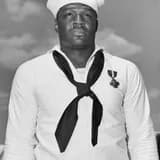
During the Pearl Harbor attack, Miller carried wounded sailors to safety and manned an anti-aircraft gun despite no weapons training, becoming a national hero.
On the morning of December 7, 1941, Doris Miller was collecting laundry aboard the battleship USS West Virginia when Japanese aircraft launched their surprise attack on Pearl Harbor. As torpedoes and bombs struck the ship, Miller rushed to his battle station, only to find it had been destroyed. He then moved through the smoke and chaos to help carry wounded sailors, including the ship's mortally wounded captain, Mervyn Bennion, to safer areas.
Miller, who as a Black mess attendant had been barred from weapons training, then took command of an unmanned .50-caliber Browning anti-aircraft machine gun and fired it at attacking Japanese planes until he ran out of ammunition. Witnesses credited him with downing several enemy aircraft, though official counts vary. He continued to help evacuate sailors from the sinking ship until ordered to abandon it himself.
Miller's actions were extraordinary given that he had received no formal gunnery training whatsoever—a direct consequence of the Navy's discriminatory policies restricting Black sailors to menial roles. His composure, bravery, and initiative under fire, performed entirely outside his assigned duties, immediately captured public attention once his story was reported, becoming emblematic both of individual heroism and of the injustice of a segregated military that had denied him the training and rank his abilities warranted. His actions helped galvanize the civil rights movement's push for integration of the U.S. armed forces, a process that would not formally happen until 1948.