← All women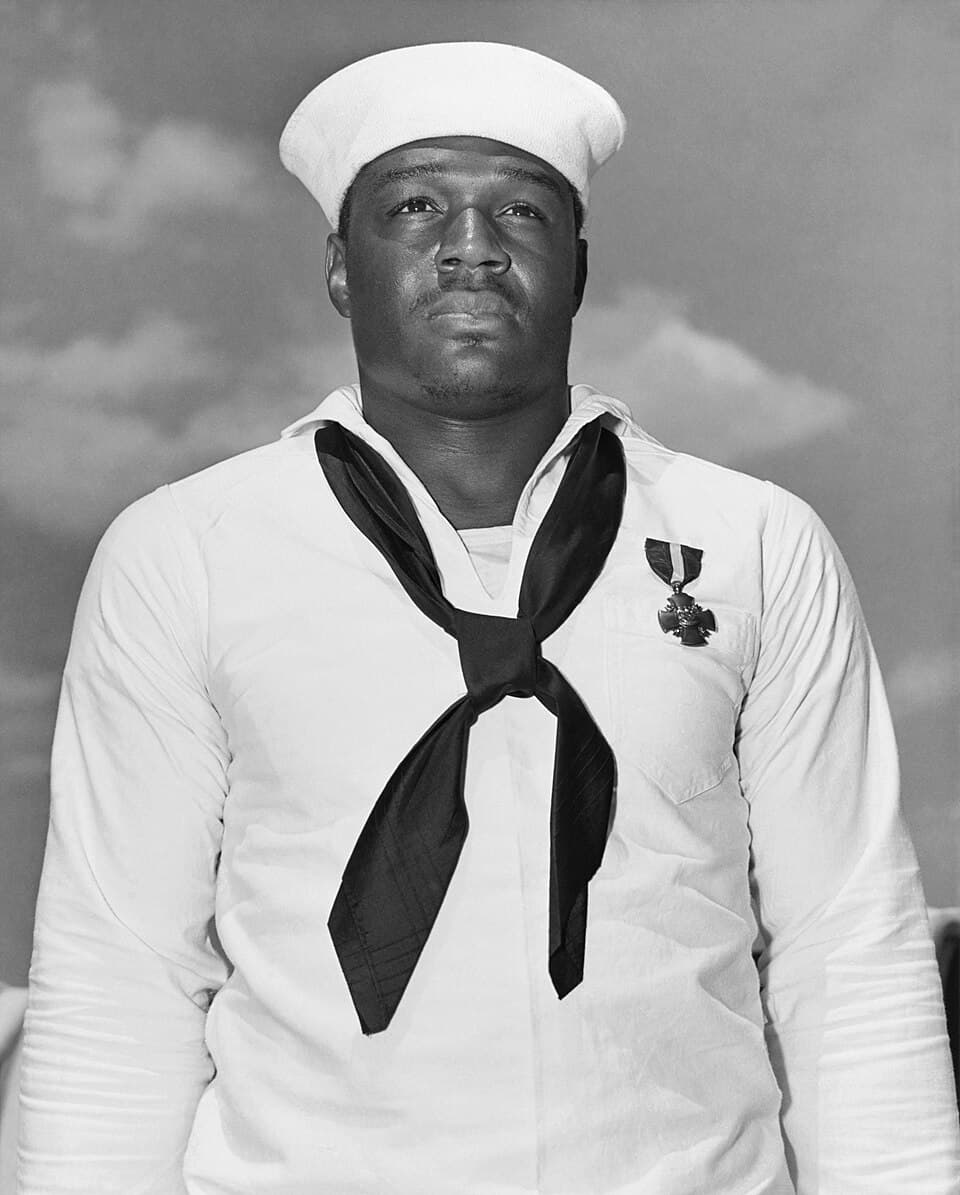
American · Activism
Doris Miller
October 12, 1919 – November 24, 1943
Note on Subject
This profile concerns Doris "Dorie" Miller (1919–1943), an African American U.S. Navy sailor whose extraordinary heroism at Pearl Harbor made him a landmark figure in the history of American civil rights and military desegregation. Although named "Doris"—a name his family had chosen expecting a daughter—Miller was male; his story is included in historical archives on gender and naming conventions, and his legacy intersects deeply with the broader fight against racial (and by extension, related identity-based) discrimination in American institutions.
Early Life and Background
Doris Miller was born on October 12, 1919, on a farm near Waco, Texas, the third of four sons born to Connery and Henrietta Miller, sharecroppers who worked the land in rural McLennan County. His unusual first name arose because his parents and grandmother had expected a girl. Raised amid the entrenched racial segregation of the Jim Crow South, Miller grew up doing farm labor from a young age, helping his family scrape by economically.
He attended A.J. Moore High School in Waco, one of the schools designated for Black students under segregation, where he played fullback on the football team and was noted for his impressive size and physical strength. Before enlisting in the military, he worked various jobs, including as a cook, to help support his family. Friends and family later described him as quiet, hardworking, and possessed of remarkable physical power—qualities that would serve him in unexpected ways.
Naval Enlistment and Segregated Service
On September 16, 1939, at age 19, Miller enlisted in the United States Navy in Dallas, Texas. Like the overwhelming majority of African American men who joined the Navy at the time, he was assigned to the Messman Branch—the only occupational track officially open to Black sailors under the Navy's segregation policy. This meant that regardless of ability, intelligence, or ambition, Black sailors served in menial roles: as cooks, stewards, and cabin attendants for white officers, without access to weapons training, technical instruction, or paths toward promotion into command positions.
After recruit training at Naval Station Norfolk, Virginia, Miller was assigned to the ammunition ship USS Pyro. In January 1940, he transferred to the battleship USS West Virginia, stationed at Pearl Harbor, Hawaii. Aboard the "Wee Vee," Miller worked as a mess attendant and also gained recognition as the ship's heavyweight boxing champion, a role that made him popular among the crew and hinted at the physical prowess that would later prove pivotal.
The Attack on Pearl Harbor, December 7, 1941
On the morning of December 7, 1941, Miller was gathering laundry aboard the USS West Virginia when Japanese aircraft began their surprise assault on the U.S. Pacific Fleet at Pearl Harbor. The ship was struck by multiple torpedoes and bombs. Miller's assigned battle station, an anti-aircraft battery magazine, had already been destroyed by torpedo damage, so he moved to assist wherever he could.
He first helped move the mortally wounded ship's captain, Mervyn Bennion, who had suffered severe abdominal injuries, to a more sheltered location, though Bennion refused to leave his post and later died. Miller then, without any prior weapons training—training he had been denied because of his race—took control of an unmanned .50-caliber Browning anti-aircraft machine gun. He fired at Japanese aircraft until his ammunition was exhausted, an action credited by several witnesses with downing multiple enemy planes, although exact numbers remain historically disputed. As the ship began to sink and take on fire, Miller continued to help pull wounded sailors from the oil-slicked, burning water, saving numerous lives before being ordered to abandon ship.
His composure and bravery under fire, performed entirely outside the narrow duties assigned to Black sailors, stood in stark and immediate contrast to the discriminatory assumptions underlying his rank and role.
Public Recognition and the Navy Cross
Initial Navy reports on the Pearl Harbor attack did not name Miller, referring to him only as an "unidentified Negro messman" in recognition of an act of bravery. This anonymity sparked outrage and organizing among Black press outlets, most notably the Pittsburgh Courier, and civil rights organizations including the NAACP, who launched a campaign demanding that the sailor be identified and properly honored. Their efforts succeeded: Miller was publicly named, and pressure mounted on the Navy to award him formal recognition commensurate with his actions.
On May 27, 1942, Admiral Chester W. Nimitz, Commander-in-Chief of the U.S. Pacific Fleet, personally presented Miller with the Navy Cross aboard the aircraft carrier USS Enterprise at Pearl Harbor. The citation praised his "distinguished devotion to duty, extraordinary courage and disregard for his own personal safety." Miller thereby became the first African American in U.S. Navy history to receive the Navy Cross, the service's third-highest decoration for valor in combat. He also received the Purple Heart, the American Defense Service Medal, the Asiatic-Pacific Campaign Medal, and the World War II Victory Medal.
Miller was subsequently sent on a war bond tour across the United States, and his image was used in Navy recruitment materials—including a widely circulated 1943 recruitment poster—making him one of the most publicly recognized Black servicemen of the war. Despite his fame, the Navy declined pressure to commission him as an officer or to fundamentally reform its segregation policies at that time, though his case became a frequently cited example in the growing campaign against military segregation.
Later Naval Service and Death
After his war bond tour, Miller was promoted to Mess Attendant First Class and later Ship's Cook Third Class, and he returned to active sea duty in the Pacific theater. He was assigned to the newly commissioned escort carrier USS Liscome Bay.
On November 24, 1943, during the Battle of Makin in the Gilbert Islands campaign, the Liscome Bay was struck by a torpedo fired from the Japanese submarine I-175 near Butaritari Island. The torpedo detonated the ship's bomb magazine, causing a massive explosion that sank the carrier in less than 25 minutes. Of approximately 900 crew members aboard, 644 were killed, including Doris Miller, whose body was never recovered. He was 24 years old. In keeping with standard military procedure, he was officially declared "presumed dead" one year and a day after the sinking.
Personal Life
Miller never married and had no children; his short adult life was largely consumed by his naval service. He remained close to his family in Waco throughout his service, and following his death, his parents received his posthumous honors on his behalf. Accounts describe him as humble and reluctant to embrace the celebrity that followed his heroism, preferring to deflect attention from his individual actions to the broader sacrifices of his fellow sailors.
Legacy and Historical Impact
Doris Miller's story became one of the most significant symbols in the campaign to desegregate the United States armed forces. His heroism, achieved despite—and in defiance of—the systemic racism that denied him weapons training and advancement, was frequently invoked by civil rights leaders, journalists, and eventually policymakers as evidence that Black servicemen were being denied opportunities they had already proven capable of seizing under fire. His case contributed to the broader political momentum that led President Harry S. Truman to sign Executive Order 9981 in 1948, formally desegregating the U.S. military.
Numerous honors have followed Miller posthumously. The Navy commissioned the frigate USS Miller (DE-1091/FF-1091) in his honor in 1973, the first Navy warship named after an African American sailor. Streets, schools, parks, a Navy housing area, and community centers across the country bear his name, including Doris Miller Memorial Park in Waco, Texas, and Doris Miller Avenue at Naval Station Pearl Harbor.
In January 2020, the U.S. Navy announced that a new Gerald R. Ford-class aircraft carrier, the USS Doris Miller (CVN-81), would be named in his honor—making him the first African American, the first enlisted sailor, and only the second non-president to have a supercarrier named after him. The announcement, made during Black History Month, was widely celebrated as a historic and overdue recognition of his contributions.
Miller has also been the subject of renewed public interest in the 21st century amid ongoing conversations about racial equity in military history, memorialized in documentaries, books, museum exhibits (including at the National Museum of the Pacific War and Pearl Harbor's USS Arizona Memorial visitor center), and popular culture, including a depiction in the 2001 film Pearl Harbor. His life remains a touchstone for discussions of both individual heroism and the long, uneven struggle for racial justice within American institutions.
Dated achievements
5 indexed.
- Oct121919Science
Born in Waco, Texas
Doris "Dorie" Miller was born near Waco, Texas, the third of four sons of sharecroppers Connery and Henrietta Miller.
View details Texas State Historical Association - Miller, Doris "Dorie" - Sep161939Science
Enlisted in the U.S. Navy as a Mess Attendant
Miller enlisted in the U.S. Navy, joining the racially segregated Messman Branch as a Mess Attendant, Third Class.