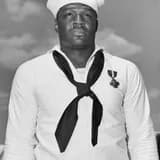
Miller died at age 24 when the escort carrier USS Liscome Bay was torpedoed by a Japanese submarine near Butaritari during the Battle of Tarawa.
Doris Miller died on November 24, 1943, at the age of 24, when the escort carrier USS Liscome Bay, on which he was serving as a cook, was struck by a torpedo fired from the Japanese submarine I-175 near Butaritari Island during the Battle of Makin in the Gilbert Islands campaign. The torpedo detonated the ship's bomb magazine, causing a catastrophic explosion that sank the vessel in under twenty-five minutes.
Of the roughly 900 men aboard, 644 were killed, including Miller, whose body was never recovered. He was officially listed as "presumed dead" one year and a day after the sinking, per Navy protocol, and was posthumously commemorated for his continued service after Pearl Harbor, during which he had been promoted to Mess Attendant First Class and later Ship's Cook Third Class.
Miller's death occurred less than two years after his celebrated actions at Pearl Harbor had made him a national hero and symbol of Black valor in a segregated military. His loss was widely mourned, and it intensified public and political pressure to recognize the contributions and sacrifices of African American servicemen. In the following decades, Miller's memory was honored extensively: the Navy commissioned the USS Miller (DE-1091) in his name in 1973, and in 2020 the Navy announced plans to name the aircraft carrier USS Doris Miller (CVN-81) after him, the first U.S. Navy aircraft carrier named for a Black American and for an enlisted sailor.