← All women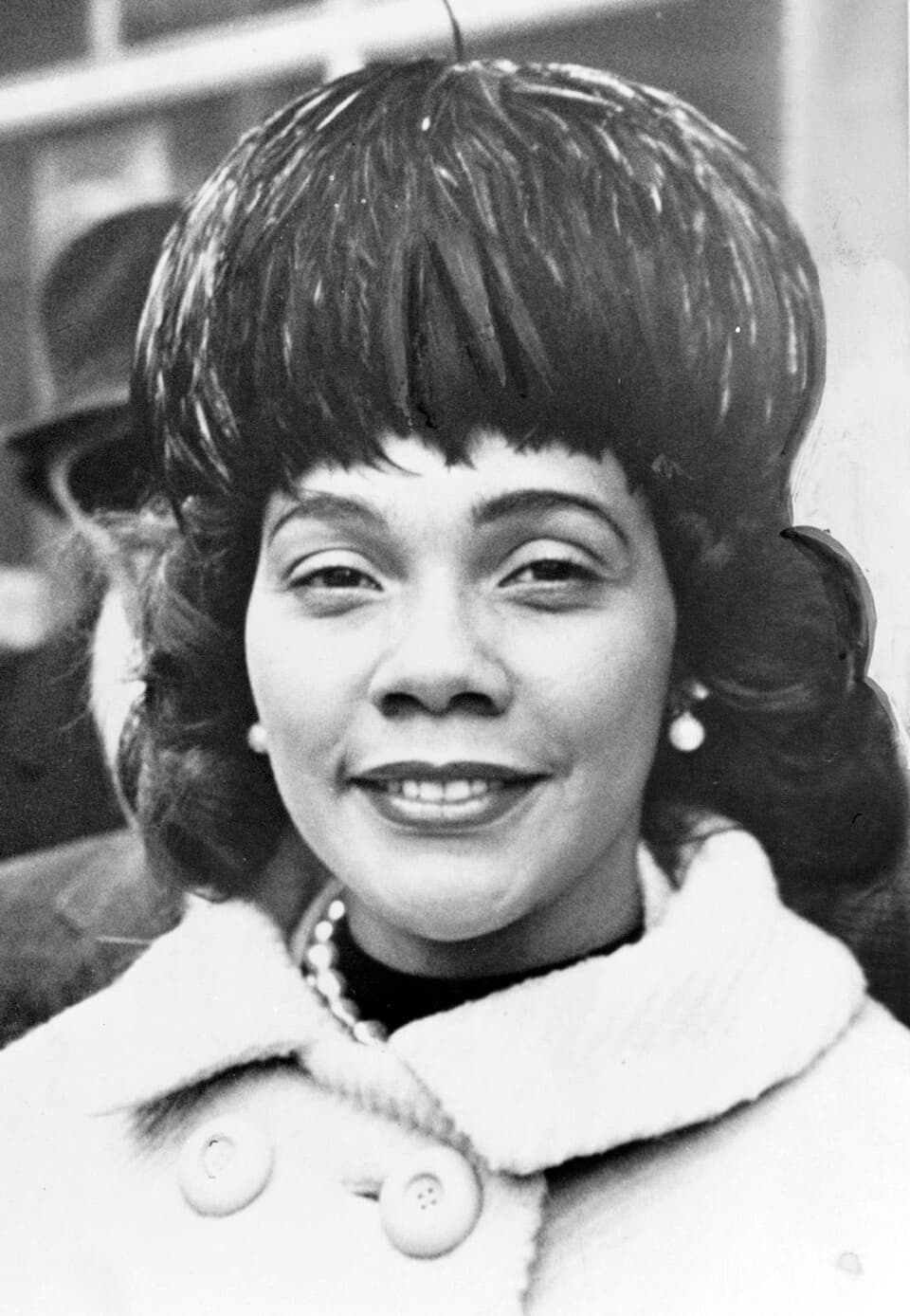
American · Activism · Politics · Arts
Coretta Scott King
April 27, 1927 – January 30, 2006
Early Life and Background
Coretta Scott King (née Scott) was born on April 27, 1927, in the rural community of Heiberger near Marion, Perry County, Alabama, in the heart of the Jim Crow South.[1][3][4] She was the third of four children of Obadiah (Obie) Leonard Scott and Bernice McMurry Scott, Black landowners who operated a small farm, sawmill, and trucking business.[1][5] In an era when Black economic independence was often met with violent backlash, the Scotts’ relative prosperity and entrepreneurial standing made them both respected and targeted in the local community.
Coretta’s childhood was shaped by both opportunity and terror. Her parents taught their children racial pride, self-reliance, and the importance of education, insisting that their daughters and son aim beyond the narrow roles prescribed for African Americans in the segregated South.[1][2] At the same time, the family suffered repeated acts of racist harassment; their home was burned, and white supremacists sabotaged Obie Scott’s sawmill and trucking operations.[1][5] Coretta later recalled these experiences as formative, instilling in her a deep resolve to oppose injustice.
The Scotts valued schooling, but segregation imposed harsh inequalities. Coretta and her siblings walked miles each day to an underfunded all-Black school, while white children rode buses to better-equipped facilities.[1][2] Despite such barriers, she excelled academically and musically. She attended the one-room Crossroads School and later Lincoln High School in Marion, where she became a standout student and singer. She graduated as valedictorian, an early indication of the discipline and leadership that would define her later life.[2][4]
Music quickly emerged as a central part of her identity. She sang in church choirs and school performances and learned piano and violin. Her vocal talent opened doors beyond the constraints of segregated Alabama, suggesting that she might pursue a career as a professional concert singer. Those aspirations would carry her north and intersect with a broader political awakening.
Education and Formative Influences
In the mid-1940s, Coretta left Alabama to study at Antioch College in Yellow Springs, Ohio, an institution with a progressive reputation and a history of abolitionist activism.[2][4][7] She enrolled on a scholarship, majoring in music and elementary education. Antioch exposed her to an integrated campus environment and to left-liberal politics that sharply contrasted with the rigid segregation of her youth.
At Antioch she joined campus organizations concerned with civil liberties and racial equality, and she confronted discrimination first-hand when local schools rejected her for student-teaching placements because of her race.[2][12] With faculty support, she successfully challenged these exclusions, an experience that deepened her sense that ordinary individuals could contest institutional racism. She also became active in peace and civil rights circles, absorbing ideas about nonviolence and democratic participation.
After receiving her B.A. in music and education, Coretta won a scholarship to the New England Conservatory of Music in Boston, where she pursued advanced study in voice and violin and trained for a career in concert singing.[3][4][7] Boston exposed her to a vibrant Black intellectual community, including students and clergy engaged in theological debates about social justice. She supported herself in part through work and continued to follow world events, including decolonization struggles abroad and emerging civil rights battles in the United States.
Marriage to Martin Luther King Jr. and Early Activism
In Boston, a mutual friend introduced Coretta to a young Baptist minister and doctoral student from Atlanta: Martin Luther King Jr.[3] Their first meeting, often recounted in civil rights histories, blended personal and political connection. Martin was drawn to her poise, intellect, and musical gifts; Coretta, already politically engaged, questioned him about his views on pacifism, social justice, and the role of women.
After a courtship that included discussions of theology, Gandhi, and world affairs, the couple married on June 18, 1953, at the Scott family home in Marion, Alabama.[3][4][6] King’s father officiated the ceremony, and at Coretta’s insistence, the vow promising that she would "obey" her husband was removed, underscoring her expectation of an egalitarian partnership.[3] This stance foreshadowed her later insistence that she was a co-laborer, not merely a supportive spouse, in the freedom struggle.
Initially, Coretta envisioned balancing a musical career with life as a minister’s wife. After Martin accepted a pastorate at Dexter Avenue Baptist Church in Montgomery, Alabama, in 1954, the couple relocated to the state capital, placing them at the epicenter of an emerging protest movement.[3] Their home soon became a gathering place for young Black professionals, clergy, and activists.
Coretta’s early activism in Montgomery included singing at church events, organizing community programs, and supporting local branches of the National Association for the Advancement of Colored People (NAACP) and other groups. She and Martin quickly had children—Yolanda, Martin III, Dexter, and Bernice—forcing her to juggle motherhood with public responsibilities.[3][4]
The Montgomery Bus Boycott and the Civil Rights Movement
The arrest of Rosa Parks in December 1955 and the subsequent Montgomery bus boycott thrust the Kings into international prominence. Martin was chosen to lead the new Montgomery Improvement Association, but Coretta also played a critical role. She hosted strategy meetings, fielded constant phone calls, and endured threats and harassment directed at the family.[3][5]
On one occasion, a bomb exploded on the front porch of the King home while Coretta and baby Yolanda were inside. They escaped injury, but the attack underscored the personal risks she bore as an activist.[3][5] Rather than retreat, she redoubled her commitment to nonviolence, later recalling that the danger strengthened her faith and sense of purpose.
Beyond logistical support, Coretta used her musical training to advance the movement. She organized and performed in "freedom concerts" that combined classical music, spirituals, and spoken narration to raise funds and awareness for civil rights campaigns.[1][9] These concerts became a signature contribution, enabling her to link art and activism and to reach audiences who might not attend political rallies.
As the movement expanded in the late 1950s and early 1960s—to Birmingham, Albany, Selma, and Chicago—Coretta traveled widely, delivering speeches, singing, and meeting with grassroots organizers and political leaders. She joined Martin on trips abroad, including a 1957 visit to Ghana for the country’s independence celebrations, which reinforced their understanding of civil rights as part of a global struggle against colonialism and racism.[3][5]
Peace Activism and Global Engagement
Coretta’s activism extended beyond racial equality to encompass broader peace and human rights issues. She opposed nuclear weapons and militarism and saw connections between racism at home and colonialism and war abroad.[1][12] In 1962, she served as a Women’s Strike for Peace delegate to the 17-nation Disarmament Conference in Geneva, Switzerland.[1] There she joined women from multiple countries in urging world leaders to halt nuclear testing and pursue disarmament, amplifying the voices of women in Cold War diplomacy.
As the United States escalated its involvement in Vietnam, Coretta became an outspoken critic of the war, sometimes even before Martin adopted a full-scale antiwar stance. She argued that spending on militarism undermined anti-poverty efforts and that violence abroad was morally incompatible with democratic ideals at home.[1][12] Her peace work sometimes attracted criticism from more cautious civil rights leaders, but she persisted, seeing peace and justice as inseparable.
Widowhood and the Founding of The King Center
The assassination of Martin Luther King Jr. in Memphis on April 4, 1968, transformed Coretta’s life and public role. Within days, she emerged as a central figure of continuity for the movement. She led a silent march of tens of thousands in Memphis, demonstrating that nonviolent protest would continue despite violence.[3][5] At his funeral in Atlanta, she delivered a televised address and insisted that one of Martin’s antiwar sermons be played in full, linking his legacy to peace as well as civil rights.
Determined to preserve his teachings and expand their reach, Coretta founded The Martin Luther King Jr. Memorial Center in Atlanta on June 26, 1968, later known as The King Center for Nonviolent Social Change.[1][3] She envisioned the Center as a "living memorial" that would house archives, train activists, and serve as a hub for global nonviolence education. Building the institution required extensive fundraising, negotiations with governments and donors, and navigation of internal movement politics, tasks she undertook with increasing confidence.
In these years, she also began to step forward more fully as an independent civil and human rights leader. She accepted speaking invitations worldwide, maintained relationships with international figures, and used her platform to address issues ranging from apartheid in South Africa to workers’ rights and economic justice in the United States.[1][9]
Breaking Barriers in Religious and Academic Institutions
In the months after Martin’s death, Coretta’s leadership was recognized in prestigious venues traditionally reserved for men. On July 1, 1968, she delivered the Class Day address at Harvard University, becoming the first woman to hold that role.[3] In a speech to graduating students, she challenged them to devote their lives to fighting racism, poverty, and war, and urged them to embrace nonviolence as a way of life.
The following year, she broke another barrier in religious life. In 1969, she became the first woman to preach during a statutory service at St Paul’s Cathedral in London, one of Anglicanism’s most venerable churches.[1][7] Her sermon linked Christian faith with the imperative to dismantle racial injustice and oppose war, and her presence in that pulpit symbolized a significant advance for women in ecclesiastical leadership.
Also in 1969, Coretta received the Universal Love Award in Italy, becoming the first non-Italian to be honored with the prize.[2] The award recognized her commitment to nonviolence and humanitarian service and highlighted the growing international resonance of her work. Collectively, these milestones underscored her status as a global moral voice and a pioneer for women in institutions that had long marginalized them.
Organizing for Economic Justice and Coalition Politics
Throughout the 1970s, Coretta Scott King expanded her focus to include economic rights and broad-based coalition building. In 1974, she helped form and co-chair the National Committee for Full Employment, a coalition of more than 100 religious, labor, business, and women’s organizations advocating for full employment and economic opportunity.[1][10] This work reflected her belief that civil rights would remain incomplete without addressing poverty and structural inequality.
She also linked racial justice struggles to gender equality. Coretta supported the Equal Rights Amendment, spoke at women’s conferences, and insisted that the civil rights and women’s movements recognize their overlapping aims. She framed economic justice, women’s rights, and racial equality as interconnected components of a broader human rights agenda.
The Campaign for the King Holiday and the Coalition of Conscience
One of Coretta’s most sustained and influential campaigns was the effort to establish Martin Luther King Jr. Day as a U.S. federal holiday. Beginning in the late 1960s and intensifying in the 1970s and early 1980s, she coordinated national lobbying efforts, testified before Congress, mobilized churches and unions, and organized public events to build support.[1][11]
In 1983, she helped form the Coalition of Conscience, a nationwide alliance of hundreds of human rights, labor, religious, and civil rights organizations that organized the 20th-anniversary commemoration of the 1963 March on Washington for Jobs and Freedom.[3][10] The coalition’s activities helped pressure political leaders to recognize the enduring significance of King’s vision.
That same year, President Ronald Reagan signed the federal King holiday into law, with the first official observance taking place in 1986. Although these legal milestones are often associated with Martin, historians emphasize that the holiday’s creation owes much to Coretta’s strategic leadership and persistence.[1][11] Through this victory, she helped institutionalize a national day of reflection and service rooted in nonviolence and social justice.
The King Center’s Growth and International Outreach
Under Coretta’s leadership, The King Center grew from a modest memorial into a major institution of education, research, and activism. In 1981, the King Center complex in Atlanta was formally dedicated, anchoring what would become the Martin Luther King Jr. National Historical Park.[1][3] The Center houses extensive archives of King’s papers, organizes training programs in nonviolence, and hosts annual events around the King holiday.
Coretta also used the Center as a staging ground for international initiatives. She spoke out against apartheid in South Africa, aligning with global campaigns to isolate the apartheid regime and calling for sanctions and divestment.[1][12] She met with world leaders, including those in newly independent African nations, and emphasized the shared stakes between struggles in the United States and those abroad.
In 1990, she helped convene a Soviet–American Women’s Summit in Washington, D.C., bringing together women from both sides of the Cold War divide to discuss peace, human rights, and social justice.[3][10] The summit reflected her long-standing commitment to international feminist and peace networks and her conviction that women’s leadership was essential to global problem-solving.
Advocacy for LGBTQ+ Rights and Expanded Human Rights Vision
In her later decades, Coretta Scott King increasingly emphasized a broad understanding of human rights that included LGBTQ+ equality. Drawing on her husband’s philosophy of the "beloved community" and his writings on the dignity of all people, she argued that discrimination based on sexual orientation was akin to racism and other forms of oppression.[12]
She spoke at events supporting gay and lesbian civil rights, opposed homophobic legislation, and urged religious communities to embrace inclusion. At times, this stance placed her at odds with more conservative Black clergy and politicians, but she insisted that the logic of nonviolence demanded solidarity with all marginalized groups.[12] Her advocacy made her an important ally for LGBTQ+ movements, particularly at a time when few nationally prominent civil rights leaders were openly supportive.
Personal Life and Family
Coretta and Martin raised four children—Yolanda Denise (born 1955), Martin Luther King III (born 1957), Dexter Scott King (born 1961), and Bernice Albertine King (born 1963)—while maintaining intense public schedules.[3][4] Coretta worked to shield them from some of the harshest realities of their parents’ activism, even as the children grew up amid bomb threats, FBI surveillance, and the constant presence of reporters.
After Martin’s assassination, she sought to preserve his image for their children while also modeling resilience and leadership. All four children later became involved, in varying ways, with The King Center and with ongoing civil and human rights work. Coretta remained deeply attached to her extended family in Alabama and visited Marion and Perry County often, preserving ties to the community that had shaped her.
Despite the demands of public life, she maintained her love of music, occasionally performing and incorporating song into speeches and memorial services. Friends and colleagues described her as reserved but warm, disciplined, and deeply spiritual, with a keen strategic sense nurtured over decades of organizing.
Later Life, Illness, and Death
In her later years, Coretta continued to speak, travel, and lead The King Center, although she gradually reduced her schedule. She remained a visible presence at annual King holiday commemorations, civil rights anniversaries, and international peace events. She also published her memoir, My Life with Martin Luther King, Jr., which offered personal insight into their partnership and the day-to-day realities of the movement.[12]
In 2005, Coretta suffered a serious stroke and heart attack, which impaired her speech and mobility.[3] Seeking rehabilitation and alternative treatments, she traveled to a clinic in Rosarito, Baja California, Mexico. There, on January 30, 2006, she died at the age of 78 from complications related to ovarian cancer and respiratory failure.[3][4]
Her body was returned to Atlanta, where large crowds gathered for memorial services attended by national and international dignitaries. On February 4, 2006, she became the first woman and the first African American to lie in honor in the rotunda of the Georgia State Capitol, a symbolic reversal in a building that had once enshrined segregation.[1][3][11] She was later interred at The King Center, beside a reflecting pool near her husband’s tomb, on the site she had worked for decades to create.
Awards, Honors, and Recognition
Over the course of her life, Coretta Scott King received numerous awards and honorary degrees recognizing her contributions to civil rights, peace, and human rights. Among them was the Universal Love Award in Italy in 1969, where she became the first non-Italian recipient.[2] She was inducted into the National Women’s Hall of Fame and honored by universities and civic organizations around the world.[7]
Her leadership in the campaign for the King holiday and in international anti-apartheid activism further solidified her standing. She remained in high demand as a speaker and commentator on issues of race, democracy, and global justice well into her seventies. Posthumously, schools, streets, and community centers have been named in her honor, and scholars increasing emphasize her as a central figure—not a secondary one—in civil rights history.[9][12]
Legacy and Historical Impact
Coretta Scott King’s legacy is multifaceted. As the co-strategist and partner of Martin Luther King Jr., she helped shape the direction of the modern civil rights movement. As an independent leader after his death, she broadened that movement’s agenda to encompass peace, women’s rights, LGBTQ+ rights, and global human rights.[1][2][12]
Through The King Center, she institutionalized nonviolence as a living philosophy, providing training and archival resources for activists, scholars, and the general public. Her decades-long campaign for a federal King holiday permanently embedded her husband’s—and, indirectly, her own—vision in the U.S. civic calendar. Her willingness to cross traditional boundaries—between church and academy, between domestic and international spheres, between racial justice and other human rights struggles—made her a bridge figure connecting multiple movements and generations.
Historians increasingly highlight her as emblematic of Black women’s leadership in social movements: often under-recognized, yet essential to strategy, coalition-building, and moral framing. Her life illustrates how grief can be transformed into institution-building and how artistic talent can serve political ends. By insisting that the "beloved community" include all marginalized people, she left a legacy that continues to inform struggles for justice in the United States and around the world.
Dated achievements
8 indexed.
- Apr271927Activism
Birth of Coretta Scott King
Coretta Scott is born in Marion, Perry County, Alabama, later becoming a leading figure of the U.S. civil rights movement.
View details Coretta Scott King - Wikipedia - Jun181953Activism
Marriage to Martin Luther King Jr.
Coretta Scott marries Martin Luther King Jr. in Marion, Alabama, beginning a partnership central to the civil rights movement.