← All women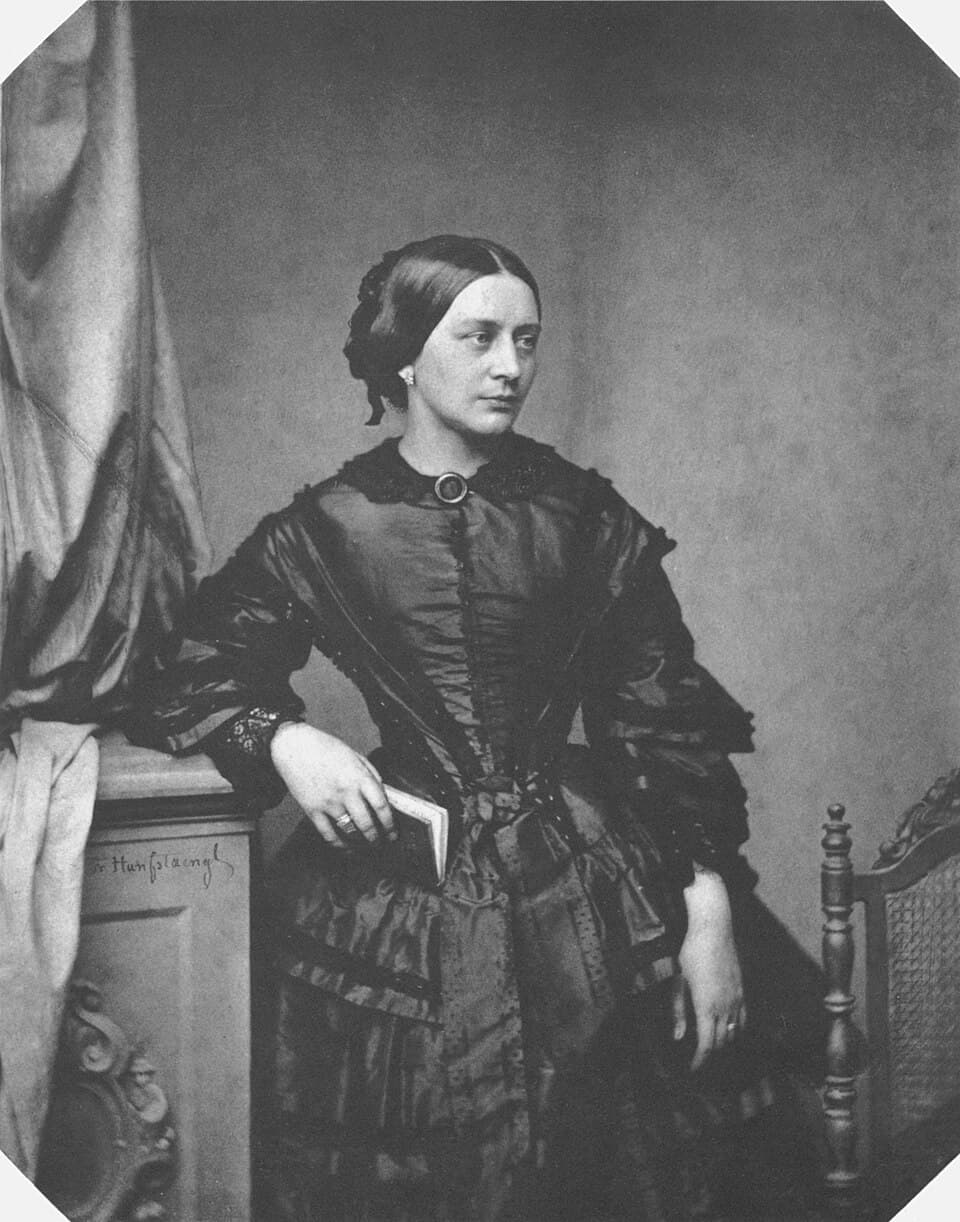
German · Arts
Clara Schumann
September 13, 1819 – May 20, 1896
Early Life and Background
Clara Josephine Wieck (later Clara Schumann) was born on 13 September 1819 in Leipzig, in the Kingdom of Saxony, then part of the German Confederation.[2][3][5][15] Her father, Friedrich Wieck, was a prominent piano teacher, music critic, and dealer in musical instruments, who believed he could train a child to become a great virtuoso.[1][2][5] Her mother, Marianne Tromlitz Wieck, was a gifted soprano and pianist who had studied with Friedrich but left the marriage when Clara was around five, later marrying violinist Adolph Bargiel.[10][15] After the parental separation, Clara remained with her father, who took full charge of her education and upbringing.[1][5][10]
Friedrich Wieck designed an exceptionally rigorous curriculum for his daughter. Clara studied piano intensively from early childhood, supplemented by instruction in theory, composition, violin, and voice.[5][10][13] She also received a broad general education and languages, although her musical training dominated. Wieck was determined to prove that discipline and method could produce artistry, and Clara became both his most important pupil and a living advertisement for his pedagogy.[1][5]
From a very young age, Clara displayed extraordinary musical aptitude. By nine she was already performing in public, and her father carefully crafted her image as a child prodigy.[10][2] Growing up in Leipzig, a major musical center, she had exposure to the city’s rich cultural life, especially the Gewandhaus concerts, and she soon interacted with leading figures of German Romanticism. This environment, combined with her intensive training, formed the basis of her later stature as one of the foremost pianists of the nineteenth century.[1][2][5]
Career Beginnings and Development
Clara made her public performance debut at age nine on 20 October 18288 November 1830 she gave her first formal concert at Leipzig’s Gewandhaus, one of the most prestigious halls in Germany.[2] These appearances marked the beginning of a long international performing career that ultimately spanned more than six decades.[2][16]
Wieck arranged concert tours that took Clara to major cities while she was still in her early teens. By the early 1830s she was touring Germany and, soon after, Paris and other European centers, winning enthusiastic reviews that praised not only her flawless technique but also her interpretive depth and composure.[1][2][5] On 9 November 1832, she performed Bach’s Triple Concerto in D minor with Felix Mendelssohn and violinist Rakemann in Leipzig, placing her alongside leading professional musicians despite her youth.[2]
Her career flourished rapidly. On 28 April 1833, Clara participated in the first performance at the Leipzig Gewandhaus of a symphonic work by Robert Schumann, playing part of one of his symphonies.[3] This early advocacy of Schumann’s music foreshadowed her later role as his primary interpreter and promoter. By her mid-teens she was widely regarded as one of Europe’s foremost pianists, noted for her execution of works by Beethoven, Chopin, Hummel, and contemporary German composers.[1][5]
In the mid-1830s, Clara’s reputation as a composer also began to grow. On 9 November 1835, at the Gewandhaus under the direction of Mendelssohn, she premiered her Piano Concerto in A minor, Op. 7, performing as soloist in a work she had developed from an earlier single movement.[2] The concerto demonstrated her mastery of large-scale form and idiomatic writing for the piano, and it was well received by critics and audiences.[2][5]
By the late 1830s, Clara was touring Vienna and other major cultural centers. In 1837 during a triumphant Viennese tour, she received the honorary court title K.k. Kammervirtuosin, and was elected to the Society of the Friends of Music (Gesellschaft der Musikfreunde), affirming her standing among the elite of European musical life.[5] She was by then not only a star pianist but also a respected composer, with works such as her Soirées musicales and Romances contributing to the piano literature.
Relationship with Robert Schumann and Personal Life
Clara’s connection to Robert Schumann began when he moved into the Wieck household as a piano student of Friedrich around 1830.[3][15] Clara was eleven, and Robert nine years her senior. Over time, they grew emotionally close; however, Friedrich vehemently opposed their relationship, fearing it would harm both Clara’s career and his own ambitions.[5][15]
Despite her father’s objections, Clara and Robert became engaged in 1837 and fought a protracted legal battle to secure permission to marry.[15] On 12 September 1840, the eve of her twenty-first birthday, they were finally wed in Leipzig.[3][5][15] The marriage created one of the most famous artistic partnerships of the Romantic era, though it also imposed heavy domestic responsibilities on Clara.
The couple had eight children between 1841 and 1854: Marie (born 1841), Elise, Julie, Emil (who died in infancy), Ludwig, Ferdinand, Eugenie, and Felix.[5][15] Clara struggled to balance motherhood with her touring and compositional work. She continued to perform, both to sustain the family financially and to support Robert’s growing reputation, often leaving the children in the care of relatives or domestic staff when she went on tour.[5][10]
Clara and Robert’s artistic relationship was deep and complex. Clara premiered many of his works and influenced his compositional decisions through her playing and commentary. Robert, in turn, encouraged Clara’s composing, dedicating works to her and publicly praising her talent. Nonetheless, societal expectations and the pressures of family life led Clara gradually to devote less time to composition and more to performance and teaching.[2][5][7]
Major Works and Compositional Output
Although Clara Schumann’s compositional output is relatively small—often cited at around 23 published works—it includes several pieces now recognized as significant contributions to the Romantic repertoire.[2][7] Her works span piano solo pieces, songs, and chamber music.
Key piano works include the Piano Concerto in A minor, Op. 7 (1835), and collections such as Soirées musicales, Quatre pièces fugitives, and various Romances, which reveal her lyrical style, nuanced harmonic language, and idiomatic writing for the instrument she knew best.[2][7][13] Her songs, some written in collaboration with Robert, are notable for their sensitivity to text and refined melodic lines.
One of her most acclaimed compositions is the Piano Trio in G minor, Op. 17, completed in 1846.[7] Written while she was caring for four small children and supporting Robert’s career, the trio is praised for its structural coherence, expressive depth, and equal treatment of the instruments. It is often cited as her finest work and remains in the chamber music repertoire today.[7][2]
Clara’s compositional activity diminished markedly after the early 1850s. Factors included the demands of motherhood, Robert’s worsening mental illness, and her increasing responsibilities as a performer and editor of his works.[2][5][7] She once remarked that she had "no creative power" compared to Robert and that her duty was to interpret his music and care for their family, reflecting internalized gender expectations of her time.[5][19]
Despite the modest size of her oeuvre, modern scholarship has increasingly highlighted Clara’s works as important examples of nineteenth-century music written by a woman, challenging older narratives that reduced her role to that of performer alone.[13][18]
Career as Performer and Teacher
Clara Schumann’s performing career was extraordinarily long, beginning with her childhood debut and continuing until her last public recital in 1891.[2][16] She was renowned for her commanding technique, profound musicality, and serious approach to programming. Rather than focusing on flashy paraphrases or purely virtuosic showpieces, she emphasized substantial works by composers such as Beethoven, Bach, Schumann, and later Brahms.[1][2]
She is frequently credited with helping establish the model of the "high art" piano recital, in which a single performer presents long, memorized programs of serious music to an attentive audience.[1][2] By making such repertory central to her concerts, she shaped the taste of the European bourgeoisie and contributed to the canonization of key works.
Clara also played an important role as a teacher. In 1878, she joined the Hoch Conservatory in Frankfurt am Main
As an editor and guardian of Robert Schumann’s legacy, Clara supervised the publication of his works, helped establish performance practices, and advised conductors and pianists on interpretation.[2][5][13] Her editorial decisions had lasting impact on how his music is presented and understood. Clara’s role in the careers of Robert Schumann and Johannes Brahms cannot be overstated. She was Robert’s foremost interpreter, performing his piano works extensively throughout Europe. After his serious mental health crisis in 1854 and death in 1856, she dedicated herself to preserving and promoting his music.[2][5][13] She prepared editions of his works, corresponded with publishers, and collaborated with musicians to ensure accurate performances.[2][5] Her authority as both his widow and a leading pianist gave weight to her views, helping to secure Schumann’s place in the Romantic canon. Clara also played a decisive role in the emergence of Johannes Brahms. She and Robert met the young composer in 1853 and quickly recognized his genius.[8][3] On 23 October 1854, Clara gave the first public performance of any Brahms work, playing movements from his Piano Sonata in F minor in Leipzig.[8] She continued to champion his music, performing and promoting his works across Europe. The friendship between Clara and Brahms was deep and enduring, marked by mutual artistic admiration. Brahms valued Clara’s judgment highly and often sought her opinion on new compositions. Their correspondence reveals a complex emotional relationship that, while constrained by social norms and circumstances, profoundly influenced both artists’ creative lives.[3][8] Throughout her life, Clara Schumann received numerous honours reflecting her stature. During her Vienna tour in 1837, she was awarded the title K.k. Kammervirtuosin (Imperial and Royal Chamber Virtuoso) by the Austrian court and was elected to the Gesellschaft der Musikfreunde, one of Europe’s most prestigious musical societies.[5] These honours, rarely accorded to women, underscored the exceptional nature of her achievements. By mid-century, critics referred to her as the "Queen of the Piano," and her concerts were major social and artistic events.[1][19] She was widely recognized not only for technical brilliance but for setting high artistic standards in performance. Her later appointment at the Hoch Conservatory further confirmed her authority within German musical institutions.[5][2] Although nineteenth-century honours for women were limited, Clara’s titles, institutional affiliations, and the reverence of colleagues and audiences amount to a form of informal canonization. In contemporary assessments, she is frequently described as one of the greatest pianists of the nineteenth century, placing her alongside figures such as Franz Liszt and Anton Rubinstein.[5][13][18] Robert Schumann’s health deteriorated markedly in the early 1850s. In 1854 he attempted suicide and was admitted to a psychiatric institution in Endenich, where he remained until his death in 1856.[3][5] During these years, Clara faced immense emotional strain and financial responsibility, yet continued to perform to support the family and her husband’s legacy. After Robert’s death, Clara lived in Düsseldorf for a time and then moved to cities including Berlin, where she performed, taught, and edited his works and letters.[10][5] She increasingly took on the role of cultural guardian, curating performances and publications that shaped the reception of Schumann’s music. In 1878, Clara accepted the position of principal piano teacher at the Hoch Conservatory in Frankfurt, a city that became her main base in later life.[5] She combined regular teaching with occasional concert tours, although the frequency of her performances gradually decreased. Her last public concerts occurred in 1891, closing a performing career of more than sixty years.[2][5] Clara suffered a stroke late in life and died on 20 May 1896 in Frankfurt am Main, aged 76.[2][3][5][15] She was buried next to Robert Schumann in Bonn.[12] At the time of her death, she was still revered as an iconic figure in German musical culture, and obituaries emphasized her dual role as great pianist and faithful custodian of her husband’s works. Clara Schumann’s legacy encompasses performance, composition, pedagogy, and cultural influence. She helped define the modern concept of the serious piano recital, emphasizing high artistic standards, memorization, and a focus on major works rather than light entertainment.[1][2] Through her programming, she contributed to the canonization of Beethoven, Schumann, and Brahms, and thus to shaping the repertory that still dominates piano concerts today. As a composer, she produced works that are increasingly recognized for their originality and craft, especially the Piano Trio in G minor, Op. 17 and her piano collections.[2][7] Although she wrote relatively little, largely because of domestic and social pressures, recent scholarship and performances have restored her music to a more visible place in the Romantic repertoire.[13][18] In women’s history, Clara stands as a pivotal figure who navigated and partially transcended the limitations placed on women’s professional lives in the nineteenth century. She maintained a demanding international career while raising a large family and coping with her husband’s illness, demonstrating that women could participate fully in the public artistic sphere. Her success challenged contemporary assumptions about women’s abilities and appropriate roles.[5][10][19] Her influence as a teacher at the Hoch Conservatory extended into the twentieth century. Students who trained under her carried forward her interpretive ideals of structural clarity, textual fidelity, and expressive restraint, contributing to the evolution of German pianism.[5][2] Her editorial and advocacy work ensured that Robert Schumann’s and Brahms’s music occupied central positions in the canon. Modern reassessments increasingly view Clara Schumann not only as "the wife of Robert Schumann" but as an independent creative force: a virtuoso whose performance style helped define Romantic interpretation, a composer whose works enrich the repertoire, and a cultural figure whose choices shaped musical history. Her life illustrates both the constraints faced by women and the profound impact they could have when given—or when they carved out—the opportunity to exercise their talents.Advocacy for Robert Schumann and Johannes Brahms
Awards, Honours, and Recognition
Later Life and Death
Legacy and Historical Impact
Dated achievements
10 indexed.
- Sep131819Arts
Birth of Clara Schumann
Clara Josephine Wieck was born in Leipzig, Germany.
View details Wikipedia: Clara Schumann - Oct201828