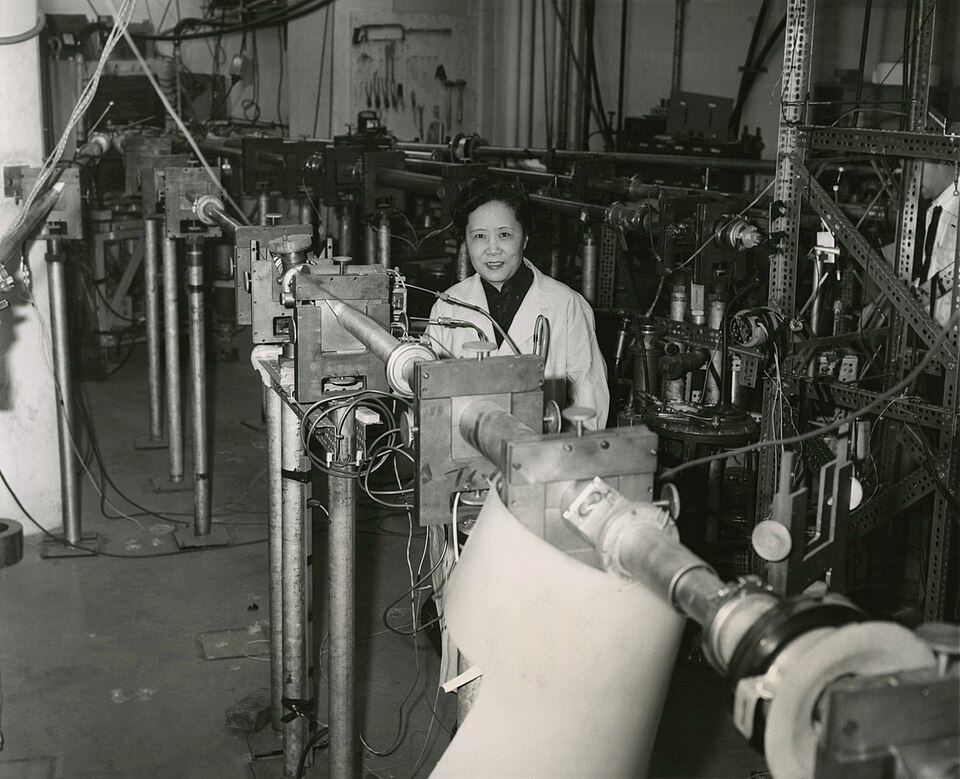
Chien-Shiung Wu was born in Liuhe, Jiangsu province, China, later becoming a pioneering experimental physicist.
Chien-Shiung Wu was born on May 29, 1912, in the small town of Liuhe, in Jiangsu province, China, not far from Shanghai. Her father, Wu Zhong-Yi, was a progressive engineer and educator who founded one of the first schools for girls in the region, an unusual and forward-thinking act in early twentieth-century China where female education was far from guaranteed.
Growing up in this household, Wu was encouraged from an early age to pursue rigorous academic study, including in the sciences, at a time when such opportunities were rarely extended to girls. This early exposure to a household that valued learning and gender equality would prove foundational to her extraordinary career.
She would go on to become one of the most significant experimental physicists of the twentieth century, contributing to the Manhattan Project, providing definitive experimental proof of parity violation in weak nuclear interactions, and breaking numerous barriers as a woman and as a Chinese immigrant in American academic science. Her birth in a small Chinese town to a family committed to educational equity set the stage for a life that would fundamentally reshape modern physics.
Her legacy is honored today through prizes, fellowships, buildings, and a minor planet named in her honor, cementing her status as one of the most important scientists of her era.
Images