← All women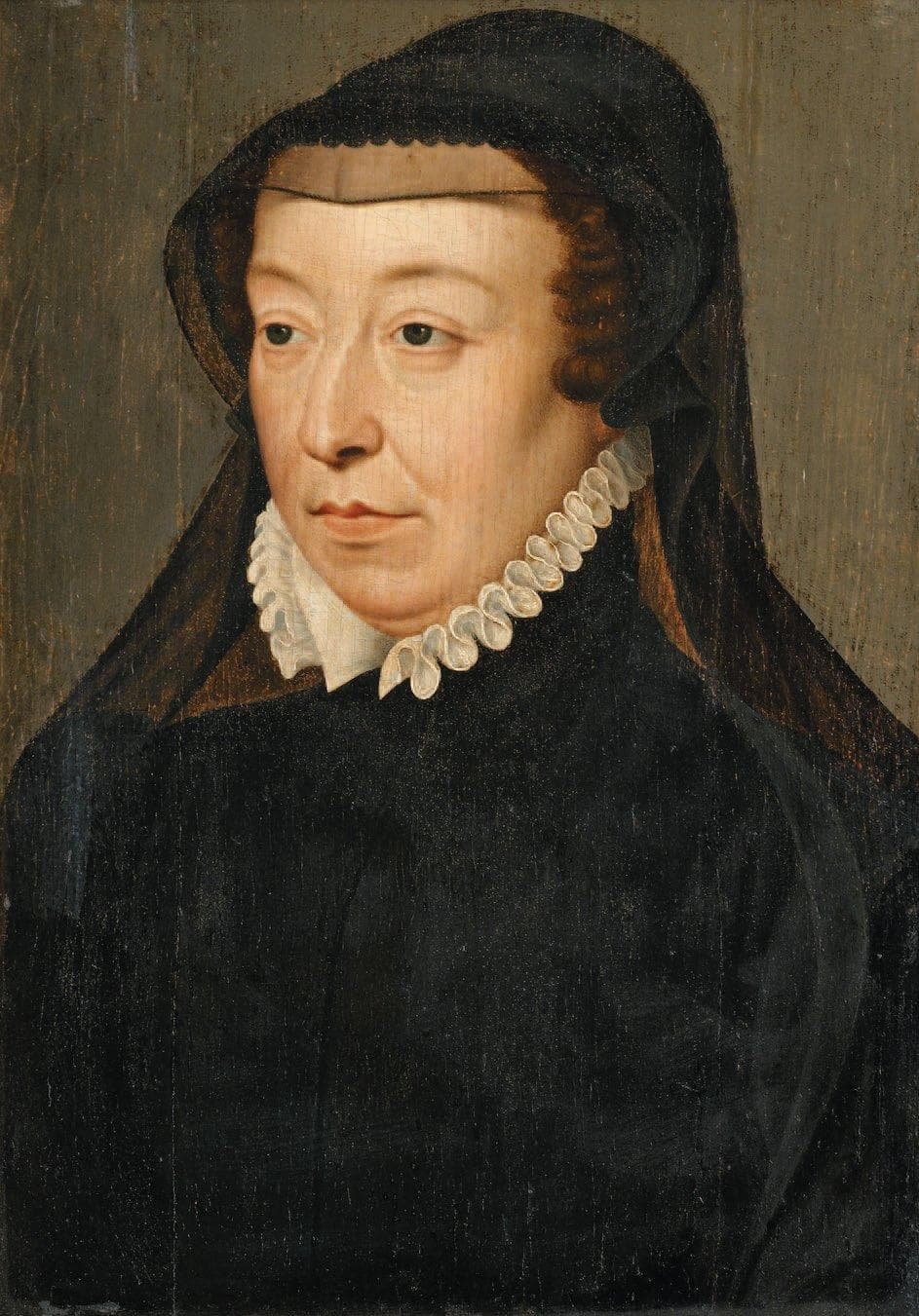
Italian, French · Politics · Arts
Catherine de’ Medici
April 13, 1519 – January 5, 1589
Early life and background
Catherine de’ Medici was born in Florence on 13 April 1519 into the powerful Medici family, a dynasty that had risen to extraordinary influence in Renaissance Italy through banking, politics, and patronage. She was the daughter of Lorenzo II de’ Medici, Duke of Urbino, and Madeleine de La Tour d’Auvergne, linking her by birth to both Italian and French noble networks. Her early life was shaped by the instability of Medici rule and by the violent political upheavals that repeatedly threatened the family’s place in Florence.
Orphaned as a young child, Catherine was raised in a world of shifting alliances and factional struggle. The Medici were briefly expelled from Florence, and she experienced firsthand the vulnerability that could accompany dynastic power. This background mattered enormously: it taught her the practical language of survival in a courtly environment, where kinship, patronage, and political calculation were inseparable. Although she was not educated to rule as a sovereign, she grew up amid the culture of humanist courts, religious ceremony, and political negotiation that would later define her own style of queenship.
When the Medici returned to prominence, Catherine became a valuable dynastic asset. Her marriage prospects were tied to larger diplomatic strategies, and her position as a Medici princess made her an attractive bride for European royalty. The long-term significance of her early life lies in the way it prepared her for a foreign court. She entered France as an Italian noblewoman, but she would eventually become one of the most influential figures in French politics.
Marriage and entry into French royal life
On 28 October 1533, Catherine married Henry, Duke of Orléans, the future Henry II of France, in Marseille. The marriage, arranged under Francis I, linked the Medici and Valois dynasties and placed Catherine in the heart of French royal politics. As a young foreign bride, she arrived in a court that was sophisticated but difficult to penetrate, especially for a woman whose value was initially measured by fertility, lineage, and diplomatic usefulness.
Her first years in France were not easy. Catherine had to establish herself in a court where the future of a queen depended heavily on producing heirs. For a time, her lack of children exposed her to uncertainty and possible marginalization. Over time, however, she gave birth to a large family, including the future kings Francis II, Charles IX, and Henry III. Her role as mother became one of the primary sources of her political importance. In sixteenth-century monarchical systems, succession was a political crisis as much as a biological fact, and Catherine eventually became indispensable to the Valois line.
When Henry II became king on 31 July 1547, Catherine became queen consort of France. Her formal position changed, but for much of her husband’s reign she remained outside the top tier of decision-making. That did not mean she was politically irrelevant. She observed court politics closely, cultivated networks, and developed the skills of mediation and patronage that would later make her one of the most formidable political women in Europe.
Queen mother and political power
Catherine’s public career entered a new phase after the death of Henry II on 10 July 1559. Widowhood elevated her to the role of queen mother, a position that, in the context of underage or vulnerable royal heirs, could become a powerful political office in practice even if not in law. Her son Francis II inherited the throne, but his reign was brief, and Catherine’s influence increased as the crown moved through a series of succession crises.
Francis II died on 21 September 1560, and on 5 December 1560 Charles IX formally began his reign. During this transition, Catherine became the indispensable adult presence in royal governance. Her reputation as a political operator grew rapidly. Modern historians often describe the period from Henry II’s death to the end of the Valois line as the “age of Catherine de’ Medici,” a phrase that reflects the extent of her public influence.
France in the 1560s was deeply divided by religion. The rise of Protestantism and the resistance of Catholic elites created a dangerous political environment. Catherine tried repeatedly to preserve royal authority by balancing factions and using negotiation before force. This strategy reflected both her temperament and the constraints under which she worked. As a woman, she could not claim sovereignty in her own right, but as a widow and mother of kings she could act through family and counsel in ways that shaped policy at the highest level.
Religious conflict and the French Wars of Religion
One of Catherine’s most important political acts came on 17 January 1562, when she issued the Edict of January. This measure granted limited tolerance to Protestants and sought to restrain violence between Catholics and Huguenots. It was a pragmatic attempt to keep the kingdom intact, not a modern doctrine of religious freedom, but it reveals Catherine’s commitment to containment and compromise at a time when the monarchy was under severe strain.
The edict did not solve the crisis. Civil war followed, and Catherine spent much of the remainder of her political life trying to manage the instability of the French Wars of Religion. She negotiated with factions, used ceremonial politics to reinforce royal legitimacy, and attempted to keep the crown above confessional partisanship. Her policies often appear inconsistent to later historians because they were shaped by rapidly changing emergencies and the need to preserve the monarchy in an environment where no option offered a clean solution.
Her most controversial association came with the events of 24 August 1572, when the St. Bartholomew’s Day Massacre began in Paris. The violence followed the marriage of her daughter Margaret of Valois to Henry of Navarre on 18 August 1572, a union intended to symbolize reconciliation between Catholics and Protestants. The massacre became one of the defining tragedies of the French Wars of Religion and forever shaped Catherine’s historical reputation. Historians continue to debate the degree of her responsibility, but it is clear that she was implicated in the broader political crisis and in the volatile decision-making surrounding court faction and security.
Later reigns and court culture
When Charles IX died on 30 May 1574, Catherine’s youngest son Henry III succeeded to the throne. She remained a major adviser during his reign, continuing to participate in diplomacy and internal politics. On 15 February 1575, Henry III was crowned at Reims, and Catherine remained an important figure in the ceremonial and political life of the court. Her experience with ritual, hierarchy, and patronage made her especially effective in a monarchy where symbolism mattered as much as administration.
Catherine’s cultural importance was as real as her political influence. She was a major patron of the arts, architecture, and court spectacle. Renaissance rulers often used patronage to project legitimacy and sophistication, and Catherine embraced that model with exceptional energy. Her court became known for elaborate festivals and performances that combined entertainment with dynastic messaging. This patronage helped shape the French Renaissance court and secured her place in the history of the arts as well as politics.
A landmark in that cultural legacy came on 15 October 1581, when Ballet Comique de la Reine was performed for her court. Scholars widely regard it as the first authentic ballet. The work blended dance, music, poetry, and pageantry in a unified performance, and it stands as one of the clearest examples of how Catherine’s patronage fostered new forms of artistic expression. In a court world dominated by male authority, she exercised cultural leadership through sponsorship and taste, showing that women could shape artistic history even where formal power remained limited.
Personal life, children, and reputation
Catherine’s marriage to Henry II was the central relationship of her life, but her political identity was equally defined by motherhood. She bore several children, including the three sons who successively became kings of France: Francis II, Charles IX, and Henry III. She also had daughters, among them Margaret of Valois, whose marriage to Henry of Navarre became central to the politics of 1572. The repeated succession of her sons made Catherine unusually prominent among early modern queens, since her maternal role translated directly into state importance.
Her reputation has long been contested. Some contemporaries and later writers portrayed her as calculating, manipulative, or even sinister, while others emphasized the extraordinary difficulty of the circumstances she confronted. She governed in a kingdom fractured by religious war, factional politics, noble rivalries, and dynastic fragility. In that setting, compromise, surveillance, negotiation, and occasional coercion were tools of survival. Catherine’s image as a “Machiavellian” queen owes much to the anxieties her power aroused in a deeply patriarchal political culture.
At the same time, she has also been recognized as a significant patron of letters, ceremony, and court culture. Her influence helped define the monarchy’s public face during the Valois era. She was neither a sovereign in law nor a powerless consort in practice, but something more historically revealing: a queen mother whose authority came from her position within the dynasty and from her mastery of political management.
Legacy and historical impact
Catherine de’ Medici died on 5 January 1589 at the Château de Blois. Her death came shortly before the Valois dynasty lost the French throne, underscoring how closely her life was tied to the fate of the royal house she had worked to sustain. By that point, she had spent decades at the center of French public life and had become one of the most recognizable women in European history.
Her legacy remains complex. She is remembered as one of the most influential women of the sixteenth century, a queen consort, queen mother, and political operator who helped navigate France through some of its most violent crises. She also remains associated with the darker side of the Wars of Religion, especially the St. Bartholomew’s Day Massacre. Yet her career also demonstrates the possibilities and constraints of female power in early modern Europe. She could not rule as king, but she could shape monarchy, diplomacy, succession, and culture.
Modern scholarship increasingly views Catherine not simply as a villain or a victim of circumstance, but as a pragmatic ruler working within severe structural limits. Her importance lies in the combination of survival, patronage, statecraft, and dynastic continuity. For historians of women’s power, she stands as a key example of how a woman could become indispensable to government without holding a formal throne.
Dated achievements
13 indexed.
- Apr131519Politics
Birth of Catherine de' Medici
Catherine de' Medici was born in Florence into the powerful Medici family.
View details Wikipedia: Catherine de' Medici - Oct281533Politics
Marriage to Henry, Duke of Orléans
Married Henry, Duke of Orléans, future Henry II of France, linking Medici and Valois dynasties.