← All women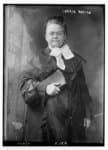
American · Activism · Politics
Carrie Nation
November 25, 1846 – June 9, 1911
Early Life and Background
Carrie (or Carry) Amelia Moore Nation was born Caroline Amelia Moore on 25 November 1846, in Garrard County, Kentucky, into a slaveholding but financially unstable family.[1][2][3][10][16] Her father, George Moore, was a planter and slave owner, and her mother, Mary Campbell Moore, struggled with mental illness, which later observers described as possible psychosis or severe emotional disturbance.[5][10][16] The family’s fortunes declined over time, exposing Carrie to the insecurity of debt and the disruption of frequent moves.
Nation’s childhood unfolded against the backdrop of sectional tensions and the coming of the American Civil War. She spent parts of her youth in Kentucky and Missouri, and later in Texas and Kansas, experiencing the social upheaval of war, Reconstruction, and frontier settlement.[1][10][16] Although her formal education was limited, she briefly attended schools in Kentucky and Missouri and absorbed an intense evangelical Protestant environment that emphasized personal salvation, scripture, and moral reform.[5][8][10]
Biographical accounts emphasize that family instability, her mother’s illness, and exposure to slavery and wartime violence shaped Nation’s moral worldview. She came to see alcoholism, vice, and social injustice as interconnected forces destroying homes and communities. Her later conviction that she had a divine mission to fight alcohol was rooted in these formative experiences, including the trauma of watching family members struggle and institutions fail to protect the vulnerable.[5][10][16]
Early Marriages and Formative Experiences
In 1867, Nation married Dr. Charles Gloyd, a Union Army veteran and physician who was also an alcoholic.[1][5][8][10] Gloyd’s alcoholism soon devastated their household. Despite her love for him, she left the marriage for health and safety reasons shortly before the birth of their daughter, Charlien.[5][8][10][16] Gloyd died soon afterward from complications related to drinking, a loss that deeply marked Nation’s thinking about alcohol as a destroyer of families.
Biographers consistently identify Gloyd’s death as a critical turning point in her life. Nation later interpreted the tragedy as proof that alcohol was an intolerable menace and that existing institutions—medical, legal, and religious—were failing to protect women and children.[5][8][10][16] She believed God had allowed her to experience this suffering so she would understand the urgency of the temperance cause.
In 1874, she married David Nation, a widowed lawyer, minister, and sometime journalist.[1][5][10] The marriage brought with it the responsibility of caring for his children from a previous union, and the couple moved repeatedly, living in Texas and later in Kansas.[1][4][8][10] Their relationship was troubled; differences over money, religion, and Carrie’s increasingly militant activism eventually led to separation and divorce.[1][5][10] Yet during this period she began to preach, organize Bible studies, and engage in charitable work, honing the skills she would soon direct toward temperance.
Move to Kansas and Activism in Medicine Lodge
In 1889, Carrie and David Nation moved to Medicine Lodge, Kansas, a small community in Barber County.[1][5][8][10] Kansas had adopted statewide prohibition decades earlier, but enforcement was uneven, and illegal saloons operated in many towns. In Medicine Lodge, Nation became deeply involved with the Woman’s Christian Temperance Union (WCTU), joining other women in prayer meetings, petitions, and campaigns aimed at enforcing the state’s dry laws.[1][5][8][10][16]
Nation quickly emerged as a local leader. She organized jail and hospital visits, taught Sunday school, and cultivated a reputation for outspoken moral criticism. Convinced that God spoke directly to her, she increasingly framed her work as obedience to divine commands. Historians note that her activism combined conventional female roles—charity, religious teaching—with a growing willingness to challenge male authorities and public institutions.[5][8][10][16]
By the late 1890s she had begun confronting saloonkeepers, entering premises to sing hymns, pray, and admonish patrons. When these efforts failed, she concluded that legal prohibition without enforcement was meaningless, and that more drastic measures were needed. Her religious conviction, personal experiences with alcoholism, and frustration with official inaction laid the groundwork for her later "hatchetations."[5][11][12][16]
Emergence of "Hatchetations" and Early Raids
Nation’s first major series of anti‑saloon raids began around 1900, in the context of Kansas’s dry laws and widespread noncompliance.[1][5][8][11][16] She believed she had received a vision from God instructing her to "smash" saloons, and she acted accordingly. Initially, she used rocks and bricks, not yet the hatchet that would become her emblem.[5][11][16]
On 31 May 1900, in Kiowa, Kansas, she carried out one of her earliest and most dramatic "smashings," attacking illegal saloons and destroying liquor bottles and fixtures in open defiance of proprietors and authorities.[11] She invoked her understanding of Kansas law, arguing that she was enforcing a constitutional prohibition that officials had neglected. Kiowa’s raids drew regional attention and polarized opinion, with some local supporters seeing her as a courageous enforcement agent and others viewing her as a dangerous vigilante.
The success of these early actions emboldened Nation, who soon adopted a small hatchet as her signature tool. She interpreted the growing notoriety as proof of divine favor and a necessary shock to awaken public conscience. Her tactics, though controversial, were consistent with a broader strain of militant reform in the Progressive Era, and they highlighted the gap between moral legislation and lived reality.[11][12][13][16]
The Carey Hotel Raid and National Fame
Nation’s national fame crystallized with her raid on the bar of the Carey Hotel in Wichita, Kansas, on 27 December 1900.[2][3][11][12] The Carey was an elite establishment whose lavish saloon operating under a dry regime symbolized defiance of Kansas’s prohibition laws. Armed with a hatchet and accompanied by other women, Nation smashed the bar, mirror, glassware, and a nude painting that she considered indecent.[11][12]
Police arrested her and she was briefly jailed, but the incident received extensive coverage in local and national newspapers. Cartoonists and reporters dubbed her "Carry Nation" and "Hatchet Granny", and some mocked her appearance and methods while others praised her zeal.[2][3][5][11][12] The Wichita raid exposed tensions between business interests, local officials, and reformers over the enforcement of prohibition and the legitimacy of direct action.
For women’s history, the Carey Hotel episode is pivotal. Nation, a middle‑aged woman without formal office, publicly and physically confronted male‑dominated institutions and spaces. Her arrest and sensational image challenged expectations that women should confine their activism to private or polite realms. The raid also linked her name—and her hatchet—to the broader temperance movement, ensuring that her subsequent actions would be widely reported.
Lecture Tours and Movement Organizing
In the wake of the Wichita raid, Nation leveraged her notoriety into extensive lecture tours. By 1901, she traveled widely across the United States and later to England, speaking on temperance, morality, and women’s responsibilities.[5][8][11][16] On 9 February 1901, around one thousand people greeted her arrival in Des Moines, Iowa, where she had been invited to speak.[11] Newspapers described the crowd’s curiosity and the mixed reactions of admirers and critics.
Shortly afterward, on 18 February 1901, Kansas newspapers reported that her followers and allied temperance groups were organizing across the state, forming clubs and societies to support anti‑saloon efforts.[11] These organizations, sometimes acting under her name, reflected the broader influence of the Woman’s Christian Temperance Union but embraced more militant styles of protest.
Nation used her lecture income and the sale of souvenir items—including miniature hatchets—to finance her activism. She traveled to cities and towns where temperance sentiment was strong as well as to places where the liquor trade was entrenched. Her speeches combined biblical references, personal testimony, and sharp criticism of what she saw as hypocrisy among officials and clergy who tolerated saloons.[5][11][12][16]
Expansion Beyond Kansas and Confrontations
As her fame spread, Nation took her campaign beyond Kansas. She visited numerous states, including Texas, Oklahoma, and Utah, and even appeared in Britain. In these places, she confronted different legal regimes and cultural attitudes toward alcohol. On 16 October 1902, during a visit to Austin, Texas, she entered a saloon and was forcibly thrown out by the owner.[11] The incident illustrated the hostility her tactics provoked in regions where prohibition was not law and where saloons were deeply embedded in social life.
Despite such opposition, Nation continued her travels. On 7 April 1903, she visited Salt Lake City, Utah, where she sold miniature hatchet souvenirs alongside her lectures.[11] These trinkets both symbolized her earlier violent tactics and provided financial support for ongoing activism. While she had begun to reconsider the wisdom of physical smashing, she kept the hatchet image alive as a potent piece of political theater.
Nation’s outings often led to confrontations with officials, proprietors, and patrons. She was arrested numerous times, sometimes beaten or roughed up, and frequently denounced as a nuisance or fanatic.[5][12][16] Yet her persistence and the visibility of these conflicts ensured continued press attention, helping to keep debates over alcohol regulation and moral reform in the public eye.
Shift from Hatchet to Bible and Publications
By the early 1900s, Nation faced mounting criticism from within the temperance movement and from sympathetic observers who feared that her violence undermined the cause. On 1 March 1903, press reports noted that she had "laid down her hatchet" and declared she would now fight primarily with the Bible.[11] This symbolic shift reflected an effort to reframe her activism around preaching and moral suasion rather than property destruction.
Nation never wholly abandoned confrontational rhetoric, but she increasingly relied on lectures, sermons, and writing. In 1904, she published her autobiography, often cited as The Use and Need of the Life of Carry A. Nation, which offered her own account of her spiritual calling, the suffering caused by alcoholism, and her raids.[4][6][10] The book combined narrative, exhortation, and documentation of her public battles, and it remains a key primary source for understanding her motivations.
She also experimented with publishing ventures. In Oklahoma, where she moved after separating from David Nation, she helped organize a Prohibition Federation and from 1905–1906 issued a newspaper called The Hatchet, using it to promote prohibition and moral reform.[8][17] These efforts show her desire to shape public opinion through print as well as through performance.
Support for Women’s Suffrage and Broader Reform
Although best known as a temperance advocate, Nation increasingly connected her cause to women’s rights. On 22 January 1908, she publicly endorsed women’s suffrage, arguing that women needed the vote to protect their homes and influence legislation regarding alcohol and vice.[11][8] Her stance reflected the broader alliance between the WCTU and suffrage organizations, many of which believed enfranchised women would support prohibition.
Nation’s support for suffrage did not always align her with mainstream suffragist strategy; she remained focused on moral reform and did not become a central figure in constitutional campaigns. Nonetheless, her endorsement carried symbolic weight because she embodied a widely recognized female public figure advocating expanded political rights.
Beyond alcohol and suffrage, she spoke out against tobacco, gambling, and other behaviors she viewed as destructive. She criticized what she saw as the exploitation of women through prostitution and the vulnerability of children in homes affected by addiction.[5][8][12][16] In all these areas, her approach blended religious fervor, personal testimony, and a willingness to confront powerful interests.
Personal Life, Separation, and Later Years
Nation’s personal life remained complicated. Her marriage to David Nation deteriorated under the strain of financial problems and disagreements over her activism. Sources note that they separated and eventually divorced, leaving her largely self‑supporting through lectures, book sales, and fundraising.[1][5][8][10] She continued to maintain a relationship with her daughter, Charlien, who struggled with health issues that Carrie partly attributed to her first husband’s alcoholism.[5][8]
In later years, Nation lived in various places, including Texas, Kansas, and Oklahoma. She settled for a time in Guthrie, Oklahoma Territory, where she hoped to influence debates over constitutional prohibition as the territory moved toward statehood.[8][17] Oklahoma entered the Union as a dry state on 16 November 1907, a development later commentators linked to the broader temperance movement in which Nation was a prominent figure, though she herself held no official role in drafting the law.[8][17]
As she aged, Nation’s health declined, but she continued to travel and speak. Accounts describe her as tireless, even obsessive, in her efforts to promote temperance and moral reform. Her strong personality and unconventional methods kept her at the margins of some reform circles, yet her independence allowed her to pursue campaigns unconstrained by institutional leadership.[5][12][16]
Later Life, Collapse, and Death
In her final years, Nation remained active on the lecture circuit. She continued to address audiences on temperance, women’s rights, and moral issues, often using provocative language and symbolic gestures to maintain attention. In early 1911, she collapsed while speaking in Eureka Springs, Arkansas, an event widely noted in subsequent biographical accounts as a sign of failing health.[5][11][16]
Nation was later hospitalized in a sanatorium in Leavenworth, Kansas. On 9 June 1911, she died there at the age of sixty‑four.[2][3][5][10][16] Some secondary sources mistakenly give 2 June 1911 as her date of death, but major reference works—including Encyclopædia Britannica, the Social Welfare History Project, and research summaries—concur on 9 June as the correct date.[3][5][10][16]
Obituaries and later retrospectives reflected mixed views of her legacy. Some writers dismissed her as eccentric or mentally unstable; others praised her courage and sincerity. The setting of her death in a mental health institution contributed to ongoing debates about the psychological dimensions of intense religious and reformist zeal.[5][15][16] Regardless of interpretation, her passing marked the end of a remarkable career that had placed a woman at the center of national controversy over alcohol.
Legacy and Historical Impact
Carrie Nation’s legacy lies primarily in her symbolic and catalytic impact on the temperance movement and on perceptions of women’s activism. She did not hold public office, craft major legislation, or gain formal honors, but her dramatic raids and relentless lecturing kept prohibition issues in the headlines during the decades leading up to the Eighteenth Amendment (1919), which instituted national prohibition, and the Nineteenth Amendment (1920), which enfranchised women.[5][8][10][16]
Historians note that Nation’s methods were controversial even among reformers. Many WCTU leaders and moderate prohibitionists preferred legal and educational strategies, worrying that property destruction would alienate potential allies.[5][11][12][16] Nonetheless, her confrontational style highlighted structural problems: laws unenforced, officials complicit with liquor interests, and women’s lack of direct political power. Her activism dramatized these issues in ways more conventional campaigns often did not.
In women’s history, Nation is significant as a figure who challenged gender norms by occupying public space, speaking loudly on moral and political topics, and physically disrupting male institutions. She appropriated traditionally masculine tools—a hatchet, forceful rhetoric—to claim moral authority while framing her actions as protective of home and family. This blend of domestic justification and public militancy made her a distinctive example of Progressive Era female activism.[5][14][16]
Popular culture has preserved her image in caricatures, plays, and later interpretations, often emphasizing the spectacle of a woman wielding a hatchet in saloons.[2][6][12][13] Some portrayals oversimplify her as a comic figure, but recent scholarship has sought to understand her within the context of trauma, religious conviction, and the broader social movements of her time.[12][16][18] Her autobiography, contemporary newspaper coverage, and later analyses continue to serve as sources for examining the interplay between gender, religion, and political reform.
While there is no clear documentation that she was the "first" woman to undertake every aspect of militant temperance activism, she became its most famous representative. Her life story illustrates how individual charisma, religious motivation, and strategic use of the press can elevate a local reformer to national prominence. For editors and researchers in women’s history, Carrie Nation stands as a case study in the possibilities and limitations of outsider activism in an era before women possessed full political rights.
Dated achievements
10 indexed.
- Nov251846Science
Birth of Carrie Nation in Garrard County, Kentucky
Caroline Amelia Moore, later famed temperance crusader Carrie Nation, was born in Garrard County, Kentucky.
View details Carry Nation | Britannica - May311900Science
Smashes saloon stock in Kiowa, Kansas
Carrie Nation destroyed liquor stock at saloons in Kiowa, Kansas, an early act in her militant temperance crusade.