← All women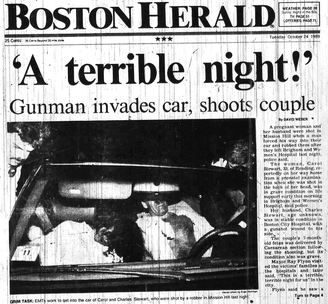
United States · Activism · Law
Carol Stuart Murder
March 26, 1959 – October 24, 1989
Early Life and Background
Carol Ann DiMaiti (later known as Carol Ann DiMaiti Stuart) was born on March 26, 1959, in the United States.[1] She grew up in the Boston area in a working‑ and middle‑class Italian American family, part of the broad suburban community that developed around the city in the post‑war decades.[1][10] Little public information survives about her childhood, in part because she was not a public figure during her lifetime; much of what is known about her life emerges only through coverage of her death.
Sources indicate that Carol was regarded by those who knew her as bright, ambitious, and oriented toward professional achievement.[11] Later reporting and documentary work describe her as a woman who had built a career and who was planning to balance work and motherhood.[11][14] In the retellings of her story, she comes to stand for many women whose ordinary lives—family, education, career aspirations—remain largely undocumented until a tragic event thrusts them into public view.
Education and Professional Formation
Accounts of the case repeatedly mention Carol’s professional status. Several sources note that she was a career woman, and some describe her as an attorney or professional in a white‑collar occupation, highlighting the expectation that she would continue working after childbirth.[10][11] This detail figures prominently in reconstructions of her husband’s motives: Charles Stuart allegedly feared that Carol would not resume her career after the baby’s birth and was unhappy about the pregnancy, factors that prosecutors and journalists later linked to his decision to kill her.[10][11]
Though the specific institutions where she studied are not reliably documented in widely accessible sources, the consensus is that Carol belonged to the cohort of women who entered professional fields in the 1970s and 1980s, benefiting from expanding opportunities for women in higher education and the professions. Her story is often invoked as emblematic of a woman who had done "everything right"—pursued education, developed a career, and started a family—only to be killed by an intimate partner.[7][14]
Career and Work Life
In the late 1980s, Carol lived with her husband, Charles "Chuck" Stuart, in Reading, a predominantly white suburb north of Boston.[1][8] Charles worked as a manager at a fur store in downtown Boston.[1][8] Carol’s own work is described in later accounts as professional and white‑collar; some sources report that she worked in the legal field and that her husband resented the demands and independence associated with her career.[10][11]
While the murder coverage centers more on Charles’s occupation than Carol’s, the tension around her continued employment after childbirth appears as an important element in some reconstructions of motive. Commentators note that Stuart allegedly wanted Carol to terminate the pregnancy and was concerned that parenting would change her professional trajectory.[10][11] For women’s‑history purposes, Carol’s work life is significant because it places her within a generation of women negotiating marriage, motherhood, and professional identity at a time when such balancing acts were newly visible but not always supported.
Personal Life: Marriage and Pregnancy
Carol married Charles Stuart in the mid‑1980s; by 1989 they had been married for about four years.[11] They lived in Reading and were, in the language of contemporary reports, "white suburbanites" traveling in and out of the city for work and medical care.[8] In 1989, Carol was pregnant with their first child.[1][14] She was about seven months pregnant in October of that year.[14] The couple attended childbirth classes at Brigham and Women’s Hospital, one of Boston’s major teaching hospitals, preparing for the arrival of their baby.[2][5][14]
Sources later revealed that the pregnancy, which Carol welcomed, was a source of conflict within the marriage. Charles reportedly opposed the pregnancy and wanted Carol to have an abortion, fearing the financial responsibilities and potential changes to their lifestyle and her career.[10][11] Investigative reporting and docuseries produced decades later emphasize that Carol was unaware she was in mortal danger from her spouse, and that signs of his violent intent were hidden from her family and friends.[14][16]
The Night of the Attack: October 23, 1989
On the evening of October 23, 1989, Carol and Charles left a childbirth education class at Brigham and Women’s Hospital and drove through or near Boston’s Mission Hill neighborhood, a predominantly Black and Latinx area adjacent to Roxbury.[2][5][14] At approximately 11 p.m., while Carol sat in the passenger seat of their blue Toyota Cressida, Charles shot her in the head.[5][10][14] He also inflicted a gunshot wound on his own abdomen, apparently to support a staged narrative that they had both been attacked.[5][10]
Charles then called 911 using the car phone, telling the dispatcher that a Black man had carjacked them, forced him to drive, robbed the couple, and shot both Carol and himself before fleeing.[5][10][14] Police arrived to find Carol critically injured and Charles wounded but conscious. The scene, a white suburban couple allegedly attacked by a Black stranger in an inner‑city neighborhood, immediately activated racial anxieties and became a high‑profile crime story.
Medical Response and Carol’s Death
Carol was rushed back to Brigham and Women’s Hospital, where doctors attempted to save both her and her unborn child. Within hours, physicians performed an emergency cesarean section to deliver her son, Christopher, who was gravely injured.[14][17] Carol remained in critical condition, and her prognosis was poor from the outset due to the severity of the gunshot wound.
On October 24, 1989, Carol died at the hospital from her injuries.[1][14] Christopher survived for several days before dying as well, but sources do not document a precise calendar date for his death.[14][17] Carol’s death at age 30 extinguished the life of a woman poised to enter motherhood and continue a professional career. Initially, she was publicly remembered as the innocent victim of a random urban carjacking; only later would it be widely acknowledged that she was a victim of intimate partner homicide.
Police Investigation and Racialized Manhunt
In the weeks following the shooting, police and media largely accepted Charles Stuart’s account that an unknown Black man had attacked the couple.[5][10][14] Investigators focused on Mission Hill and surrounding neighborhoods, launching a massive manhunt that included stop‑and‑frisk sweeps, home raids, and intensive questioning of Black residents.[5][14] The operation became one of the largest manhunts in Boston’s history, and it took place in a city still deeply scarred by racially charged battles over court‑ordered school busing in the 1970s.[5]
Two Black men, Alan Swanson and Willie Bennett, were prominently, and wrongly, connected to the case.[5][6][10] Bennett, an ex‑convict, was arrested and publicly portrayed as the likely killer after a relative allegedly joked about his involvement.[10] These investigative choices, based largely on hearsay and Stuart’s description of a "Black man in a tracksuit,"[8][10] reinforced stereotypes of Black criminality and deepened mistrust between Boston’s Black communities and law enforcement.
For Carol herself, this phase of the investigation had the effect of converting her death into a symbol of interracial fear, obscuring the possibility that the threat had come from within her own marriage. Feminist and critical‑race scholars later noted that the narrative positioning Carol as a white victim of Black violence made it easier for the public to engage with racialized fears than with the reality of domestic violence.[7][14]
Revelation of the Truth: January 1990
The turning point came on January 3, 1990, when Matthew Stuart, Charles’s brother, met with prosecutors and implicated Charles in the murder.[2][5] Matthew disclosed that Charles had planned to kill his wife to collect life‑insurance money and had enlisted him in disposing of evidence, including the handgun and other incriminating items.[2][12][14] His account contradicted months of official and media narratives that had focused on a supposed Black carjacker.
News of Matthew’s statement quickly spread. Public confidence in the original story collapsed, and attention shifted to Charles as the likely perpetrator. The next day, on January 4, 1990, Charles drove to the Tobin Bridge in Boston and jumped to his death, an apparent suicide.[1][5] With his death, the state was deprived of the chance to prosecute him for murder; the criminal case against a principal suspect ended without trial.
Matthew Stuart was later charged and convicted of insurance fraud, obstruction of justice, and related weapons offenses, serving prison time in the early 1990s.[14][12] His prosecution shifted focus from the fabricated stranger attack to the financial and familial conspiracy that had cost Carol her life.
Media Coverage, Race, and the Erasure of Domestic Violence
The Stuart case quickly became a national symbol of racially charged crime reporting and policing. Major outlets, including the Los Angeles Times, covered the saga in detail, presenting it as an example of how a false accusation could galvanize racialized fear and lead to the victimization of innocent Black men.[4][9][20] Over time, historians and journalists examined the case as a key episode in Boston’s history of racism, alongside the earlier controversies over school desegregation.
Yet for many years, commentary focused more on race and media than on domestic violence. Carol’s murder was framed as a "hoax" case—a story about a lying husband and a misled city—rather than a story about a woman killed by her spouse. Columnist Adrian Walker of The Boston Globe later stressed that Carol "was a victim of domestic violence" and that this fact had been "obscured or lost" amid the sensationalism.[14] Scholars and advocates pointed out that the gendered nature of the crime, and Carol’s experience as an abused woman, received comparatively little attention.
In 2009, on the twentieth anniversary, WBUR and other outlets reflected on how the case had forced Boston to confront its racial divides but still often treated Carol primarily as a figure in a racial drama rather than as a domestic‑violence victim.[9] In 2014, at the 25‑year mark, further retrospectives revisited the case, again emphasizing the racial branding that Boston "just can’t seem to shake" but only beginning to bring the lens of intimate partner violence into view.[5][3][20]
Carol Stuart in Popular Culture
Carol’s case entered popular culture as an emblem of race, fear, and violence. In October 2002, Michael Moore’s documentary "Bowling for Columbine" was released and made reference to the Stuart case.[1] Moore used the episode to illustrate how media amplification of racially coded crime stories can shape public attitudes toward gun ownership and social safety, drawing connections between the fear‑based narratives surrounding Carol’s murder and broader gun‑culture dynamics.
More recently, the story has been revisited in podcast series, longform journalism, and documentaries. The HBO docuseries "Murder in Boston: The Untold Story of the Charles and Carol Stuart Shooting" chronicles the case and its racial fallout, foregrounding the impact on Mission Hill’s Black residents and on wrongly targeted men such as Bennett and Swanson.[15][19] Investigative series such as Reveal’s The Racist Hoax That Changed Boston similarly center the role of systemic racism and the erasure of Carol’s status as a domestic‑violence victim.[14]
Reframing the Case as Domestic Violence
A major interpretive shift occurred on December 12, 2023, when The Boston Globe published an opinion essay explicitly arguing that Carol’s murder should be understood as an act of domestic violence and intimate partner homicide.[7] The piece emphasized that early public narratives had "made it easier" for many to believe a random Black man killed her than to consider what turned out to be the truth—that Carol’s death was "plotted and planned by her husband."[7]
The editorial called for re‑centering Carol and recognizing that the structures of misogyny and patriarchy, as much as racism, had shaped her fate. It also acknowledged the Globe’s own role in amplifying the initial, racially biased narrative. Media‑ethics scholars have since treated this article as a key example of institutional self‑reflection, showing how newsrooms can revisit past coverage to address blind spots related to both race and gender.[11]
Official Apology and Ongoing Racial Reckoning
On December 20, 2023, Boston Mayor Michelle Wu delivered a formal apology to Alan Swanson and Willie Bennett, two Black men wrongfully suspected and, in Bennett’s case, arrested in connection with Carol’s murder.[6] She stated that "there was no evidence that a Black man committed this crime" and acknowledged that the city’s response had been racially biased.[6] The apology was accompanied by a $150,000 settlement, with $100,000 for Bennett and $50,000 for Swanson.[6]
This apology is widely regarded as the first municipal acknowledgment directly tied to the harms inflicted on specific individuals in the Stuart case.[6][8] It came in the context of renewed scrutiny prompted by the HBO docuseries and investigative reporting and was part of broader efforts to address historic wrongdoing in Boston’s criminal‑justice system. For women’s‑history archives, the apology has dual significance: it highlights the ways in which attempts to secure justice for a murdered woman can themselves become vehicles of racial injustice, and it underscores the need for intersectional analysis of gender, race, and state power.
Legacy and Historical Impact
Carol DiMaiti Stuart’s legacy is multifaceted. She is remembered first as a woman whose life was taken by her husband in a carefully staged act of domestic violence. Her case demonstrates how intimate partner homicide can be masked by narratives that shift blame away from the home and toward marginalized communities. The initial refusal to suspect Charles, coupled with the eagerness to hunt for a Black assailant, has been cited repeatedly as evidence of systemic racism in Boston’s policing and media culture.[5][14][20]
At the same time, Carol’s story has prompted new conversations about how women victims are portrayed. Advocates argue that she should be remembered not simply as a symbol within a racial drama, but as a professional woman and expectant mother whose trust in her spouse was fatally betrayed.[7][14] Her name now appears in scholarly and journalistic discussions of domestic violence, racial profiling, media ethics, and urban history, particularly in analyses that seek to understand how intersecting forms of bias can distort both investigations and public memory.
In 2024, analyses such as the Harvard Gazette feature "Could troubling police, media response to Stuart murder happen again?" used Carol’s case as a lens to examine current policing and reporting practices, asking whether similar failures could recur.[5][6] The continued return to her story more than three decades later testifies to its enduring relevance in debates about law enforcement, race, gender, and the responsibilities of institutions tasked with telling the public what happened when a woman is killed.
Later Life and Death
Because Carol’s life was cut short at age 30, there is no "later life" in the conventional biographical sense. Her final months were spent preparing for motherhood, attending childbirth classes, and maintaining her professional identity in suburban Boston.[2][5][14] Her death on October 24, 1989, at Brigham and Women’s Hospital, followed a night of violence that also critically injured her son.[1][14]
The aftermath—the racially biased investigation, the eventual implication and suicide of her husband, the prosecution of his brother, and the decades‑long process of civic reckoning—forms the postscript to her biography. In that sense, the "later life" of Carol DiMaiti Stuart exists not in her own experiences, but in the evolving public narrative about her death. Each retrospective, documentary, and apology reshapes how she is understood: as a victim of domestic violence, as a catalyst for examining systemic racism, and as a reminder that the lives of women lost to intimate partner homicide deserve more than being footnotes in stories about the men who killed them.
Recognition and Commemoration
Carol has not been commemorated through formal awards or monuments in the way some public figures have, but her name is invoked in a variety of contexts: in legal analyses of police practices, in medical discussions about responding to trauma in pregnancy, and in social‑justice essays about race and gender.[5][6][7][14] The HBO docuseries and investigative coverage have brought renewed attention to her story, prompting calls for more explicit recognition of domestic‑violence victims in public memorialization.
For women’s‑history editors and researchers, including Carol in almanacs and timelines is an act of corrective memory. It ensures that a case long treated as a racial "hoax" is also understood as the story of a woman whose aspirations for work and family were destroyed by her husband’s violent calculation. Her biography, reconstructed largely from the circumstances of her death, stands as a reminder of both the fragility of women’s historical visibility and the importance of documenting their lives beyond the headlines they did not choose.
Dated achievements
10 indexed.
- Mar261959Activism
Birth of Carol Ann DiMaiti
Carol Ann DiMaiti, later known as Carol Stuart, was born on March 26, 1959, in the United States.
View details Murder of Carol Stuart - Wikipedia - Oct231989Activism
Shooting of Carol DiMaiti Stuart in Mission Hill
Pregnant Carol Stuart was shot in the head by her husband Charles Stuart in their car in Boston's Mission Hill area after a childbirth class.