← All women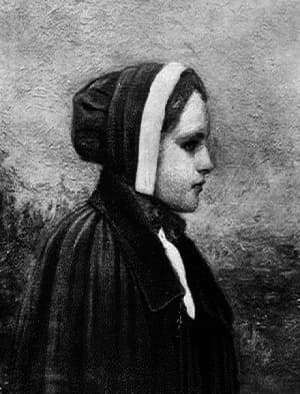
English, Colonial American · Law · Activism
Bridget Bishop
1632 – June 10, 1692
Early Life and Background
Bridget Bishop (very likely born Bridget Playfer, sometimes rendered Playfer or Plaifor) entered the historical record as one of the most notorious figures in the Salem witch trials, yet relatively little is securely known about her early life.[1][3][15] Modern reference works generally place her birth in England around 1632, sometimes giving a range between 1632 and 1637, based on age estimates at the time of her death and genealogical reconstructions.[1][15] No surviving primary source provides a precise birth date, parish, or baptismal record, and historians therefore describe her birth as "circa" or "sometime between" these years rather than fixing an exact day.[1][15]
Biographical accounts suggest that Bridget came from modest origins and emigrated to the Massachusetts Bay Colony as part of the broader movement of English settlers to New England in the mid‑seventeenth century.[3][5] One scholarly profile notes that she likely arrived in the colony by about 1660, though this is inferred from later records of marriage and landholding rather than direct passenger lists or immigration documents.[3] The sparse evidence for her childhood, education, and formative influences is typical of ordinary women in this period, whose lives were often poorly documented unless they intersected with property disputes, church discipline, or criminal prosecutions.
Later legal and narrative sources emphasize that Bridget was connected to several family names—Magnus, Playfer, Bishop—through marriage and possibly remarriage, reflecting both the hazards of colonial life and the fluidity of identity among English settlers.[1][3] She is frequently described as having been married more than once and as a widow at the time of the Salem trials, but many details of her family relationships remain contested among genealogists and are not fully resolved in the surviving court records.[3][15]
Life in Salem and Social Position
By the 1670s and 1680s, Bridget Bishop was a recognizable figure in Salem Town, part of the wider Salem community that included both the more commercial town and the agrarian Salem Village where many accusers lived.[3][10] Contemporary descriptions and later histories present her as a woman who stood out from conventional Puritan norms. She is repeatedly characterized as a tavern or inn keeper, a woman who ran or was associated with a drinking establishment, and as someone who wore bright, even "flamboyant" clothing—especially red—at a time when sober black and gray were the expected colors.[5][9][10]
Such traits made Bishop a subject of gossip and moral scrutiny. Historians note that she was involved in various neighborhood quarrels, appeared in court records related to disputes, and was perceived by some neighbors as sharp‑tongued or defiant.[3][15] In Puritan New England, where religious conformity and communal surveillance were intense, a woman who spoke her mind, managed property, and did not fully conform to gendered expectations of modesty and submissiveness was vulnerable to accusations of disorderliness, and, in times of crisis, witchcraft.[3][8]
Some later accounts mention that she may have worked as a midwife, though the evidence for this role is limited and largely interpretive, derived from the fact that many women accused of witchcraft had occupations that brought them into intimate contact with other households.[1] Whether or not she regularly practiced midwifery, her visible position in the community—as a tavern‑associated woman, twice widowed, and economically active—made her a convenient focus for moral suspicion.
Accusations of Witchcraft
The Salem witchcraft crisis of 1692 began in Salem Village with the strange fits of young girls who claimed to be tormented by invisible forces, and quickly expanded into a sweeping series of accusations.[11] Bridget Bishop was not the first resident to be accused; earlier complaints focused on figures such as Tituba, Sarah Good, and Sarah Osborne.[7][11] However, Bishop became the first person whose case moved through the full machinery of indictment, trial, conviction, and execution before the Court of Oyer and Terminer, making her central to the legal history of the episode.[4][11]
According to edited Salem court records and modern summaries, multiple individuals accused Bishop of practicing witchcraft and harming them through supernatural means.[3][4][13] Young women, including Abigail Williams, Ann Putnam Jr., Mercy Lewis, Mary Walcott, and Elizabeth Hubbard, claimed that Bishop’s specter tormented them, appearing in visions and inflicting pains that they interpreted as diabolical attacks.[13] Neighbors testified about "poppets" (small dolls) found in her home that they believed were used for malefic magic, and about an "unnatural mark" discovered on her body during a search, a detail that prosecutors presented as evidence of a witch’s teat.[3][12]
Bridget steadfastly denied these accusations. In surviving interrogations, she declared that she had never used witchcraft and did not even know some of her accusers.[3][12] Nonetheless, in an atmosphere of escalating fear and theological conviction that the Devil was actively assaulting the colony, her denials carried little weight. Historians emphasize that the trial relied heavily on spectral evidence—testimony about visions and apparitions—which would later be widely condemned as unreliable and inappropriate for legal proceedings.[11][12]
Trial Before the Court of Oyer and Terminer
In 1692, Governor Sir William Phips established a special court, the Court of Oyer and Terminer, to handle the growing backlog of witchcraft cases.[11] Bridget Bishop’s case was among the first to be heard, and according to standard reference works she became the first colonist tried and condemned in this tribunal.[4][11] Although some narrative sources describe an "eight‑day" trial, primary documentation is fragmentary, and exact day‑by‑day chronology of indictment, jury deliberation, and sentencing cannot be fully reconstructed from extant records.[3]
The court indicted Bishop on multiple counts of practicing witchcraft against several named victims, based on both the girls’ fits and neighborhood testimony.[13] Examining magistrates and jurors heard depositions describing supernatural assaults, mysterious domestic misfortunes, and alleged statements by Bishop that were interpreted as confessions or threats. Despite the lack of physical evidence and her repeated denials, the jury found her guilty on these indictments.[3][13]
Sentencing followed the established framework of English law, which prescribed death by hanging for convicted witches. The court formally pronounced that Bishop was guilty of "the felonyes and Witchcrafts whereof she stood Indicted" and ordered that she be put to death.[13] This judgment, later recorded and transmitted to the colonial authorities, set an ominous precedent: if one woman could be executed based primarily on spectral evidence and community hostility, many more could follow.
Execution and Official Record
On June 10, 1692, Bridget Bishop’s sentence was carried out.[1][11][13] Sheriff George Corwin, responsible for executing capital punishments in Essex County, took Bishop from the Salem jail and led her to the designated place of execution, traditionally associated with what is now called Gallows Hill.[10][11] Contemporaries and later historians agree that she was the first person executed in the Salem witch trials and, in official‑style summaries, the first Salem witch hanging in the Massachusetts Bay Colony.[1][4][11]
Corwin’s written return on the execution warrant is a crucial document for understanding the event. In formal legal language, he reported that he had "safely conveighed" Bridget Bishop to the place provided for her execution and "caused the said Bridget to be hanged by the neck until she was dead."[13] This record confirms not only the fact and manner of her death, but also the bureaucratic ordinariness with which such extraordinary violence was administered.
The execution was public and widely known. Some accounts describe townspeople expressing relief that "the shape of Bridget" would trouble them no more, a reflection of how deeply the image of her specter had taken hold in local imagination.[5] Modern historians emphasize that Bishop was hanged alone on that day, the only Salem victim executed singly in 1692, and the last witchcraft defendant hanged alone in New England.[12] Her death marked the transition from an episode of strange afflictions and legal hearings into a full‑scale series of state‑sanctioned killings that would continue through the summer.
Personal Life: Marriages, Work, and Reputation
Although Bridget Bishop’s notoriety arises from her execution, surviving records and later research sketch aspects of her personal life that help explain why she became a target. Accounts describe her as having been widowed more than once, with husbands likely including Edward Bishop and possibly others, though the precise sequence of marriages is debated in genealogical literature.[3][15] Being a widow in colonial New England often meant managing her own household and, in some cases, controlling property, circumstances that could provoke resentment in a patriarchal society.
Bridget is frequently identified as a tavern keeper or a woman associated with an inn, an occupation that placed her at the crossroads of public sociability and moral suspicion.[5][10] Taverns were centers of conversation, trade, and sometimes rowdy behavior; a woman who ran such an establishment, interacted with men outside strictly domestic settings, and profited from the sale of alcohol could be accused of encouraging disorder. Legal complaints against her included allegations related to the conduct of people in her house and disputes with neighbors, though not all such accusations involved witchcraft.[3][15]
Her clothing and demeanor were central to her reputation. Multiple later accounts note that she wore red garments or otherwise conspicuously non‑Puritan dress, that she spoke openly, and that she was not easily intimidated.[5][8][9] Historian Bernard Rosenthal and others have argued that it was less her "sundry acts of witchcraft" than her "flamboyant lifestyle and exotic manner of dress" that made her the first person hanged in Salem.[15] In this reading, Bishop was targeted as much for her gender nonconformity and social independence as for any supposed diabolical activity.
Awards, Honors, and Posthumous Recognition
Bridget Bishop received no honors in her lifetime; she died under legal condemnation as a convicted witch. Over the centuries, however, her story has been reframed, and she has come to be recognized as a victim of injustice. In the twentieth century, historical scholarship and public commemoration increasingly treated the Salem defendants as wrongfully accused, and Bishop’s name appears on lists of those whose reputations were to be restored.[3][11]
In 2001, Massachusetts authorities formally exonerated Bridget Bishop along with several other Salem witch trial victims, clearing their names more than three centuries after their deaths.[14] Some narrative sources note that the legislation or gubernatorial action occurred around Halloween 2001, symbolically linking the exoneration to a date associated with popular imaginings of witches, though accessible primary documents that specify the exact day remain limited.[14] Regardless of the precise date, the action represented an official acknowledgment that the convictions were unjust.
Today, Bridget Bishop is commemorated in museums, heritage sites, and educational materials. The Salem Witch Museum and other local institutions interpret locations associated with her home and orchards, while tours and digital exhibits highlight her trial as a case study in gender bias and mass hysteria.[7][6] Although these recognitions are not "awards" in the traditional sense, they function as collective efforts to honor her memory and to transform a once‑stigmatized figure into a symbol of resistance to injustice.
Legacy and Historical Impact
Bridget Bishop’s legacy extends well beyond Salem. As the first person executed in the Salem witch trials, her case has become the starting point for countless histories of the episode and a focal point for discussions of law, religion, and gender in colonial America.[1][4][11] Legal‑historical analyses use her trial to illustrate how unreliable forms of evidence—particularly spectral testimony—were admitted in court and how such practices fueled miscarriages of justice.[11][12]
The Salem trials, including Bishop’s execution, contributed to long‑term changes in Anglo‑American legal thought. Scholars argue that the public horror and later condemnation of the trials helped discredit spectral evidence and encourage a stronger emphasis on empirical proof and procedural safeguards in criminal prosecutions.[10][11] In this sense, Bridget Bishop’s death, though tragic, formed part of a larger historical process by which early American law moved toward more rational standards.
Her story also resonates strongly in the history of women’s rights and feminist scholarship. Modern interpreters frame Bishop as a woman punished for her independence: she ran or was associated with a tavern, wore nonconforming clothing, spoke her mind, and owned property.[5][8] Such traits threatened a social order that demanded female submissiveness, and in times of anxiety they made her a ready scapegoat. Contemporary documentaries and essays explicitly identify Bridget Bishop as a symbol in debates about how societies treat outspoken, economically active women, and as an early example of how gendered expectations can intersect with legal systems to produce lethal outcomes.[8]
In popular culture, Bishop appears in books, films, tours, and online videos about Salem. These representations vary in detail, but many emphasize that she should be remembered not as a "witch" but as an innocent victim of hysteria.[8][12] Her name is inscribed on memorials to the victims of the Salem witch trials, and she is frequently cited on "this day in history" features that mark June 10 as a key date in American history.[9][11]
Later Life and Death
Bridget Bishop did not reach old age; her life ended abruptly in 1692 amid one of the most infamous moral panics in North American history. Before the crisis, she had lived for decades in Salem, navigating the challenges of widowhood, economic survival, and community scrutiny. Her involvement in tavern keeping and her distinctive personal style suggest that she carved out a degree of agency unusual for women of her time, but these same qualities made her vulnerable when the colony turned to searching for witches.[3][5]
After her conviction in 1692, Bishop was held in Salem jail pending execution. On June 10, 1692, Sheriff George Corwin executed the court’s warrant, leading her to the place of hanging and ending her life by the rope.[1][11][13] She was around sixty years old, based on estimates that she was about sixty at the time of her death, though, as with her birth, no exact age is documented.[1][9]
Her death did not bring an end to the crisis; instead, it opened the door for a series of additional executions over the following months. Nineteen people would be hanged and one pressed to death, while many others languished in prison.[1][11] Only later, as doubts grew and key figures—including some clergy—questioned the use of spectral evidence, did the colony halt the trials and begin to reckon with what had happened.
In the centuries since, Bridget Bishop’s reputation has undergone a profound transformation. Once recorded as a convicted witch and "singular character, not easily described," she is now widely recognized as a victim of state wrongdoing and a key figure in the history of legal reform and women’s rights.[15][8] Her story continues to be taught as a warning about the dangers of fear, prejudice, and unchecked authority, ensuring that although her life was cut short, her historical impact endures.
Dated achievements
2 indexed.
- Jun101692Science
Executed as First Victim of the Salem Witch Trials
Bridget Bishop was hanged at Gallows Hill in Salem, Massachusetts, becoming the first person executed during the Salem witch trials.
View details Bridget Bishop - Wikipedia - Jun101692Science
Sheriff George Corwin Carries Out Bishop's Execution Warrant
Sheriff George Corwin formally executed the court's warrant, hanging Bridget Bishop and beginning the deadliest phase of the Salem witch trials.