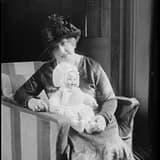
Patented a mechanism (US 2,022,286) that moved a doll's eyes and eyelids via arm position, used in her 'Miss Illusion' doll.
On November 26, 1935, Henry secured U.S. Patent 2,022,286 for a novel mechanism that animated a doll's eyes and eyelids in response to the movement of the doll's arm. This mechanical linkage allowed a child to manipulate the doll's limb and, in turn, cause lifelike blinking or eye-closing effects.
The invention was closely associated with Henry's popular 'Miss Illusion' doll, a toy notable for eyes that could not only open and close but also appear to change color, delighting Depression-era children and showcasing Henry's flair for combining whimsy with mechanical sophistication. Toy design was another arena in which Henry demonstrated her range, moving seamlessly between household goods, office equipment, and children's playthings.
This patent highlights an important dimension of Henry's inventive philosophy: she treated toys with the same rigorous mechanical engineering approach she applied to industrial or domestic products. The doll-eye mechanism required precise linkage design to translate simple arm movement into convincing, durable eye motion suitable for mass manufacture and rough handling by children. It reinforced her reputation across the toy industry, where she consulted for companies such as the International Doll Company, and it remains one of the more whimsical yet technically impressive entries in her portfolio of roughly 110 credited inventions.