← All women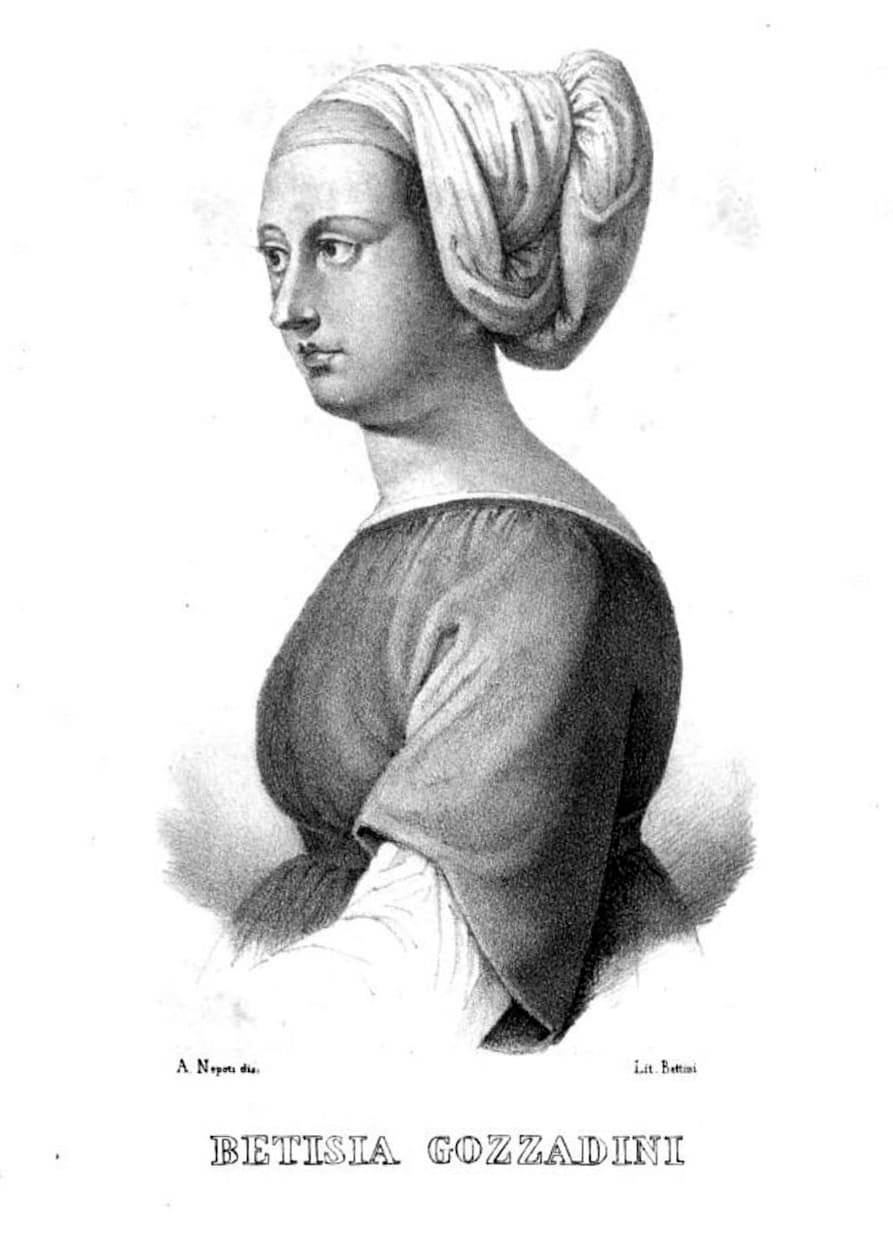
Italian · Law
Bettisia Gozzadini
1209 – November 2, 1261
Early Life and Background
Bettisia Gozzadini (also rendered as Battisia, Bettina, Bitisia or Betina Gozzadina) was a Bolognese jurist traditionally believed to have been born in 1209 in Bologna, then part of the Papal States.[1][2][3][4][6][13] She belonged to the noble Gozzadini family, which local histories describe as a powerful lineage with economic and political influence in the city over several centuries.[7][9] Her parents are identified in some accounts as Amadore Gozzadini and Adelasia de’ Pegolotti, members of an educated and well-connected milieu that was able to support an unconventional path of study for a daughter.[13]
Later narratives emphasize that from an early age Bettisia rejected the domestic occupations expected of women and instead devoted herself to learning. She is said to have mastered Latin and Greek, disciplines that were prerequisites for advanced legal and theological study.[9][16] In thirteenth-century Bologna, women’s formal access to the university (Studium) was effectively barred; however, the city’s intellectual atmosphere, shaped by its status as one of Europe’s leading centers of legal scholarship, created conditions in which a determined woman from a supportive family might pursue education through private arrangements.
The broader context of her upbringing was the dynamic and often turbulent world of communal Italy. Bologna was divided by political factions (often summarized as Guelf and Ghibelline), and law played a central role in arbitrating conflicts and upholding communal statutes. Some modern authors suggest that the Gozzadini family was aligned with the Guelf cause, though detailed evidence for their political activity is limited.[11] In any case, Bettisia’s formative years unfolded in a milieu that valued legal expertise and cultivated jurists whose opinions shaped civic life.
Education and Path to Legal Scholarship
Almost all modern accounts agree that Bettisia received an extensive private education in the liberal arts and law, even though women could not enroll formally as students at Bologna’s university.[1][2][3][7][9] A detailed local biography hosted by a Bologna historical site states that she studied "da privata"—as a private student—because it was considered unimaginable that a woman could be listed among the matriculated students of the Studio.[7] Through private tutors or attendance at lectures in an unofficial capacity, she reportedly acquired a deep knowledge of civil and canon law.
There is no surviving contemporary university register that documents her studies, but later narratives, beginning in the sixteenth century and elaborated in the twentieth and twenty-first, consistently depict her as having attained a level of expertise comparable to leading jurists of her day.[1][2][4][9] She is frequently mentioned alongside figures such as Irnerius and Accursius, a rhetorical pairing that underlines her perceived status within Bologna’s legal tradition.[7]
Some modern popular articles and local commemorations state that Bettisia obtained her law degree around 1237, while one Italian essay gives 3 June 1238 as the date of her laurea at the University of Bologna.[9][16] A more detailed Bologna biography, however, specifies 3 June 1236, combining the conferral of her degree in jurisprudence with an appointment to a chair of law.[7] Because these dates derive from later or local traditions rather than from extant medieval diplomas, historians treat them cautiously. Nevertheless, the convergence of sources on a mid-1230s timeframe supports the broader claim that Bettisia was one of the earliest women known to have obtained a university-level law qualification.
Appointment and Career at the University of Bologna
The most distinctive feature of Bettisia Gozzadini’s biography is her reputed teaching career at the University of Bologna, then commonly called the Studium. Modern encyclopedic entries in several languages agree that she began lecturing in law around 1239, and that she did so in a formal capacity comparable to male professors.[2][3][4][5][6][8] She is thus widely described as the first woman to lecture at a university or as the first woman university professor in history.[1][2][3][4][6][13]
According to the detailed Bologna biography, on 3 June 1236 the Studio conferred upon Bettisia a laurea in jurisprudence and simultaneously granted her a chair of law, which she occupied until her death in 1261.[7] This narrative emphasizes the exceptional nature of the decision: a woman who had not been officially enrolled as a student was recognized by the university’s governing structures and integrated into its teaching staff. While this account cannot be independently corroborated with surviving administrative records, its persistence in local historiography has made it central to the way Bettisia’s career is remembered.
Different sources characterize her teaching in various ways. Several encyclopedias describe her simply as a jurist and professor of law who lectured at Bologna from about 1239.[2][3][4][6] Others, including popular articles and local websites, elaborate with anecdotal details: that she initially taught law in her own house for two years before accepting an official position at the Studium, that she was an extraordinary orator, and that she attracted such large crowds that her lectures were sometimes held outdoors.[11][12] Some legends even claim that she veiled her face or disguised herself as a man while teaching, though these specific motifs are not consistently reported and are generally treated by modern authors as unverified embellishments.[2][11][12]
Despite the fragmentary documentation, there is a strong consensus that Bettisia was recognized in her era, and certainly in later memory, as a doctor of laws who taught civil and canon law to substantial audiences at Bologna.[5][6][8][13] Her presence in the classroom challenged prevailing norms that excluded women from formal teaching roles and suggests that at least in some circumstances, merit and reputation could override gender-based restrictions in medieval universities.
Major Works, Teaching, and Public Oratory
No written works by Bettisia Gozzadini have survived, or at least none have been securely identified as hers.[2][12] Modern biographical sketches uniformly state that there is no extant production of legal treatises or commentaries attributable to her, making it impossible to assess her doctrinal contributions in detail.[12] Her influence must therefore be inferred from the tradition of her teaching and from accounts of her public interventions as an orator.
The Bologna biography and several later narratives highlight her reputation as a great public speaker and note that she was invited to deliver funeral orations for prominent figures. One local account states that on 1 January 1241 she gave the funeral oration for Enrico Fratta, Bishop of Bologna, and that on 1 January 1244 she delivered another funeral oration for Pope Innocent IV.[7] While these specific dates emanate from local tradition and lack independent corroboration from ecclesiastical records, they reflect the belief that Bettisia was entrusted with ceremonial roles typically reserved for male clerics and scholars.
These reported orations suggest that her authority extended beyond the university classroom into the civic and religious spheres. Being chosen to speak at the funeral of a bishop implied trust in her ability to articulate theological and moral themes and to represent the community in a moment of mourning. The attribution of a papal funeral oration—if taken even as symbolic rather than strictly historical—indicates that her rhetorical skill and knowledge of canon law were seen as intersecting with the highest levels of ecclesiastical power.
Within the university, Bettisia is said to have taught topics central to Bologna’s reputation, including interpretation of Roman law and its application to contemporary communal statutes. Later writers often emphasize her participation in the flourishing legal culture populated by jurists such as Accursius, Martinus, and Jacobus, though the precise nature of her relationships with these figures is not documented.[7] Her teaching likely contributed to the formation of generations of students who would go on to serve as notaries, judges, and civic officials across medieval Italy and beyond.
Awards, Honors, and Early Modern Commemoration
While medieval records of formal "awards" in the modern sense are lacking, Bettisia’s biography itself implies that her appointment to a chair of law and the conferral of a doctorate in jurisprudence were honors that placed her on a par with the leading jurists of the Studium.[1][2][4][7] The symbolic weight of these recognitions is visible in the way later centuries chose to commemorate her.
In the seventeenth century, a terracotta bust of Bettisia was created as part of a series of twelve portrait busts of notable Bolognese women, attributed in Spanish-language sources to a sculptor referred to as the “Escultor de Casa Fibbia.”[3] This series placed her among a curated pantheon of illustrious women who had shaped the city’s history, alongside figures from other social and intellectual domains. The bust is one of the earliest known visual representations of her and demonstrates that by the early modern period, her story as a pioneering woman jurist had become a recognized part of Bologna’s cultural heritage.
In contemporary times, Bettisia has been honored in various forms of public memory. She appears in local portals and guides dedicated to "women of Bologna" and "women who made the history of Bologna," where she is consistently described as the first woman to teach at the University of Bologna.[1][13] Educational websites, municipal blogs, and cultural tourism platforms recount her life as an example of women’s early participation in higher education and civic life.
In 2026, the Italian Senate included Bettisia in its publication “Storie d’ingegno e di coraggio”, a collection highlighting pioneering Italian women. The profile presents her as possibly the world’s first woman university teacher and notes her birth in 1209 and her later attainment of a law doctorate "with the highest honors."[13] This national-level recognition signals that her story has moved beyond local legend to become part of an official narrative of Italian women’s historical achievements.
Personal Life
Information about Bettisia Gozzadini’s personal life is extremely sparse and largely non-specific. Modern encyclopedias and local biographies concentrate on her education and teaching, while offering little or no detail about marriage, children, or intimate relationships.[1][2][3][4][6][7][12] Some popular accounts emphasize that she was "intolerant" of the occupations typically destined for women—such as domestic work and exclusive focus on marriage and motherhood—but these characterizations are general and appear to be extrapolated from her decision to pursue scholarly activities rather than drawn from primary biographical documents.[9][16]
No reliable source identifies a spouse or records any offspring. In the absence of documentary evidence, historians generally refrain from speculation about whether she married or remained single. What can be said, based on the legal and social context of thirteenth-century Bologna, is that any woman engaged in sustained, high-level study and teaching would have had to navigate expectations about family life and domestic responsibilities. The silence of the sources may itself reflect how narrative attention was directed primarily toward her exceptional public role rather than her private circumstances.
Several anecdotes presented in modern popular articles—such as claims that she disguised herself as a man, veiled her face while lecturing, or lived in relative seclusion—are not supported by contemporaneous evidence and are therefore treated as legend.[2][11][12] These stories illustrate how later generations attempted to fill gaps in her biography with imaginative reconstructions that dramatize the challenges faced by a woman scholar in a patriarchal society.
Later Life and Death
Sources agree that Bettisia Gozzadini continued teaching law at Bologna until her death in 1261.[2][3][4][6][8] Her later years are not documented in detail, but the continuity of her professorial role suggests that she maintained a significant place within the university’s teaching corps over at least two decades.
Her death is reported in dramatic fashion. Multiple modern encyclopedias—English, German, Spanish, French, Portuguese, and Russian—state that she died on 2 November 1261 near Budrio, east of Bologna, when a flood of the Idice River caused the collapse of the house in which she had taken refuge. She was among a group that included other women and several students, and the tragedy led to the temporary suspension of teaching in Bologna.[2][3][4][5][6][8] A Russian entry notes that she died from an accident in November 1261 and that classes in Bologna’s schools were halted for a day in response.[8]
A local Budrio article adds more detail, specifying that during the night of 3 November 1261 the overflow of the Idice at Riccardina killed seven people, including Bettisia, who is described there as the first woman university professor in history according to local tradition.[5] This creates a minor discrepancy between the widely cited date of 2 November and the locally remembered date of the night of 3 November. Historians of women’s history generally note both versions, emphasizing that while the exact day may be uncertain, the circumstances—death in a catastrophic flood—are consistently reported.
Some accounts specify that the house that collapsed was a country residence where Bettisia and her companions had fled from their primary dwelling near the river’s banks between Mezzolara and Riccardina.[3] The episode situates her life within the physical landscape of the Bologna countryside and underscores the vulnerability of medieval communities to environmental hazards. The fact that the city reportedly suspended classes and mourned her death with a well-attended funeral indicates the respect she had earned in the academic and civic spheres.[8]
Legacy and Historical Impact
Bettisia Gozzadini’s historical significance lies primarily in her role—documented through later tradition and modern synthesis—as one of the earliest known women to receive a university law degree and to teach at a university. From the sixteenth century onward, Bolognese chronicles and histories refer to her as a "dottoressa" and as a law teacher at the University of Bologna.[1] In the twentieth and twenty-first centuries, she has been widely described as the first woman to teach at the University of Bologna and possibly the first woman university professor in the world, though scholars underline that this claim rests on tradition rather than complete documentary proof.[2][3][4][5][6][13]
Her story has become a touchstone in discussions of women’s access to higher education. Modern essays on pioneering women graduates often pair Bettisia with later figures such as Elena Lucrezia Cornaro Piscopia, the Venetian philosopher who received a doctorate at Padua in 1678, arguing that Bettisia represents an even earlier example of a woman achieving academic recognition in the thirteenth century.[9] By recalling her as a jurist who broke barriers in a male-dominated field, these narratives construct a long genealogy of women’s intellectual and professional achievements.
At the same time, careful historians and journalists emphasize the limitations of the evidence. A 2024 Spanish-language article on Bettisia describes her as a "mysterious professor" and notes that there are many legends and few verifiable facts about her life, even though she undeniably taught law in thirteenth-century Bologna.[11] Italian essays on her role as "la prima docente universitaria" similarly remark that little is known for certain, apart from the broad outline that she was considered the first woman in the world to hold a university teaching appointment.[12]
Her legacy is also reflected in the physical and symbolic spaces of Bologna. The seventeenth-century terracotta bust situates her among the city’s illustrious women.[3] Modern civic and tourism websites highlight her in lists of "the women who made the history of Bologna" and "women in the shade of the two towers," presenting her as an early emblem of gender equality in education.[13] Local commemorations, including social media posts by cultural associations, celebrate her as the "first woman graduate of Bologna" and recall her graduation and teaching as foundational milestones in the city’s university history.[16]
In national memory, the Italian Senate’s inclusion of Bettisia in “Storie d’ingegno e di coraggio” demonstrates that her story resonates beyond Bologna as part of a broader narrative of women's courage and ingenuity.[13] By acknowledging both her pioneering status and the legendary character of some details, contemporary institutions contribute to a nuanced appreciation of her role: she is a symbol of possibilities opened by women in medieval academia, and a subject whose biography inspires further research into the often-overlooked presence of women in early universities.
For historians of women and education, Bettisia Gozzadini offers a case study in how a woman’s intellectual life can be transmitted across centuries through fragmented records, local memory, and evolving interpretations. Even in the absence of her own writings, the persistence of her name in legal, civic, and artistic contexts attests to the impact she made on her contemporaries and on the city that continues to remember her.
Dated achievements
7 indexed.
- Jun031236Law
Law degree and appointment to law chair at the Studio of Bologna
Bettisia Gozzadini received a law degree and was appointed a professor at the University of Bologna.
View details Biography of Bettisia Gozzadini - Jan011241Law
Funeral oration for Bishop Enrico Fratta of Bologna
Gozzadini delivered a funeral oration for Bishop Enrico Fratta of Bologna.