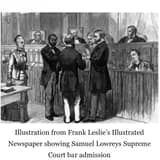
Argued Kaiser v. Stickney before the Supreme Court, the first oral argument by a woman member of its bar.
Beginning on November 30, 1880 and continuing into December 1, Belva Lockwood argued the case of Kaiser v. Stickney (102 U.S. 176) before the Supreme Court of the United States — the first time a woman member of the Court's bar had delivered oral argument before the justices.
This achievement went beyond mere admission to the bar; it demonstrated that a woman could actively practice the highest form of appellate advocacy in the American legal system, standing before the nine justices to argue points of law on behalf of a client, a role many contemporaries had assumed women were constitutionally or temperamentally unsuited for.
Lockwood's performance in this argument, and in the many Supreme Court cases she would go on to argue over the following decades — including cases on behalf of Native American clients and Civil War-era claimants — helped normalize the presence of women as serious, capable legal advocates in the nation's most prestigious courtroom. Her success undercut the arguments of skeptics who had opposed her admission to the bar just months earlier, and it opened a practical pathway for the small but growing number of women entering the legal profession in the following generation. This moment stands alongside her Supreme Court bar admission as one of the twin pillars of her legal legacy.