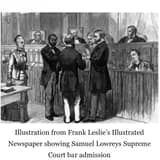
Moved the admission of Samuel R. Lowery, generally cited as the first southern Black lawyer admitted to the Supreme Court bar.
On February 2, 1880, less than a year after her own historic admission, Belva Lockwood moved the admission of Samuel R. Lowery, a formerly enslaved lawyer from Tennessee, to the bar of the U.S. Supreme Court. Lowery is generally recognized as the first Black lawyer from the American South admitted to practice before the nation's highest court.
Lockwood's sponsorship of Lowery reflected her broader commitment to civil rights and equal access to the legal profession, extending beyond her own advocacy for women to embrace the cause of racial justice at a time when Black Americans, and especially those from the former Confederacy, faced immense legal and social barriers just years after the end of Reconstruction.
This act of solidarity between two barrier-breaking legal pioneers — a woman fighting sex discrimination and a formerly enslaved man fighting racial discrimination — stands as a notable moment of intersectional advocacy in nineteenth-century American legal history. It underscores Lockwood's broader vision of the law as an instrument for dismantling systemic exclusion, not merely a vehicle for her own individual advancement. Her willingness to use her newly won standing before the Court to help another marginalized advocate gain entry exemplifies the reformist spirit that animated her entire career.