← All women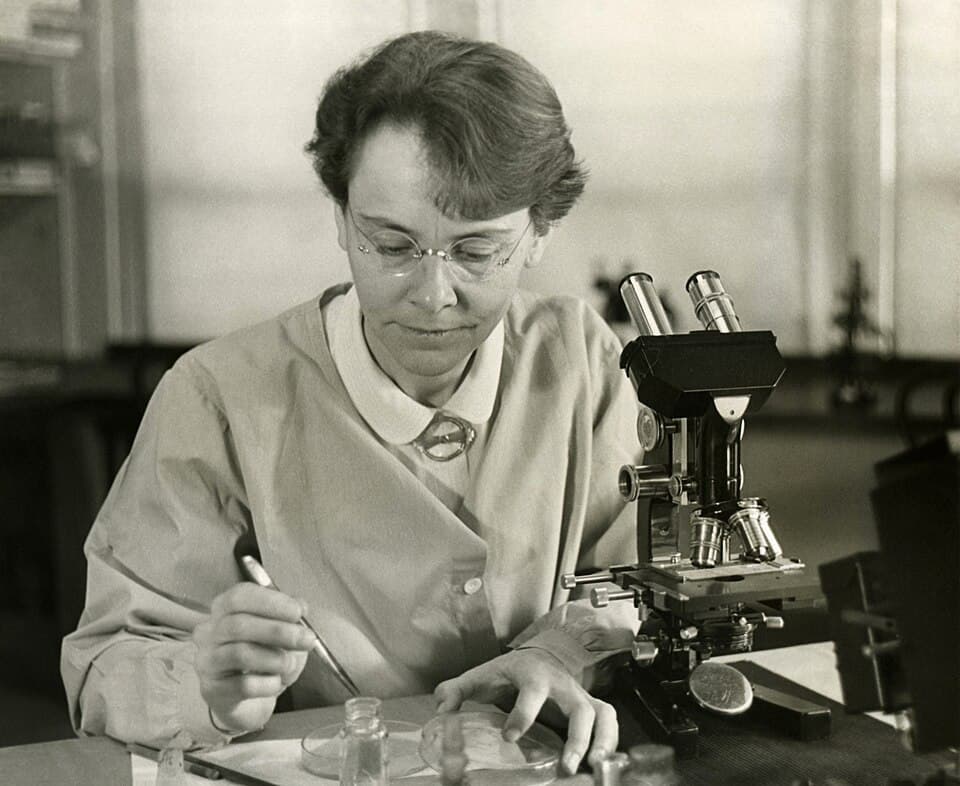
United States · Science · Medicine
Barbara McClintock
June 16, 1902 – September 2, 1992
Early Life and Background
Barbara McClintock was born on 16 June 1902 in Hartford, Connecticut, the third of four children of physician Thomas Henry McClintock and Sara Handy McClintock.[2][3][9] Her family experienced financial strain and frequent moves, reflecting the instability that many middle‑class American families faced in the early 20th century.[2][7] In 1908, the McClintocks relocated to Brooklyn, New York, where Barbara attended public schools and later Erasmus Hall High School, graduating in 1919.[2][7][8]
From an early age, McClintock showed intellectual independence and a strong interest in problem‑solving. According to biographical accounts, she had a reserved personality, disliked social conventions, and preferred solitary pursuits and rigorous study.[2][6] Her mother opposed the idea of her daughter attending college, reflecting widespread gender norms that framed higher education as unnecessary or inappropriate for women.[2][8] Her father, however, supported her ambitions and persuaded the family to allow Barbara to enroll at Cornell University’s College of Agriculture in 1919.[2][9]
This family conflict over education is central to understanding McClintock’s later career. It illustrates the structural barriers women faced in pursuing science: parental expectations, limited institutional support, and broader societal beliefs about women’s roles. Overcoming these constraints, McClintock would channel her independence into a research style characterized by deep concentration, methodological rigor, and a willingness to follow evidence wherever it led, even when it contradicted prevailing theories.[2][4]
Education and Early Career Development
At Cornell University, McClintock studied botany and quickly gravitated toward cytology and genetics, fields that were just beginning to merge into what would become cytogenetics.[1][2] She earned her B.S. in botany in 1923, followed by an M.A. in 1925 and a Ph.D. in 1927, all from Cornell.[2][5][11] Her doctoral research focused on the cytogenetics of maize, using careful microscopic analysis of chromosomes to understand how genetic traits are inherited.[1][3]
During her graduate years, McClintock joined a small but influential group of geneticists at Cornell who were exploring the relationship between chromosomal behavior and Mendelian inheritance. She developed sophisticated techniques for preparing and staining maize chromosomes, enabling her to visualize structural features during cell division with exceptional clarity.[1][3] These technical skills, combined with her ability to recognize patterns in complex data, positioned her at the forefront of chromosome research.
In the late 1920s and early 1930s, McClintock held a series of academic and research positions. She received a National Research Council fellowship and worked at the University of Missouri, among other institutions, deepening her expertise in cytogenetics.[1][3][6] However, she encountered gender‑based obstacles; some colleagues and administrators resisted appointing women to permanent faculty roles, and she ultimately left the University of Missouri in part because she saw limited prospects for advancement.[2][8] This experience contributed to her later preference for research environments that allowed independence, such as Cold Spring Harbor Laboratory.
Foundational Discoveries in Cytogenetics
In the early 1930s, McClintock made several foundational contributions to cytogenetics. In 1930, she provided detailed descriptions of the cross‑shaped configurations formed by homologous chromosomes during meiosis, clarifying the physical basis of chiasmata and genetic recombination.[1][3] Her work helped connect the abstract concept of crossing‑over—proposed by Thomas Hunt Morgan and others—with direct cytological observation.
In 1931, McClintock collaborated with graduate student Harriet Creighton to produce a landmark paper that experimentally linked genetic recombination with chromosomal crossing‑over in maize.[1][3] By correlating specific genetic traits with visible chromosomal exchanges, they showed that the reassortment of genes accompanied observable structural changes. This work is widely regarded as a key demonstration that genes reside on chromosomes and that physical exchange of chromosomal segments underlies Mendelian recombination.[3][4]
Throughout the 1930s, McClintock also investigated chromosome breakage and fusion, leading to her description of the breakage‑fusion‑bridge cycle in maize.[1][3] She observed that broken chromosome ends could fuse and then break again during cell division, producing cycles of rearrangement that affected genetic stability. These insights anticipated later studies of chromosomal instability in cancer and other diseases, underscoring her ability to see far‑reaching implications in plant cytogenetics.
Cold Spring Harbor Laboratory and Independent Research
McClintock’s long association with Cold Spring Harbor Laboratory (CSHL) began in the 1940s.[1][5] CSHL provided a relatively flexible environment where she could pursue independent research without the teaching obligations or departmental politics of a university appointment. She eventually became a staff member and remained affiliated with the laboratory for the rest of her life.[5][11]
At Cold Spring Harbor, she focused on maize as a model organism, exploiting its large chromosomes and visible kernel phenotypes to investigate genetic mechanisms. Her work combined field cultivation, controlled crosses, and painstaking microscopic analysis, an approach that demanded extraordinary patience and interpretive skill.[1][5] Colleagues often remarked on her capacity to spend long periods alone at the microscope, extracting coherent patterns from complex chromosomal behavior.[2][6]
McClintock’s independence at CSHL allowed her to follow unconventional ideas more freely than many contemporaries constrained by grant priorities or departmental expectations. This autonomy, however, also meant she had less institutional support when her findings challenged established thinking. Her major discoveries about transposable elements emerged in this context of solitary, highly focused work.[4][5]
Discovery of Transposable Elements (“Jumping Genes”)
McClintock’s most celebrated work unfolded in the 1940s and 1950s, when she discovered genetic elements in maize that could move from one chromosomal position to another, affecting gene expression and phenotype.[1][3][9] Investigating unusual patterns of kernel coloration and variegation, she inferred the presence of what she called "controlling elements"—loci that could activate or deactivate nearby genes by inserting or excising themselves.
These studies revealed that the genome is dynamically organized, with certain segments capable of transposition. In 1950, McClintock first reported in a scientific journal that genetic information could transpose from one chromosome to another, introducing the concept of transposable genetic elements.[1][3] Her analyses further suggested that environmental stress might influence the activity of these elements, hinting at complex interactions between organisms and their genomes.
At the time, her ideas were far ahead of mainstream genetics. The dominant view saw the genome as a stable, linear collection of genes, and many geneticists found the notion of mobile elements difficult to reconcile with existing models.[4] McClintock’s presentations and papers were often met with skepticism, and some peers considered her interpretations too speculative. As a result, her work on controlling elements received limited attention for several decades.[2][4]
Despite this resistance, McClintock continued to refine her understanding of transposition and genome response. In the 1960s and 1970s, as molecular tools advanced, other researchers independently discovered transposable elements in bacteria and animals, confirming that the phenomena she had observed in maize reflected a general property of genomes.[3][4][9] Her vision of the genome as a responsive system gained new relevance, influencing emerging fields such as gene regulation, epigenetics, and evolutionary genomics.
Vision of a Dynamic Genome
Beyond specific experimental findings, McClintock developed an influential conceptual framework for understanding the genome. She proposed that genetic material is not static but highly dynamic, responsive to developmental signals and environmental stress.[3][4] Transposable elements, in her view, were part of a broader regulatory system that could reorganize the genome in response to challenges.
In later writings and reflections, McClintock emphasized the importance of "feeling for the organism"—a deep, intuitive connection with the biological system under study.[4] This phrase, widely cited by historians and biographers, encapsulates her belief that successful research requires both technical skill and empathetic understanding of living processes. Her approach contrasted with more reductionist trends in mid‑20th‑century molecular biology, yet anticipated later interests in systems biology and network regulation.
Her ideas about genome responsiveness influenced thinking about stress‑induced mutation, developmental gene regulation, and the evolutionary role of transposable elements. Although not all aspects of her conceptual model have been adopted as she framed them, her insistence on genomic plasticity remains central to modern biology.[3][4][9]
Major Awards and Honors
Recognition of McClintock’s work came slowly but powerfully. In the late 1970s, she began receiving major international awards. In 1978, she received the Rosenstiel Award for Distinguished Work in Basic Medical Research, honoring her contributions to the evolution and control of genetic information.[5] That same year, she was awarded the Louis and Bert Freedman Foundation Award for Research in Biochemistry for similar achievements.[5]
In 1981, McClintock was honored with two of the most prestigious biomedical prizes: the Wolf Prize in Medicine and the Albert Lasker Basic Medical Research Award, both recognizing her discovery of mobile genetic elements and their implications for gene regulation.[5][9] These awards signaled that the biomedical community had come to regard transposable elements as central to understanding genetic mechanisms.
On 10 November 1982, Columbia University presented her with the Louisa Gross Horwitz Prize for outstanding research on the evolution of genetic information and the control of its expression.[5] The Horwitz Prize, frequently associated with future Nobel laureates, further cemented her status as a leading figure in molecular genetics.
The culmination of this recognition came in 1983. On 10 October 1983, the Nobel Assembly at Karolinska Institutet announced that McClintock would receive the Nobel Prize in Physiology or Medicine "for her discovery of mobile genetic elements."[9] On 10 December 1983, she formally received the Nobel Prize in Stockholm.[1][11] She was the first woman to receive an unshared Nobel Prize in Physiology or Medicine and the first American woman to win any unshared Nobel Prize in the sciences.[1][8]
The Nobel Prize finally aligned scientific prestige with the magnitude of her contributions. It also served as a public acknowledgment of the obstacles she had faced—both as a woman in a male‑dominated field and as a scientist whose ideas were initially considered implausible. Post‑Nobel, McClintock received numerous additional honors, including induction into various halls of fame and commemorative recognitions from women’s‑history organizations.[5][7][8]
Personal Life and Character
McClintock’s personal life was tightly interwoven with her scientific career. She never married and had no children, a choice that contemporaries and later commentators often linked to her intense dedication to research.[2][6][8] In an era when women were expected to prioritize domestic roles, her focus on science was unconventional and sometimes criticized. She, however, viewed her independence as essential to her work.
Descriptions from colleagues portray her as reserved, private, and deeply focused, yet also warmly supportive of younger scientists.[2][6] She disliked academic politics and preferred the intellectual community and relative informality of Cold Spring Harbor Laboratory. Her interactions with students and peers emphasized rigorous observation, critical thinking, and respect for the complexity of biological systems.
McClintock’s gender and personality shaped her career trajectory. She often chose positions that allowed research autonomy over higher‑status roles that might entail administrative or teaching duties. While this limited her presence in some institutional hierarchies, it enabled a level of sustained concentration on maize cytogenetics that few others achieved, directly contributing to the depth of her discoveries.[2][5]
Legacy and Historical Impact
Barbara McClintock is widely regarded as one of the most important geneticists of the 20th century.[3][7] Her discovery of transposable elements fundamentally altered scientific understanding of the genome, demonstrating that genetic material can move, rearrange, and regulate gene activity in ways previously unimagined.[1][3][9] Today, transposable elements are recognized as major drivers of genomic evolution, sources of mutation, contributors to gene regulation, and, in some cases, agents of disease.
Her work has had enduring impact across multiple fields:
- Genetics and Molecular Biology: Transposition is central to models of genome structure, mutation, and regulation.[3][4]
- Medicine and Cancer Biology: Mobile elements contribute to genomic instability, insertional mutagenesis, and cancer development.[3][9]
- Evolutionary Biology: Transposable elements shape genome architecture and evolutionary innovation.[4][9]
- Biotechnology: Tools derived from transposition mechanisms are used in gene tagging, mutagenesis, and functional genomics.
Beyond specific scientific contributions, McClintock’s career has become a touchstone in discussions of women in science. Her persistence in the face of skepticism, her decision to remain independent, and her eventual recognition with a solo Nobel Prize illustrate both the obstacles and possibilities for women scientists.[4][8] Women’s‑history organizations, such as the National Women’s History Museum and the Connecticut Women’s Hall of Fame, highlight her story as an example of overcoming early 20th‑century gender norms and institutional barriers.[7][8]
Her concept of "feeling for the organism" has influenced philosophical and historical reflections on scientific practice, suggesting that successful inquiry involves an empathetic relationship with one’s subject as well as analytical rigor.[4] McClintock’s life, therefore, resonates not only in research programs but also in broader conversations about how science is done and who is recognized for doing it.
Later Life and Death
After receiving the Nobel Prize in 1983, McClintock continued her association with Cold Spring Harbor Laboratory, engaging in scientific discussions and mentoring younger researchers, even as she conducted less intensive experimental work.[5][11] She remained intellectually active, following developments in molecular genetics and reflecting on the broader implications of genome dynamics.
McClintock died on 2 September 1992 at Huntington Hospital, near Cold Spring Harbor, New York, at the age of 90.[1][2][9] Her death marked the close of a life spent almost entirely in scientific inquiry. Posthumous acknowledgments have been extensive: she is commemorated in institutional histories, biographies, documentary films, and educational resources designed to inspire new generations of scientists.[5][6][8]
Today, McClintock’s name is firmly embedded in scientific and historical narratives. She is cited in textbooks, honored in museum exhibits, and celebrated in "women who changed science" stories by the Nobel Foundation and other organizations.[4][8] Her legacy continues to grow as research on transposable elements and genome plasticity expands, continually affirming the foresight of her maize experiments and the depth of her insights.
Dated achievements
8 indexed.
- Jun161902Science
Birth of Barbara McClintock
Barbara McClintock was born in Hartford, Connecticut, USA.
View details Barbara McClintock - Wikipedia - May041978Medicine
Presentation of Rosenstiel Award for Distinguished Work in Basic Medical Research
McClintock received the Rosenstiel Award for her contributions to understanding the evolution and control of genetic information.