← All women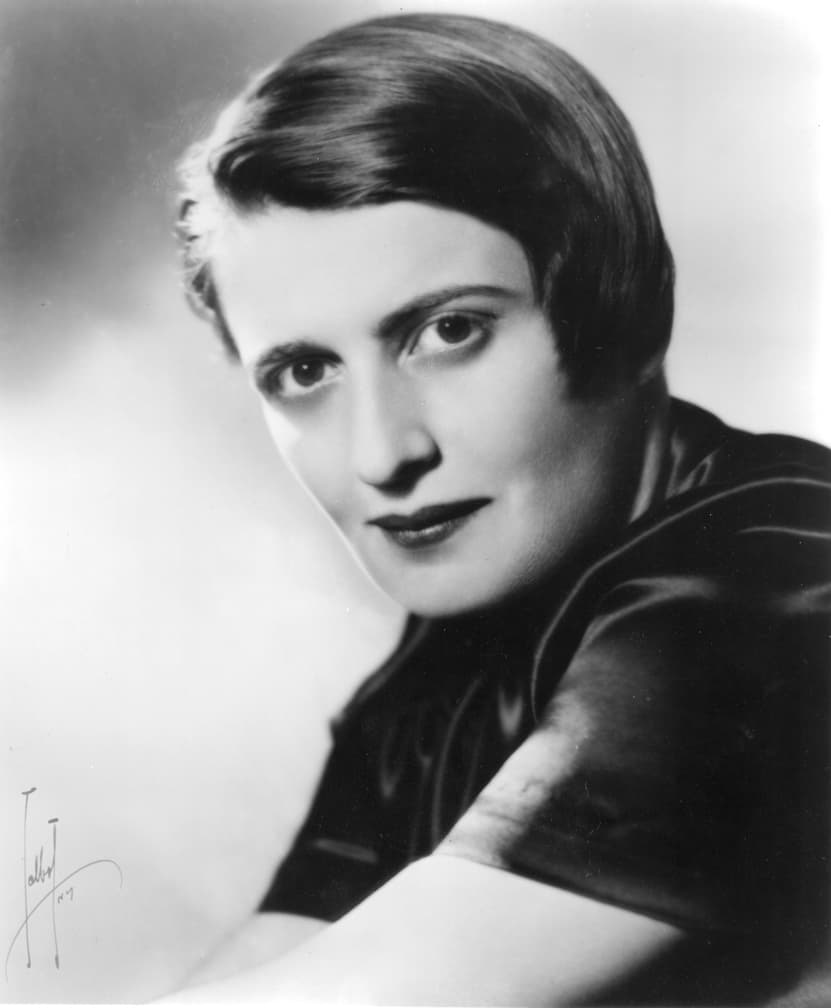
Russian, American · Literature
Ayn Rand
February 2, 1905 – March 6, 1982
Early Life and Background
Ayn Rand was born Alisa Zinovyevna Rosenbaum on February 2, 1905, in Saint Petersburg, Russia, the eldest of three daughters born to Zinovy Zakharovich Rosenbaum, a successful pharmacist and businessman, and his wife Anna. The Rosenbaums were a middle-class Jewish family, and young Alisa grew up amid the intellectual ferment and political instability of late Imperial Russia. She taught herself to read at age six and, by her own account, decided at age nine that she wanted to become a professional fiction writer.
Her childhood was upended by the seismic political events of the era. The 1917 Bolshevik Revolution led to the confiscation of her father's pharmacy by the new communist government, an event that left a searing impression on Rand and which she would later cite as formative in her lifelong hostility to collectivism and state control of property. The family fled to Crimea for a period, where Rand completed her secondary schooling, before returning to Petrograd (as Saint Petersburg was then called), where she enrolled at Petrograd State University in 1921, studying history, philosophy, and law. She graduated in 1924, having been particularly influenced by the works of Aristotle and, in a more oppositional sense, by the collectivist and altruist doctrines she was determined to refute throughout her career. She also studied screenwriting at the State Institute for Cinematography, hoping to enter the film industry.
Emigration to the United States
In late 1925, Rand obtained a visa to visit relatives in Chicago, Illinois, ostensibly for a temporary stay, but with a private determination never to return to the Soviet Union. She departed Russia and arrived in New York City on February 19, 1926. After several months living with relatives in Chicago, she moved to Hollywood, California, adopting the pen name Ayn Rand — "Ayn" reportedly derived from a Finnish name and "Rand" possibly shortened from Rosenbaum or inspired by her Remington-Rand typewriter, though the exact etymology remains debated. She chose a pseudonym partly to shield her family still living under Soviet rule from any repercussions associated with her defection and her anti-communist writings.
In Hollywood, Rand secured work as an extra and then as a script reader for the famed director Cecil B. DeMille, working on the set of his film The King of Kings. It was there that she met the actor Frank O'Connor, whom she married on April 15, 1929. The marriage helped secure her ability to remain in the United States, and she became a permanent resident in July 1929, before being naturalized as a full U.S. citizen on March 3, 1931. Rand and O'Connor remained married for fifty years, until his death in 1979.
Early Career: Screenwriting, Fiction, and Theater
Rand's earliest professional writing success came in 1932, when she sold an original screenplay, Red Pawn, to Universal Studios (though it was never produced). She achieved her first major public success as a playwright with Night of January 16th, which opened on Broadway at the Ambassador Theatre on September 16, 1935. The play was notable for its innovative structure, in which a jury selected each night from the theater audience determined the outcome of the courtroom drama by choosing one of two possible endings. The play ran for 283 performances and provided Rand with her first taste of substantial commercial recognition.
In 1936, Rand published her first novel, We the Living, through Macmillan. Set in Soviet Russia, the semi-autobiographical novel depicted the brutal realities of life under Bolshevik rule and was the most directly autobiographical of her novels, drawing heavily on her own experiences and observations before emigrating. Two years later, in 1938, her novella Anthem, a dystopian tale about a collectivist future in which the very word "I" has been abolished, was published in England by Cassell.
The Fountainhead and Rising Fame
Rand's ambitions grew considerably with her next novel, The Fountainhead, which she began writing in the late 1930s. The novel tells the story of Howard Roark, an uncompromising and visionary architect who refuses to abandon his artistic principles despite relentless social and professional pressure to conform. The manuscript was rejected by a dozen publishers before finally being accepted by Bobbs-Merrill, largely due to the passionate advocacy of a young editor, Archibald Ogden, who staked his job on its acceptance. The contract was signed on December 10, 1941, and the novel was ultimately published on May 7, 1943, with a modest first printing of only 7,500 copies.
Despite tepid initial reviews, The Fountainhead steadily built an enthusiastic readership through word of mouth and became an enormous bestseller by the mid-1940s, eventually selling millions of copies and remaining continuously in print. The novel's celebration of individualism, integrity, and creative independence resonated deeply with postwar American audiences and established Rand as a significant literary and cultural voice. In 1949, Warner Bros. released a film adaptation of The Fountainhead starring Gary Cooper as Howard Roark, with a screenplay written by Rand herself, further extending the novel's cultural reach.
Atlas Shrugged and the Culmination of Objectivism
Following the success of The Fountainhead, Rand began work on what would become her most ambitious and influential novel. She began writing Atlas Shrugged, initially titled The Strike, on September 2, 1946. The novel took over a decade to complete, and Rand used its sprawling narrative — depicting a near-future America collapsing as its most talented and productive citizens mysteriously vanish — to fully articulate her comprehensive philosophical system, which she named Objectivism.
Objectivism holds that reality exists independent of consciousness, that reason is man's only means of knowledge, that rational self-interest is the proper guide to ethical action, and that laissez-faire capitalism is the only social system consistent with individual rights. The novel's hero, the inventor John Galt, delivers a marathon radio address near the book's climax that serves as an extended manifesto of these ideas.
Atlas Shrugged was published by Random House on October 10, 1957. Though initial critical reception was famously scathing — with reviewers across the political spectrum condemning its length and didacticism — the novel became a massive commercial success, eventually selling more than seven million copies and continuing to sell hundreds of thousands annually decades after publication. It remains one of the most influential novels in American political and economic thought, frequently cited by business leaders, economists, and politicians, and has periodically surged in popularity during periods of economic uncertainty or debates over the role of government.
Later Life, Objectivist Movement, and Nonfiction
Atlas Shrugged marked the end of Rand's fiction-writing career. In the years that followed, she devoted herself to developing and promoting Objectivism through nonfiction essays and public lectures. She founded The Objectivist Newsletter in 1962 (later renamed The Objectivist), and subsequently published The Ayn Rand Letter. Working closely with the young psychologist Nathaniel Branden, with whom she also carried on a controversial personal affair known to both of their spouses, Rand helped establish an organized intellectual movement around her philosophy, centered for a time around the Nathaniel Branden Institute.
The relationship with Branden ended acrimoniously in 1968, resulting in a public and bitter split that fractured the early Objectivist movement. Rand continued writing and lecturing throughout the 1970s, publishing works such as The Virtue of Selfishness (1964), Capitalism: The Unknown Ideal (1966), and Introduction to Objectivist Epistemology (1979), addressing ethics, politics, economics, and epistemology from her distinctive philosophical perspective.
Personal Life
Rand's marriage to Frank O'Connor, a former actor who later pursued painting, lasted from 1929 until his death in 1979 — fifty years. The couple had no children. Rand's affair with Nathaniel Branden, conducted with the knowledge (if not full comfort) of both spouses, was a significant and troubled aspect of her personal life during the 1950s and 1960s, and its dissolution had lasting effects on both her personal circle and the broader Objectivist movement.
Death and Legacy
Ayn Rand died of heart failure at her home in New York City on March 6, 1982, at age 77. She was buried at Kensico Cemetery in Valhalla, New York, beside her husband. At her funeral, admirers placed a six-foot floral arrangement in the shape of a dollar sign near her casket, a striking and often-recounted tribute to her lifelong celebration of free enterprise and productive achievement.
Rand's influence has proven remarkably durable and far-reaching. The Ayn Rand Institute, founded in 1985, continues to promote her works and philosophy. Her novels continue to sell in the millions of copies annually, and she remains a touchstone figure in American libertarian, conservative, and business circles, cited by numerous public officials, entrepreneurs, and economists as a formative influence. At the same time, her uncompromising rejection of altruism and her full-throated advocacy for laissez-faire capitalism have made her one of the most controversial literary and philosophical figures of the twentieth century, generating enduring debate among critics, philosophers, and political commentators.
Whatever one's assessment of her ideas, Ayn Rand's journey from a confiscated pharmacy in revolutionary Russia to becoming one of America's best-selling novelists and most cited philosophers of individualism stands as a singular story in twentieth-century intellectual and literary history.
Dated achievements
10 indexed.
- Feb021905Literature
Birth in Saint Petersburg, Russia
Born Alisa Zinovyevna Rosenbaum in Saint Petersburg, Russia, to a Jewish middle-class family.
View details Ayn Rand - Wikipedia - Feb191926Literature
Arrival in the United States
Arrived in New York City by ship from Russia, intending to become a screenwriter, before moving on to Chicago and then Hollywood.