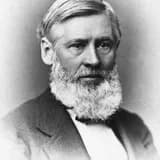
Gray began corresponding with Charles Darwin in 1855, starting a major transatlantic scientific partnership that shaped the American reception of evolution.
In 1855, Asa Gray began corresponding with Charles Darwin, opening one of the most important scientific letter exchanges of the nineteenth century. The exact day and month of the first letter are not preserved in the consulted sources, but the year is certain. Gray had already met Darwin briefly in England years earlier, yet the 1855 correspondence created a sustained intellectual relationship that lasted for the rest of Darwin’s life.
This exchange mattered because Gray became one of Darwin’s most perceptive and supportive American interlocutors. He was not simply a passive recipient of ideas: he commented on evidence, asked questions, and helped interpret natural selection for an American audience. In a period when evolutionary theory was deeply controversial, especially in religiously inflected scientific culture, Gray’s willingness to engage Darwin seriously gave the theory crucial legitimacy in the United States.
The correspondence also had lasting impact on botanical science. Gray’s own studies of plant distribution, classification, and variation informed his reading of evolution, and Darwin in turn benefited from Gray’s observations and expertise. Their letters became a model of transatlantic scientific exchange, demonstrating how American natural history could participate in the central debates of modern biology despite the relative youth of U.S. institutions.