← All women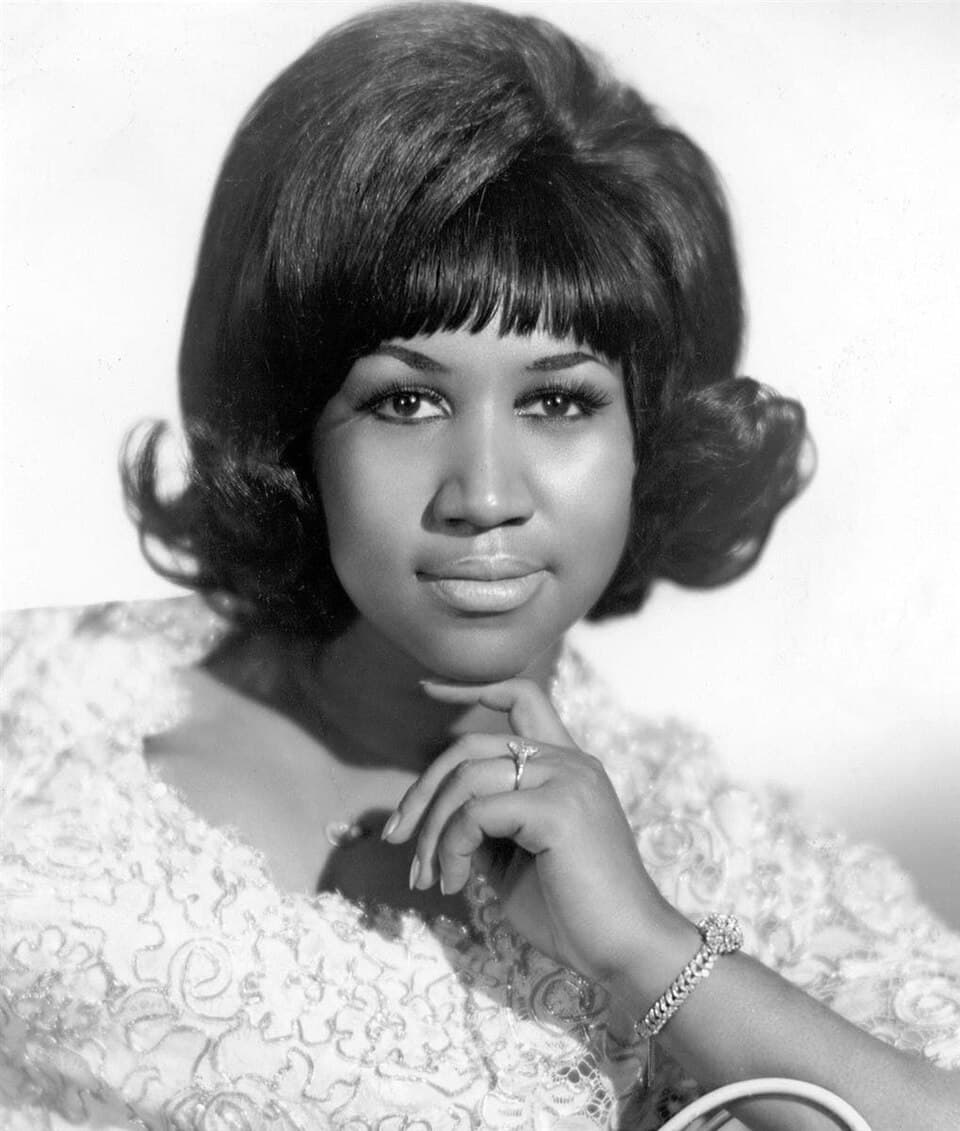
American · Arts
Aretha Franklin
March 25, 1942 – August 16, 2018
Early Life and Background
Aretha Louise Franklin was born on March 25, 1942, in Memphis, Tennessee, the fourth of five children of Baptist minister Clarence LaVaughn (C.L.) Franklin and gospel singer Barbara Siggers Franklin.[1][3] Her father was a charismatic preacher known for his "million‑dollar voice," and her mother was an accomplished vocalist, giving Aretha a deeply musical and religious home environment.[2][8] When Aretha was young, the family relocated first to Buffalo, New York, and then settled in Detroit, Michigan, where C.L. Franklin became pastor of New Bethel Baptist Church, an important center of Black spiritual and civic life.[1][3]
Aretha grew up surrounded by prominent figures in gospel and civil rights. New Bethel hosted and attracted artists such as Mahalia Jackson and Clara Ward, as well as leaders including Martin Luther King Jr., exposing her early to the connections between religious practice, music, and political struggle.[3][19] Her mother left the family home around 1948, and Aretha experienced her death in 1952, events biographers note as deeply affecting her.[3] Largely self‑taught on piano, she began playing and singing in church as a child, quickly gaining local attention for her remarkable vocal range, emotional intensity, and ability to interpret spirituals.
By her early teens, Franklin was touring with her father’s traveling revival show, performing gospel across the United States.[2][19] This experience honed her stagecraft and exposed her to different regional styles of Black worship and music. Her formal schooling was intermittent due to touring and family responsibilities; her education came primarily through church, the road, and listening closely to recordings and live performances.[2][3]
Personal Life and Early Responsibilities
Franklin’s adolescence was marked by both artistic development and early family responsibilities. She became a mother at age 12 with the birth of her first son, Clarence, in 1955, and had a second son, Edward, in her mid‑teens.[2][3] Biographical accounts emphasize that she relied on her grandmother and sister Carolyn to help care for her children while she pursued singing, illustrating the communal networks that often support Black women’s careers.[3]
In 1961, Franklin married Ted White, who became her manager during her early secular recording years.[1][2] The relationship has been described by biographers as troubled, with reports of domestic violence; they separated in the late 1960s and divorced in 1969.[1][3] She later entered a long‑term partnership with Ken Cunningham, with whom she had her third son, Teddy, in 1969, and had her fourth son, Kecalf, with road manager Ken "Kef" Cunningham
Career Beginnings: Gospel Recordings and Columbia Years
Franklin’s professional recording career began in the mid‑1950s. In 1956, at age 14, she recorded a live gospel session at New Bethel Baptist Church, released locally on the J.V.B. label as Spirituals, later reissued as Songs of Faith.[7][19] The album and the single "Never Grow Old" backed with "You Grow Closer" marked her debut as a recording artist and documented her as a leading voice in mid‑century gospel.[1][7] She continued to record gospel singles, including "Precious Lord (Part One)/(Part Two)" in 1959, expanding her presence in the sacred music market.[1][3]
Seeking broader opportunities, Franklin decided in her late teens to pursue secular music. She moved to New York and, in 1960, signed with Columbia Records.[2][19] That same year, she released her first secular album, Aretha: With The Ray Bryant Combo, which presented her as a jazz and pop vocalist backed by a small combo.[1][3] Columbia’s producers steered her toward standards, show tunes, and pop ballads, emphasizing a polished, crossover sound. Though she achieved modest success with songs like "Today I Sing the Blues" and a hit with "Rock‑a‑Bye Your Baby with a Dixie Melody," she did not yet find the definitive artistic identity that would later define her career.[1][3]
Franklin’s Columbia years (1960–1966) nonetheless provided crucial training. She learned studio techniques, fronted bands in New York clubs, and appeared on television, gaining professional visibility. DownBeat magazine named her "new‑star female vocalist" in 1961, signaling early critical recognition.[3] However, critics and Franklin herself later reflected that the material and production did not fully capture the power of her gospel‑inflected voice.
Breakthrough at Atlantic and the Emergence of the "Queen of Soul"
Franklin’s career transformed dramatically after she signed with Atlantic Records in late 1966.[1][3] Producer Jerry Wexler encouraged her to play piano and to draw directly on her gospel roots. Recording with musicians in Muscle Shoals, Alabama, and Atlantic’s New York studios, she cut a series of singles that redefined soul music.
Her first Atlantic single, "I Never Loved a Man (The Way I Love You)," recorded in early 1967, became her first million‑selling record and R&B chart‑topper.[3][18] It announced a new sound: Franklin’s voice soaring over a deep groove, blending vulnerability with defiance. In February 1967, she recorded her version of "Respect", transforming Otis Redding’s song into a demand for dignity and autonomy.[1] Released later that year, "Respect" reached No. 1 on the Billboard Hot 100 on April 29, 1967 and No. 1 on the R&B chart.[1][3] The record quickly became an anthem for the civil rights movement and women’s liberation, with its insistent spelling of "R‑E‑S‑P‑E‑C‑T" and "sock it to me" refrain resonating far beyond the original relationship narrative.[1]
Between 1967 and the early 1970s, Franklin released a string of landmark albums and singles on Atlantic: I Never Loved a Man the Way I Love You (1967), Aretha Arrives (1967), Lady Soul (1968), and Aretha Now (1968), among others.[1][3] These records featured hits such as "Chain of Fools," "Think," "(You Make Me Feel Like) A Natural Woman," and "I Say a Little Prayer." Her work during this period earned her the informal title "Queen of Soul", popularized by radio DJ Pervis Spann and widely adopted in the media.[1][3]
Franklin’s Atlantic recordings fused the emotional intensity of gospel with R&B and pop structures, creating a template for contemporary soul singing. She won multiple Grammy Awards, including a run of consecutive awards for Best Female R&B Vocal Performance from 1968 to 1975.[1][3] Her success also reflected broader shifts: the rising visibility of Black music in mainstream culture and the increasing recognition of women as central creative forces in popular music.
Civil Rights Engagement and Activism
Beyond her records, Franklin was deeply connected to the civil rights movement. Her father C.L. Franklin was a prominent activist who hosted and spoke at rallies; Aretha herself performed at events and benefits for leaders including Martin Luther King Jr.[3][19] She used her financial resources to support organizing efforts and, according to accounts, offered to help post bail for activists such as Angela Davis.[3]
Songs like "Respect" and "Think" became de facto movement anthems, articulating demands for recognition and autonomy in ways that resonated with both race and gender struggles.[1][3] Franklin’s public image—as a Black woman insisting on respect, bringing church‑trained strength to secular spaces—embodied the intersections of Black freedom movements and women’s liberation. While she did not always foreground activism in interviews, her musical choices and alliances positioned her as a symbolic figure in the fight for justice.
Gospel Homecoming: Amazing Grace
In January 1972, Franklin recorded a live gospel concert at New Temple Missionary Baptist Church in Los Angeles with the Southern California Community Choir under Reverend James Cleveland.[1][3] The resulting album, Amazing Grace, was released on June 1, 1972 and quickly became one of the best‑selling gospel albums of all time.[1]
Amazing Grace is widely regarded as a masterpiece, capturing the full power of Franklin’s voice in a sacred setting at the height of her secular fame. The recording preserves the call‑and‑response dynamics, spontaneous shouts, and emotional depth of Black worship, while also functioning as a commercial release that reached a wide audience.[3] Critics have described it as a cultural document of African American religious life and a testament to Franklin’s ongoing spiritual commitments.
Later 1970s and 1980s: Film, New Sounds, and Comeback
Franklin’s career navigated changing musical fashions in the late 1970s and early 1980s. In 1980, she appeared in the film The Blues Brothers, playing diner owner Mrs. Murphy and performing a spirited version of "Think."[1] The film’s success introduced her music to younger viewers and reinforced her persona as an assertive, witty, and powerful presence.
After leaving Atlantic, she recorded for Arista Records, exploring contemporary R&B and pop production styles. The mid‑1980s brought a notable resurgence: her 1985 album Who’s Zoomin’ Who? became her first U.S. platinum album and spawned hits including "Freeway of Love" and the title track.[1][18] "Freeway of Love" returned her to the U.S. Top 10 in July 1985, demonstrating her ability to thrive in the MTV era and connect with new audiences.[7]
Franklin continued to collect accolades. In 1987, she became the first woman inducted into the Rock & Roll Hall of Fame, a milestone recognizing her foundational role in rock‑related music and highlighting gender disparities in the institution’s early honorees.[6][12] The induction affirmed that women’s contributions, particularly those of Black women, were crucial to the genre’s history.
Honors, Awards, and Institutional Recognition
Over the course of her career, Franklin received an extraordinary array of honors. She won 18 Grammy Awards, including a special Lifetime Achievement Award and a Legend Award.[1][12] Rolling Stone magazine twice named her the greatest singer of all time, and she was consistently ranked among the most influential artists in popular music.[1][17]
In 1994, Franklin received the Kennedy Center Honors, recognizing her lifetime contributions to American culture through the performing arts.[5][7] In 1999, President Bill Clinton awarded her the National Medal of Arts, the highest U.S. government honor for artists.[7][18] In 2005, she was presented with the Presidential Medal of Freedom by President George W. Bush, the nation’s highest civilian award.[7][1]
Franklin was inducted into numerous halls of fame, including the Rock & Roll Hall of Fame (1987) and the Memphis Music Hall of Fame (2010), recognizing both her national and regional significance.[15][18] She received a star on the Hollywood Walk of Fame and honorary degrees from major universities.[1][3] These honors collectively underscore the breadth of her impact, from local church communities to global cultural institutions.
Artistic Range and Major Works
Although Franklin is best known for soul and R&B, her repertoire was remarkably wide. She recorded jazz standards, blues, gospel, pop ballads, and even classical pieces. A famous example of her versatility occurred in 1998, when she stepped in for an ailing Luciano Pavarotti at the Grammy Awards and performed Puccini’s aria "Nessun dorma," adapting it to her range and style.[1][3] The performance was widely acclaimed and demonstrated her ability to inhabit operatic material.
Her discography includes dozens of studio and live albums. Key works from her peak Atlantic period include Lady Soul and Aretha Now, while later highlights include Jump to It (1982), Who’s Zoomin’ Who? (1985), and A Rose Is Still a Rose (1998).[1] In 2014, she released Aretha Franklin Sings the Great Diva Classics, interpreting songs by female artists such as Adele, Etta James, and Gloria Gaynor, reaffirming her place as a matriarchal figure within a lineage of women vocalists.[1][7]
Legacy and Historical Impact
Franklin’s legacy is multifaceted. Musically, she helped define the sound of 1960s soul, integrating gospel techniques—melisma, call‑and‑response, emotional intensity—into secular contexts.[3] Her approach to interpretation, in which she reshaped songs to reflect her perspective, set a standard for vocal artistry. Countless singers cite her as a primary influence, from soul and R&B artists to rock and pop performers.[1][17]
As a Black woman, Franklin’s career challenged and transformed expectations in an industry that often marginalized both women and African Americans. Her insistence on artistic control, her movement between sacred and secular realms, and her embodiment of dignity and strength made her a cultural icon for Black and feminist movements.[3] "Respect" and other songs continue to serve as shorthand for demands for equality in public discourse.
Franklin also left a legacy of civic engagement. She supported civil rights organizations, used her platform to amplify calls for justice, and lent her voice to major national occasions, including the inaugurations of Jimmy Carter in 1977 and Barack Obama in 2009.[7][1] Her performances at these events symbolized the centrality of Black culture in American civic rituals.
Later Life, Health, and Final Years
In her later years, Franklin continued to perform and record, though she reduced touring as health issues emerged. She announced in 2017 that she would limit future performances, while still planning select concerts and recording projects.[1][3] Despite declining health, she maintained a strong presence in public memory, with ongoing tributes, cover versions of her songs, and documentaries exploring her life.
On August 16, 2018, Franklin died at her home in Detroit from complications of pancreatic cancer, aged 76.[1][3][13] Her death prompted global mourning, with memorials in Detroit and tributes from presidents, artists, and community leaders. Obituaries emphasized her status as the "Queen of Soul," her 18 Grammy Awards, and her role as the first woman inducted into the Rock & Roll Hall of Fame.[1][12]
Posthumously, her work continues to be celebrated and studied. Institutions such as the Rock & Roll Hall of Fame, the Memphis Music Hall of Fame, and the National Museum of African American History and Culture have highlighted her recordings and story as central to understanding American music and social history.[18][19] Her voice—powerful, nuanced, and deeply rooted in Black church traditions—remains a benchmark for vocal excellence and a symbol of the transformative possibilities of women’s artistry.
Dated achievements
19 indexed.
- Mar251942Arts
Birth of Aretha Franklin
Aretha Louise Franklin is born in Memphis, Tennessee, to C.L. and Barbara Franklin.
View details Aretha Franklin | Biography, Music, & Facts | Britannica - Jan011956Arts
First gospel album released (Songs of Faith/Spirituals)
At age 14, Aretha releases her first gospel album, recorded live at New Bethel Baptist Church.