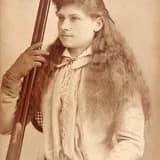
Annie Oakley appeared in an Edison Kinetoscope film demonstrating her shooting skills, among the earliest films to feature a woman performer.
On March 10, 1894, Annie Oakley appeared before Thomas Edison's cameras at the Black Maria studio in West Orange, New Jersey, to be filmed for a short Kinetoscope production simply titled "Annie Oakley." In the brief film, she performs several of her signature trick shots, including hitting small targets and glass balls tossed into the air, showcasing her skill for a new visual medium barely months old.
This appearance places Oakley among the very earliest women ever captured performing on motion picture film, at a time when cinema itself was an experimental novelty confined to penny-arcade Kinetoscope parlors rather than public theaters. Her participation reflects both her enormous contemporary fame—Edison's studio sought out celebrities and popular performers to attract paying viewers to the new technology—and the historic intersection of two era-defining phenomena: the Wild West show spectacle and the birth of American cinema.
The film is a landmark artifact in early motion picture history, frequently cited by film historians as one of the earliest surviving depictions of a female performer's skill on screen. It exemplifies how quickly new technologies sought validation through association with established celebrities, and it preserved, for future generations, direct visual evidence of Oakley's shooting technique that no written account could fully convey. The short survives today in film archives as a rare visual record of a nineteenth-century sharpshooting legend in action.