← All women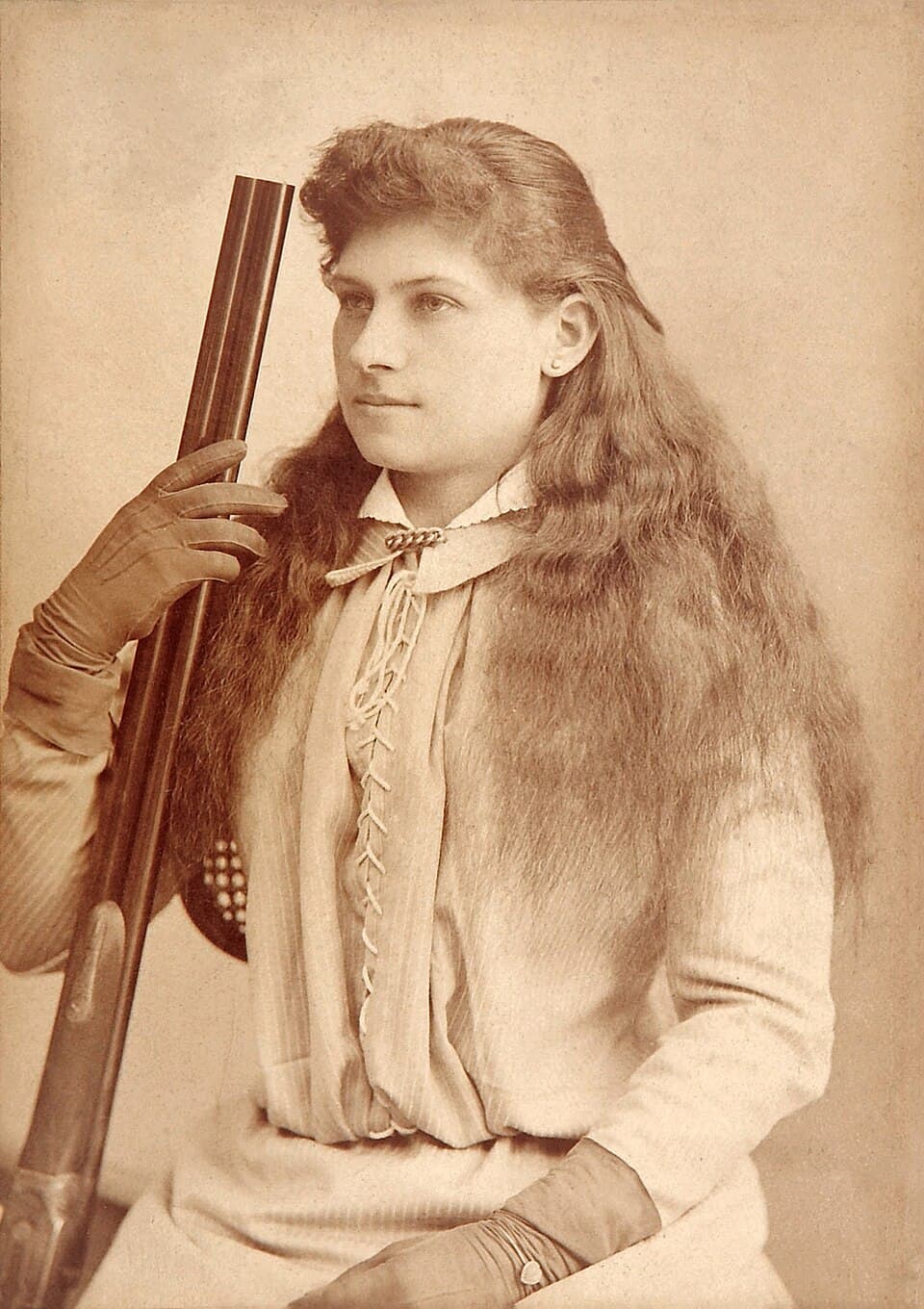
American · Sports · Arts
Annie Oakley
August 13, 1860 – November 3, 1926
Early Life and Background
Annie Oakley was born Phoebe Ann Mosey on 13 August 1860 in a log cabin in rural Darke County, Ohio, near the small communities of North Star and Willowdell. Her parents, Jacob and Susan Wise Mosey, were poor tenant farmers of German descent who struggled to support a large family in the challenging economic conditions of the post–Civil War Midwest. She was one of several children—accounts differ on the exact number—and grew up in a household frequently buffeted by illness, debt, and harsh winters.
When Oakley was still a young girl, her father died after exposure and illness contracted while traveling through winter weather, leaving the family in dire poverty. To help make ends meet, Phoebe left formal schooling early and began contributing directly to the family’s survival. Around the age of nine, she was sent to the Darke County Infirmary, effectively an orphanage and poorhouse, where she lived and worked for a period with the superintendent and his wife. In later retellings she described a subsequent placement with another farm family where she was overworked and mistreated; she later referred to them only as "the wolves."
Returning home as a young adolescent, she helped support her mother and siblings by learning to hunt and trap in the wooded areas around the farm. Using a small, often secondhand rifle, she taught herself to shoot game—rabbits, squirrels, quail—with the precision required to sell the meat to local shopkeepers, hotels, and restaurants in nearby Greenville and Cincinnati. Her accuracy became a matter not of sport but of economic necessity: every missed shot meant lost income. According to later accounts, the money she earned by selling game was substantial enough to help pay off the mortgage on her mother’s home.
These formative years forged the characteristics that would define her adult career: intense concentration, respect for firearms, physical steadiness, and a deep sense of responsibility to family. They also placed her, unusually for a girl of her generation, in a realm of work—hunting and commercial dealing—that was culturally coded as male. The combination of hardship, rural isolation, and self‑directed training created the conditions for one of the most remarkable exhibition shooters in history.
Career Beginnings and Development
By her mid‑teens, Oakley had begun to attract local notice for her marksmanship. She gave occasional shooting exhibitions in the Cincinnati area, demonstrating her ability to hit thrown objects and small targets at distance. These early performances were informal but important: they introduced her to the world of paid entertainment and gave her experience performing under observation.
A turning point came in 1875, when professional Irish‑American sharpshooter Frank E. Butler brought his traveling act to the Cincinnati region. Butler issued a challenge that no local shooter could beat him in a match. A hotelkeeper who had been buying game from Oakley recommended her as a challenger. On 1 May 1875, the two competed in a public match at a shooting range near Cincinnati. Each shot at 25 live birds released from traps; Butler hit 24, while Oakley hit all 25, winning the contest. This unexpected victory by a teenage girl over a seasoned male champion drew attention and began to build her reputation.
Oakley and Butler soon developed a personal relationship, and on 20 June 1876 they married, beginning a partnership that would last for the rest of their lives. At first, Butler continued as the headliner in their joint act, with Oakley occasionally demonstrating her skills. Over time, however, audiences increasingly responded to her precision and poise, and Butler gradually transitioned into the roles of assistant and manager. Oakley adopted the stage name "Annie Oakley" in the early 1880s—possibly derived from a Cincinnati neighborhood or railway stop—and began to be billed under that name in programs and posters.
In 1881, the couple began touring professionally together in vaudeville and variety shows across the United States, performing in theatres, small circuses, and fairs. On 1 March 1882, Oakley joined the Sells Brothers Circus as a principal shooting attraction, a significant step into large‑scale touring entertainment. With Sells Brothers and other troupes, she refined a repertoire of feats that included shooting glass balls and coins thrown into the air, snuffing candles with bullets, and splitting playing cards on edge.
Oakley’s combination of extraordinary skill and carefully cultivated modesty made her stand out. Unlike some contemporaries who adopted flamboyant or provocative personas, she appeared in simple, calf‑length skirts and tailored jackets, presented herself as devout and proper, and emphasized safety and discipline with firearms. This persona reassured audiences that a woman could occupy a traditionally masculine sphere—handling guns and riding horses—without sacrificing respectability, a key consideration in the Victorian era.
Stardom with Buffalo Bill’s Wild West
The decisive leap in Oakley’s career came when she joined William F. "Buffalo Bill" Cody’s Wild West show. On 31 March 1885, she signed on with the troupe, quickly becoming one of its star attractions. Buffalo Bill’s Wild West was not a traditional circus but a large outdoor spectacle combining staged frontier battles, rodeo‑style riding and roping, and sharpshooting demonstrations meant to evoke a mythic American West.
With the Wild West show, Oakley’s act grew in scale and theatricality. She performed such feats as shooting the flame off a candle, splitting a playing card held thin‑edge on at 30 paces, shooting over her shoulder using a hand mirror, and hitting targets while riding on horseback or moving in a horse‑drawn wagon. She was often introduced under her later‑famous nickname "Little Sure Shot", reportedly bestowed on her by Lakota leader Sitting Bull, who observed her skill and admired her steady composure.
In 1886 and 1887, as the show’s fame grew, Oakley’s stage name became firmly established in publicity materials. That same year, Buffalo Bill took his production to Europe. In 1887, the show set up at Earl’s Court in London as part of festivities surrounding Queen Victoria’s Golden Jubilee. On 20 June 1887, Oakley performed for the Queen and assembled dignitaries, astonishing audiences with her ability to hit minute targets at great speed. She later toured other British and European cities with the show.
During this European tour, Oakley executed one of her most famous feats: in 1887, she reportedly shot the ashes from a cigarette held in the mouth of Crown Prince Wilhelm of Germany, the future Kaiser Wilhelm II, during a demonstration in England. A commonly cited approximate date for this performance is 1 August 1887. Whether or not every detail of later retellings is precise, the episode symbolized the trust placed in her abilities and her status as an international celebrity.
In 1889, Buffalo Bill’s Wild West appeared at the Exposition Universelle in Paris. Beginning around 1 May 1889, Oakley performed before large European crowds attracted to the world’s fair. Her combination of refined feminine presentation and lethal accuracy made a strong impression on European observers, many of whom were fascinated by the idea of a woman who epitomized both gentility and frontier toughness.
The show continued to tour Europe into the early 1890s. On 10 September 1890, in Berlin, Oakley gave a celebrated exhibition in which she reportedly shot at least 100,000 glass balls tossed into the air without a miss, over the course of a series of demonstrations. While the exact figure likely reflects promotional hyperbole, the event underscored her reputation for unfailing precision and endurance.
Major Works, Performances, and Media Innovations
Beyond live exhibitions, Oakley was an early participant in new forms of mass media. On 10 March 1894, she appeared in one of Thomas Edison’s earliest motion pictures, the Kinetoscope short titled Annie Oakley. Filmed at Edison’s Black Maria studio in West Orange, New Jersey, the brief film showed her performing rapid‑fire shooting tricks. This appearance makes her one of the earliest women ever captured performing in a motion picture, placing her at the intersection of frontier showmanship and emerging cinema.
Oakley’s act itself functioned as a kind of "work" in the cultural sense: she helped shape enduring visual and narrative tropes of the American West. Posters and photographs showed her in fringed costumes or tailored jackets and skirts, cradling rifles or shotguns with confident familiarity. Her small stature—reported as under five feet tall—contrasted sharply with the power of the weapons she commanded, creating a memorable theatrical image that inspired later fictional characters and stage works.
In 1893, Buffalo Bill’s Wild West set up just outside the World’s Columbian Exposition in Chicago, one of the era’s most important world’s fairs. Oakley performed daily, appealing to visitors from across the United States and abroad. Her presence at major expositions in Paris and Chicago linked her image with narratives of modern progress and American national identity at a moment when women’s public roles were slowly expanding.
Oakley was also a competitive and exhibition shooter beyond the Wild West context. Over the years she accumulated numerous medals and trophies in shooting contests, though detailed records of specific competitions and dates are fragmentary. Her performances frequently demonstrated not only trick shots but also sustained, competition‑style accuracy, reinforcing her credibility among serious sportsmen as well as entertainment audiences.
Accident, Legal Battles, and Later Stage Work
On 29 June 1901, while traveling with Buffalo Bill’s Wild West near Lexington, North Carolina, Oakley was involved in a serious train wreck that caused significant back and spinal injuries. The crash forced her to leave the show that had made her famous, ending a major chapter of her career. In an era when medical treatment for such injuries was limited, her recovery required extended rest and rehabilitation.
Despite these setbacks, Oakley was determined to continue her profession. On 1 November 1901, after a period of recuperation, she joined The Young Buffalo Show, a rival production, resuming her work as a star sharpshooter. She adapted her routines as necessary but demonstrated that her fundamental accuracy remained intact.
In 1902, Oakley’s reputation came under attack when newspapers owned by publisher William Randolph Hearst and others published fabricated stories claiming that she had been arrested for theft to support a cocaine habit. In reality, the woman arrested had used Oakley’s name, and Oakley had no involvement. Outraged, she embarked on a long series of libel suits against more than 50 newspapers. Over several years she reportedly won the majority of these cases, securing monetary damages but spending much of the recovered funds on legal costs. The litigation was significant as an early example of a famous woman aggressively defending her reputation against sensationalist media.
In 1903, Oakley returned to the theatrical stage in "The Western Girl" and other dramatized versions of her life, blending narrative drama with her live shooting routines. These productions helped keep her in the public eye and broadened her image beyond the strictly Wild West format. They also reflected the increasing crossover between variety performance, melodrama, and the burgeoning film industry in the early 20th century.
Teaching, Advocacy, and World War I
As she grew older, Oakley devoted increasing attention to teaching marksmanship, particularly to women and children. She believed strongly that women should know how to handle firearms safely, both for sport and for self‑defense. Over the course of her life she is estimated to have trained thousands of students, emphasizing careful handling, proper stance, and respect for the weapon. Her instruction helped normalize the idea that shooting could be an appropriate activity for women, not only in rural hunting contexts but also as a modern sport.
During World War I, Oakley sought to contribute her expertise to the war effort. She volunteered her services to the U.S. government and reportedly trained many servicemen in shooting skills at military camps and other venues, though detailed records of each session are sparse. On 1 September 1917, she publicly offered to raise and train a regiment of women sharpshooters for combat service, writing to officials to make her proposal known. The government declined, and women were not officially accepted into combat roles, but her offer was widely noted.
Oakley’s advocacy in this period reveals her conviction that women could serve effectively as defenders of the nation and that marksmanship was a legitimate form of female empowerment. Her position intersected with contemporary suffrage campaigns: although she was not a leading suffrage organizer, she expressed support for women’s rights and autonomy, including financial independence and vocational training.
Awards, Honors, and Records
Throughout her career, Oakley received numerous medals, trophies, and accolades from shooting clubs, expositions, and civic groups. Contemporary accounts describe her winning medals in both informal and organized competitions, though detailed documentation of specific events is uneven. Her true distinction lay in the consistency of her exhibition performances and her ability to outshoot many of the era’s best male marksmen.
One of her most notable late‑career achievements occurred on 5 March 1922, when she hit 100 clay targets in succession at a trapshooting exhibition, thereby breaking existing women’s trapshooting records. This feat, accomplished when she was in her early sixties, was widely reported as a record for women and underscored her enduring mastery of the sport. It served both as a personal triumph and as a public demonstration that older women could still perform at elite athletic levels.
Long after her death, Oakley continued to receive institutional recognition. She was posthumously honored in various halls of fame and commemorated on U.S. postage stamps. Museums, including the Buffalo Bill Center of the West in Cody, Wyoming, and regional institutions in Ohio, have devoted exhibits to her life and artifacts, such as custom‑made firearms and performance costumes. In 2012, she was inducted into the New Jersey Hall of Fame in recognition of her years living and performing from that state.
Personal Life and Character
Oakley’s personal life was closely intertwined with her career. Her marriage to Frank Butler was by most accounts affectionate and collaborative. Butler took primary responsibility for business arrangements, bookings, and logistics, allowing Oakley to focus on performance and practice. The couple had no children, a circumstance that may have been influenced by their constant travel and the demands of show life.
Despite her onstage association with firearms and frontier imagery, Oakley cultivated a reputation for modesty, religious faith, and philanthropy. She preferred practical but decorous costumes, avoided coarse language, and discouraged sensationalism about violence in her act. She donated money and goods to orphanages and charities and is known to have quietly supported poor children and young women seeking education or vocational training.
Contemporaries often remarked on the contrast between Oakley’s small physical stature—she stood under five feet tall—and her steady, commanding presence on stage. In private, she enjoyed domestic pursuits such as sewing and cooking and cherished periods of quiet life in rural homes between tours. Her combination of domesticity and professional daring made her an appealing figure for a wide public, especially women who saw in her a model of independence that did not reject prevailing feminine ideals.
Later Life and Final Years
After the turn of the 20th century, Oakley gradually reduced the intensity of her touring schedule, though she never fully retired from shooting. In 1913, she and Butler settled for a time in Cambridge, Maryland, from where she continued to travel for exhibitions, charity performances, and teaching engagements. She remained active in marksmanship well into her sixties, appearing at events and giving demonstrations that drew substantial crowds.
By the early 1920s, Oakley’s health had begun to decline, but she continued to practice and to break records. The 1922 trapshooting achievement of 100 straight targets showed that her technical skills remained sharp despite age‑related challenges. She also continued to write about shooting and to advise younger performers and competitors.
In her final years, Oakley returned to her native Ohio. She died on 3 November 1926 in Greenville, Ohio, at the age of 66, with the cause of death reported as pernicious anemia, a blood disorder involving vitamin B12 deficiency. She was buried in Brock Cemetery near Greenville. Her husband Frank Butler died just 18 days later, and he was buried beside her, reinforcing the image of their enduring partnership.
Legacy and Historical Impact
Annie Oakley’s legacy operates on multiple levels: as a pioneering woman in sport and entertainment, as a cultural icon of the American West, and as an early advocate of women’s marksmanship and self‑reliance.
In the sphere of women’s sports, Oakley demonstrated that a woman could not only participate in but dominate a highly technical, physically demanding skill traditionally reserved for men. She did so while maintaining a persona that was deliberately modest and feminine, thereby expanding the boundaries of acceptable female behavior for mainstream audiences. Her public success made it easier for later generations of women to engage in shooting sports, archery, and other precision disciplines.
As a popular culture figure, she became one of the earliest female "superstars" of mass entertainment, with her name and image recognized across the Atlantic world. She influenced fictional representations of women in Westerns and adventure stories and was later memorialized in the mid‑20th‑century Broadway musical Annie Get Your Gun and its film adaptation, which, although highly fictionalized, cemented her place in the cultural imagination.
In terms of gender norms, Oakley’s life offered a model of female independence grounded in skill, professionalism, and economic contribution to family. She earned substantial income, managed aspects of her career, and made choices about where and how to live—all at a time when many women’s financial lives were controlled by male relatives. Her advocacy for women learning to shoot intersected with wider movements for women’s rights, suggesting that competence and confidence in traditionally male areas could complement demands for legal and political equality.
Finally, in the context of media and technology history, Oakley’s appearance in an 1894 Edison film places her at the dawn of cinema, while her widely circulated photographs and posters contributed to early celebrity culture. She helped shape enduring visual archetypes of the "Western woman"—self‑possessed, armed, and capable—that continue to influence representations of women in film, television, and literature.
Today, museums, historians, and local communities in Ohio and elsewhere continue to study and commemorate Annie Oakley’s life. Exhibitions of her guns, costumes, and personal effects, along with scholarly biographies and documentaries, emphasize both her extraordinary technical achievements and her broader importance in the history of women’s participation in sport, public performance, and national myth‑making.
Dated achievements
15 indexed.
- Aug131860Science
Birth of Annie Oakley
Phoebe Ann Mosey, later famed as Annie Oakley, was born in a log cabin in Darke County, Ohio.
View details Wikipedia: Annie Oakley - May011875Science
Defeats sharpshooter Frank Butler in shooting match
At about age 15, Annie Oakley defeated champion marksman Frank Butler in a Cincinnati-area shooting match, hitting 25 for 25.