← All women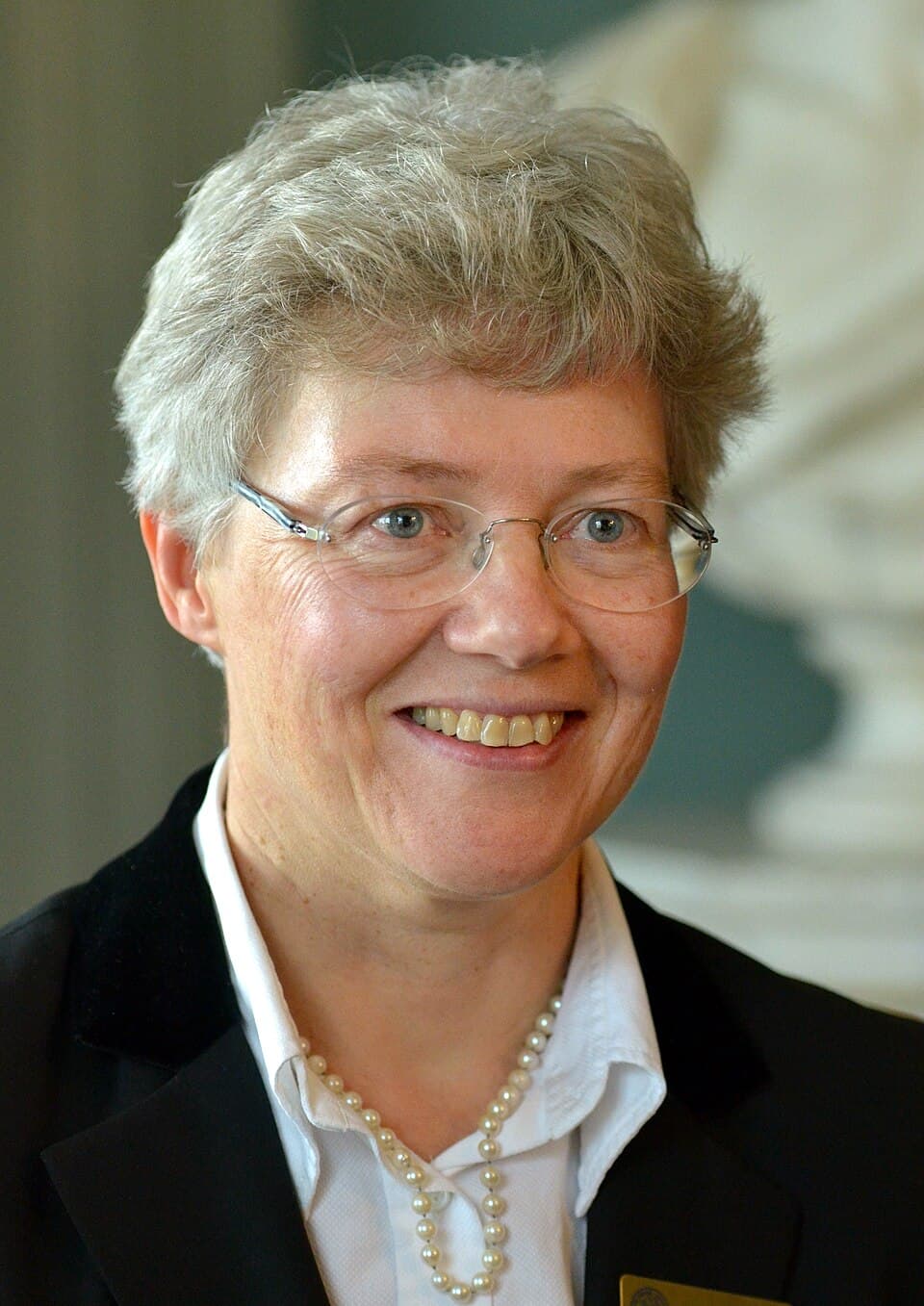
French · Science
Anne L’Huillier
August 16, 1958 – present
Early Life and Background
Anne Geneviève L’Huillier was born on 16 August 1958 in Paris, France.[1][2] She grew up in a country with a strong tradition in mathematics and physics, but at a time when women were still significantly underrepresented in these fields. Paris, home to leading institutions such as the Sorbonne and École Normale Supérieure, provided a rich intellectual environment that helped shape her interest in science. Biographical notes emphasize her French origins and later dual identification as both French and Swedish, reflecting the international trajectory of her career.[2][6]
L’Huillier’s early education is described in institutional biographies as solidly grounded in physics and mathematics, although detailed accounts of her family background and schooling are less frequently documented in public sources.[9] She pursued higher education in physics in France, eventually specializing in atomic physics and laser–matter interactions. This choice of specialization positioned her at the intersection of quantum theory, optics, and rapidly advancing laser technology, fields that were undergoing major transformations in the late twentieth century.
Academic Formation and Career Beginnings
After completing her university studies in France, L’Huillier undertook research in atomic and optical physics. She became associated with French research centers such as the Saclay Nuclear Research Centre, where she contributed to early experiments in intense laser–gas interactions and high-order harmonic generation.[9][14] In the late 1980s she participated in experiments using solid-state picosecond laser systems to generate harmonics in gases, work that would prove foundational for the emerging field of attosecond physics.
Biographical profiles from the Nobel Foundation and other institutions highlight that in 1987, L’Huillier discovered that transmitting infrared laser light through a noble gas produces many different overtones or high-order harmonics of light.[2][9] This phenomenon—where the gas irradiated by an intense laser emits light at multiples of the original frequency—was initially surprising and required both theoretical explanation and experimental refinement. L’Huillier continued to investigate this effect, gradually building an understanding of how strong fields drive electrons in atoms and how this motion can lead to coherent emission of high-frequency light.
Her work during this period placed her at the forefront of strong-field laser physics. Through collaborations and systematic experiments, she contributed to the realization that phase-locked harmonics could be harnessed to produce extremely short light pulses. In the early 1990s, she was among the key figures demonstrating that such harmonics could be combined to generate pulses in the attosecond domain.[9][14] These insights established a conceptual and technical pathway from high-order harmonics to attosecond pulse generation.
Move to Lund and Development of an Attosecond Research Group
In the 1990s, L’Huillier’s career took a decisive international turn when she began working with high-power femtosecond laser systems in Sweden. Around 1992, she conducted research at the Lund High-Power Laser Facility, which hosted one of Europe’s first high-power femtosecond titanium–sapphire laser systems.[14] This facility enabled experiments that linked femtosecond laser technology with the high-order harmonic generation she had studied earlier, creating conditions suitable for producing ever-shorter light pulses.
L’Huillier formally joined Lund University in 1995, becoming a professor of atomic physics and building what would become one of the world’s leading research groups in attosecond science.[14][8] As a faculty member in the Faculty of Engineering (LTH), she supervised doctoral students, led experimental programs, and helped develop the university’s laser infrastructure. Over time she acquired Swedish nationality, and contemporary profiles often describe her as Franco–Swedish.[5][6]
At Lund, L’Huillier’s team focused on strong-field physics, high-order harmonic generation, and the creation and characterization of attosecond light pulses. She played a central role in training a generation of researchers in the experimental and theoretical tools needed to probe electron dynamics on unprecedented time scales. Her group’s work contributed significantly to the consolidation of attosecond science as a distinct and respected subfield of physics.
Major Scientific Contributions
L’Huillier’s most celebrated scientific contributions lie in the realm of high-order harmonic generation and attosecond pulse production. Her 1987 discovery that an intense infrared laser driving a noble gas produces many harmonics of the fundamental frequency laid the groundwork for later attosecond technology.[2] Subsequent work established the physical mechanism: electrons are ionized by the strong laser field, accelerated, and then driven back to recombine with their parent ions, emitting high-energy photons at harmonic frequencies. This three-step model became a cornerstone of strong-field physics.
In the early 1990s, L’Huillier and colleagues showed that these harmonics could be phase-locked, meaning that multiple frequencies could be combined coherently to form ultrashort pulses.[14] This insight transformed harmonic generation from a curiosity into a practical route to attosecond time resolution. By optimizing laser parameters, gas targets, and phase-matching conditions, she helped push the attainable pulse duration ever shorter.
A major milestone came in 2003, when her group generated one of the shortest light pulses recorded at that time, on the order of 170 attoseconds, using high-order harmonics.[14] This achievement effectively turned attosecond physics from a theoretical possibility into a demonstrable reality, enabling experiments that could resolve electron motion in atoms and molecules. Such attosecond "camera flashes" opened the way to time-resolved studies of photoionization, charge migration, and other ultrafast electronic processes.
Beyond pulse generation, L’Huillier’s research encompassed strong-field phenomena such as non-sequential double ionization and the detailed characterization of electron dynamics under intense laser fields. A commemorative address given in Jena in 2015 highlighted her contributions to high-harmonic generation, non-sequential double ionization, and attosecond pulses, underscoring her leadership in strong-field and attosecond physics.[14]
Awards, Honors, and Recognition
Over the course of her career, Anne L’Huillier has received numerous prestigious awards. Her early and mid-career distinctions include the Prix Aimé-Cotton, the Göran Gustafsson Prize in Physics, and the Carl Zeiss Research Award, as listed in the French-language and other Wikipedia entries.[5][12] She has been recognized with honors such as the Max Born Prize, the Julius Springer Prize, the Blaise Pascal Medal, and membership or fellowship in major scientific societies (including the American Physical Society and the Optical Society).[5]
A key milestone in international recognition came when she received the L’Oréal–UNESCO For Women in Science Award (European Laureate) in 2011. UNESCO and L’Oréal highlighted her development of ultra-fast "cameras" capable of recording events in attoseconds, emphasizing both the scientific breakthrough and her status as a woman leading a cutting-edge field.[3] The award drew attention to the importance of supporting women scientists and represented a significant step in her public profile.
L’Huillier later received the BBVA Foundation Frontiers of Knowledge Award for fundamental contributions to physics, as well as multiple honorary doctorates from universities such as Pierre and Marie Curie (Paris), Friedrich Schiller University Jena, and Paris-Saclay.[5] She also received French national honors, being appointed to ranks in the Légion d’honneur, and Swedish distinctions including the Order of the Polar Star, reflecting her dual national impact.[5]
In 2022, she was co-awarded the Wolf Prize in Physics, one of the most prestigious international science awards after the Nobel Prize.[12] The Wolf Foundation recognized her pioneering contributions to attosecond science and strong-field physics, affirming her central role in advancing understanding of laser–matter interactions.
The pinnacle of her recognition came with the Nobel Prize in Physics 2023. On 3 October 2023, the Royal Swedish Academy of Sciences announced that the prize would be awarded jointly to Pierre Agostini, Ferenc Krausz, and Anne L’Huillier "for experimental methods that generate attosecond pulses of light for the study of electron dynamics in matter."[2][8] She was affiliated with Lund University at the time of the award.[2] This prize made her the fifth woman ever to receive the Nobel Prize in Physics and the first Nobel laureate based at Lund University.[1][8]
Nobel Prize and Global Profile
The Nobel Prize dramatically expanded L’Huillier’s global profile. Media outlets and institutional communications emphasized that she was only the fifth woman physics laureate, following Marie Curie, Maria Goeppert Mayer, Donna Strickland, and Andrea Ghez.[1][7][8] Articles and interviews noted that she thus became a symbol of both progress and ongoing underrepresentation of women in physics.
The Nobel Foundation’s biographical note describes her work as essential to creating new tools for studying electron dynamics, crediting her discoveries from the 1980s onward with laying the groundwork for attosecond science.[2][9] At the award ceremony on 10 December 2023 in Stockholm, she received the Nobel medal and diploma from the King of Sweden, a moment widely photographed and reported.[2]
Following the announcement, institutions such as Lund University highlighted that she was the university’s first Nobel laureate, underscoring the significance of her achievements for Swedish science and for the university’s international reputation.[8][4] Her Nobel lecture and subsequent public talks elaborated on the multi-decade trajectory from high-order harmonic experiments to attosecond pulse generation.
Public Engagement and Role Model for Women in Science
After 2023, L’Huillier increasingly engaged in public outreach and discussions about science and gender. She featured in profiles and interviews that explored her career path and the challenges of being a woman in a historically male-dominated discipline.[10][13] In a Nobel Prize podcast, she spoke about her new role as a role model, about "doubling" her prize by winning it for both France and Sweden, and about learning Swedish well enough to teach advanced physics.[10]
On 11 February 2024, the International Day of Women and Girls in Science, she participated in a live interview and podcast organized by Nobel Prize media.[10][13] The event framed her story explicitly as an example meant to inspire girls and young women considering careers in science. She discussed attosecond physics in accessible terms, connecting frontier research with everyday curiosity and reinforcing the message that women can lead at the highest levels of physics.
L’Huillier has also been profiled by organizations such as AWIS (the Association for Women in Science), which emphasizes her pioneering role and the importance of visibility for women physicists.[8] These public engagements complement her scientific work by contributing to broader efforts to increase gender diversity in STEM fields.
Personal Life
Biographical sources note that Anne L’Huillier holds both French and Swedish nationality, reflecting her long residence and professional life in Sweden.[5][6] She has built her career at Lund University, where she is a professor of atomic physics, and has integrated into Swedish academic and cultural life to the point of teaching advanced physics courses in Swedish.[10] Specific details about her family life, marriage, or children are not extensively documented in publicly available institutional profiles, which tend to focus on her scientific contributions.
In interviews, L’Huillier occasionally mentions life-work balance and the importance of supportive environments but generally keeps personal aspects private, in line with many contemporary scientific biographies that emphasize professional achievements. Her personal story that is most highlighted is the transnational dimension of her career: a French-born physicist who became a leading figure in Swedish science while maintaining strong ties to the French scientific community.
Legacy and Historical Impact
Anne L’Huillier’s legacy is closely tied to the emergence and consolidation of attosecond science. Her pioneering work transformed high-order harmonic generation from a puzzling effect into a powerful tool for generating ultrashort light pulses. By helping to create attosecond "camera flashes" that can track electron motion in real time, she enabled direct experimental access to processes that were previously only described theoretically.[2][8]
This capability has far-reaching implications. Attosecond techniques can be used to study photoionization dynamics, charge transfer in molecules, ultrafast processes in solids, and potentially to guide the design of faster electronic and photonic technologies. L’Huillier’s contributions thus intersect with fundamental physics, chemistry, and materials science, and may shape future technological advances.
From the perspective of women’s history, L’Huillier holds a distinctive place as the fifth woman Nobel laureate in Physics and the second French woman after Marie Curie to receive the prize in this discipline.[1][5] Her career demonstrates how a woman can build and lead a world-class research group in a highly technical field, obtain major international awards, and influence global scientific directions. Her recognition by programs such as L’Oréal–UNESCO For Women in Science, and by high-level prizes like the Wolf Prize and the Nobel Prize, contributes to changing perceptions about who can be a physicist at the highest level.
Institutionally, she has elevated Lund University’s profile by becoming its first Nobel laureate in physics, strengthening Sweden’s position in ultrafast laser research and atomic physics.[4][8] Internationally, she is regarded as one of the central figures in strong-field and attosecond physics, alongside her co-laureates Pierre Agostini and Ferenc Krausz.[14]
Later Life and Continuing Work
As of the mid-2020s, Anne L’Huillier continues to be active in research and teaching at Lund University.[8][9] Following her Nobel Prize, she has taken on additional roles as a scientific advisor, public speaker, and advocate for women in physics. Her ongoing work includes further exploration of strong-field phenomena and attosecond applications, as well as mentoring the next generation of physicists.
Because she is still living, there is no death date to report, and her biography remains open-ended. Future developments in attosecond science and ultrafast technology will likely continue to bear the imprint of her pioneering contributions. Her career trajectory—from Paris-born student to Franco–Swedish Nobel laureate and international role model—secures her place in both the history of modern physics and the broader narrative of women’s achievements in science.
Dated achievements
6 indexed.
- Aug161958Science
Birth of Anne L'Huillier in Paris
Anne Geneviève L'Huillier was born in Paris, France, later becoming a leading atomic physicist and attosecond-science pioneer.
View details Anne L'Huillier – Facts – NobelPrize.org - Mar032011Science
L'Oréal–UNESCO For Women in Science European Laureate
Anne L'Huillier received the L'Oréal–UNESCO For Women in Science Award (European Laureate) in Paris for her attosecond physics research.