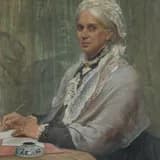
Clough became the first Principal of what evolved into Newnham College, Cambridge, one of the earliest institutions for women's higher education in Britain.
In October 1871, Anne Jemima Clough was appointed the first Principal of a small house of residence in Cambridge established for women attending lectures newly opened to them by sympathetic university teachers. This modest beginning, initially known as Newnham Hall, would grow into Newnham College, one of the first two Cambridge colleges for women (alongside Girton College).
Clough had already built a reputation as an educational reformer, having organized lecture courses for women in the north of England through the North of England Council for Promoting the Higher Education of Women, which she helped found in 1867. Her appointment to lead the Cambridge venture was the culmination of years of grassroots campaigning for women's access to serious academic study at a time when universities were almost exclusively male preserves.
As Principal, Clough shaped the ethos of the institution with an emphasis on rigorous scholarship combined with pastoral care, mentoring generations of women students who would go on to become teachers, scholars, and reformers themselves. Newnham College grew steadily under her leadership, gaining new buildings and expanding its student body, and it remains a women's college of the University of Cambridge to this day. Her role as founding Principal is widely regarded as a sentinel achievement in the history of women's higher education in Britain, breaking significant institutional barriers of the Victorian era.