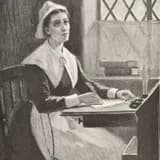
Anne Bradstreet sails on the Arbella with the Winthrop Fleet to New England, becoming one of the earliest Puritan settlers and later a foundational poet of colonial America.
On 13 June 1630, Anne Bradstreet sailed from England to New England with the Winthrop Fleet aboard the flagship Arbella, joining the Puritan migration that founded the Massachusetts Bay Colony. Travelling with her husband Simon Bradstreet and her parents Thomas and Dorothy Dudley, she left the cultured world of an English manor for the uncertainties of a colonial frontier.
The voyage was arduous, lasting several weeks under cramped and dangerous conditions typical of seventeenth‑century Atlantic crossings. As a young woman of about eighteen, Bradstreet faced profound upheaval—loss of homeland, social networks, and material comforts—while carrying with her a deep commitment to Puritan faith and the literary culture she had absorbed in England.
Arrival with the Winthrop group placed Bradstreet within the very first generation of European settlers in Massachusetts Bay. In the decades that followed, she would manage a demanding household and raise eight children in harsh conditions, yet continue to write poetry, often by candlelight after long days of domestic work.
This emigration is historically significant because it situates Bradstreet as one of the earliest poets to compose English verse in the American colonies and as a participant‑observer of colonial nation‑building. Her later work, including reflections on illness, love, and the New England environment, grew directly from experiences that began with this 13 June 1630 crossing, making the voyage a foundational event in the emergence of American literature.