← All women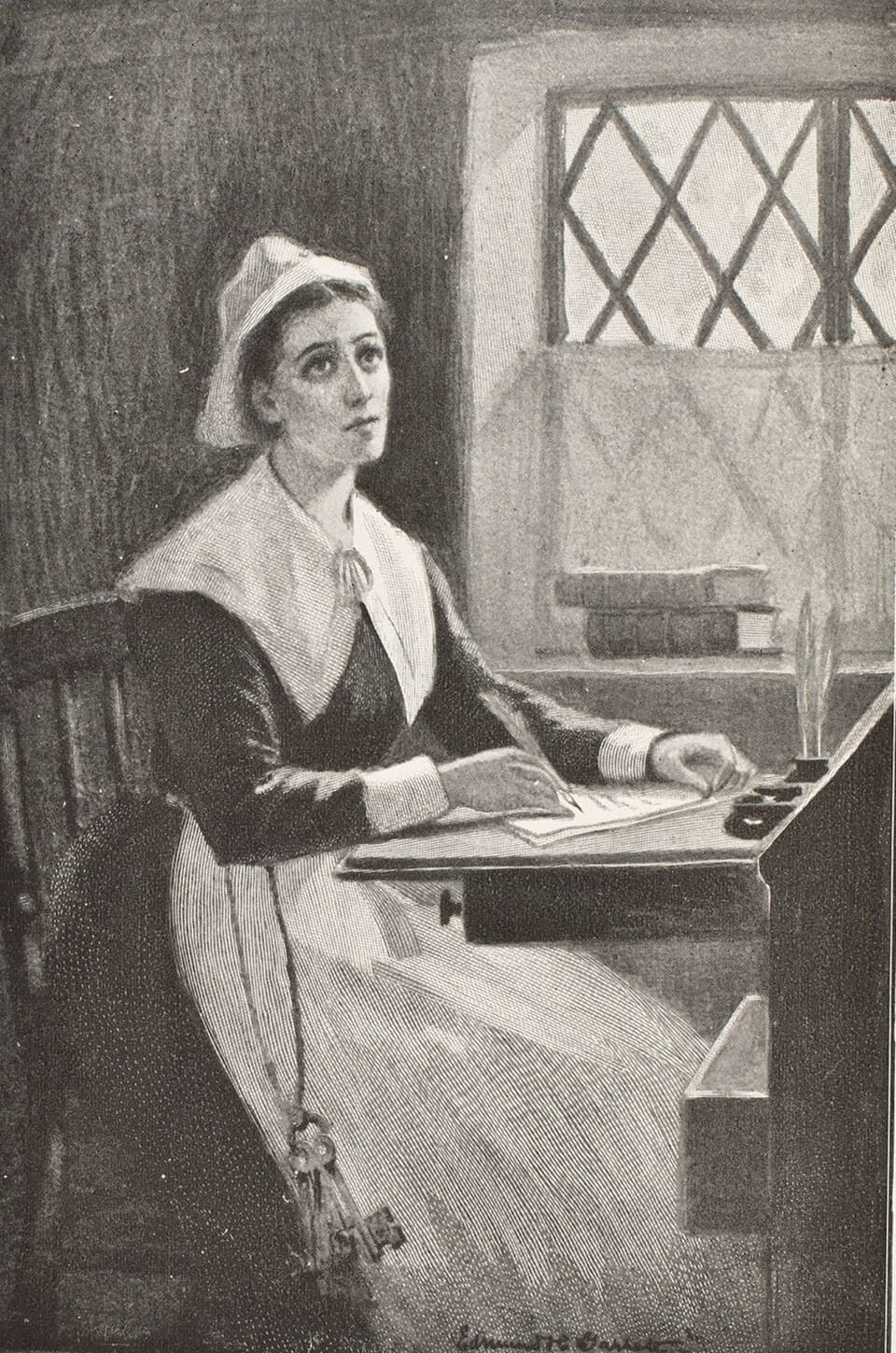
English, American · Literature · Arts
Anne Bradstreet
March 8, 1612 – September 16, 1672
Early Life and Background
Anne Bradstreet (née Anne Dudley) was born on 8 March 1612 in or near Northampton, Northamptonshire, England, into a well‑connected Puritan family. Her father, Thomas Dudley, served as steward to Theophilus Clinton, fourth Earl of Lincoln, overseeing the Earl’s estates and placing the family within an aristocratic, literate milieu.[3][6][8] Her mother, Dorothy Yorke, also came from a respectable background, and Bradstreet was the second of their six children.[6][8]
Unlike most girls in early seventeenth‑century England, Bradstreet received a substantial education. Living in the Earl of Lincoln’s household, she had access to the manor’s extensive library and was tutored in history, theology, languages, and literature.[4][6] Biographical accounts emphasize that she was familiar with classical authors, the Bible, and contemporary English poetry, all of which later informed the learned allusiveness of her own verse.[6][14]
Her formative years were shaped by the religious currents of the period. The Dudley family was strongly Puritan, aligned with the movement that sought to reform the Church of England along stricter Reformed lines. Debates over church discipline, piety, and the role of secular culture were part of her intellectual environment, and Bradstreet internalized a worldview that valued both spiritual seriousness and reading.[3][14] These influences would later appear in her poetry’s persistent concern with providence, sin, and redemption.
Marriage and Preparation for Migration
By about sixteen, Anne Dudley married Simon Bradstreet, a Cambridge‑educated Puritan who had studied at Emmanuel College and was closely associated with leading reformers.[1][3][8] Their marriage linked two prominent Puritan families and further embedded Anne in the circles that would organize the Massachusetts Bay venture.
In the late 1620s, mounting tensions between Puritans and the English ecclesiastical establishment, combined with economic challenges, led many to consider leaving England. Thomas Dudley and Simon Bradstreet became key figures in the group planning the establishment of the Massachusetts Bay Colony.[3][6] Anne, as a young wife and daughter, joined this endeavor not as a decision‑maker but as part of a family unit committed to building a godly community overseas.
Emigration to New England
On 13 June 1630, Anne Bradstreet sailed from England with the Winthrop Fleet, the principal group of Puritan settlers headed by John Winthrop.[3][4][14] She travelled on the flagship Arbella with her parents and husband. The transatlantic voyage subjected passengers to cramped conditions, illness, and the uncertainties of storm‑prone seas; Bradstreet later referred to the hardships of migration in her prose meditations.
The fleet reached the New England coast in June 1630, and Bradstreet initially lived in the nascent settlements around Salem and Charlestown before moving with the community to Newtowne (later Cambridge).[3][4] These early years were marked by significant material deprivation compared with the comforts of the Lincoln household. She struggled with poor health, exposure, and the labour required to establish homes and farms, experiences that surface in her poems on illness and adversity.
Settling in Ipswich and Andover
By 1635, the Bradstreet family moved to Agawam (Ipswich), Massachusetts, where Anne’s father and husband held prominent civic roles.[4][8] Ipswich was still a frontier town, and Bradstreet’s daily life involved managing household tasks—food preparation, textiles, child‑rearing—amid limited resources.
In 1644, the family relocated again, this time to Andover, Massachusetts, where Simon Bradstreet became a leading magistrate and landholder, eventually rising to serve as governor of Massachusetts.[1][3] Anne lived in Andover for the rest of her life. The town’s relative remoteness and rough conditions challenged her health, yet it was here that she produced much of her mature poetry.[1]
Family Life and Domestic Responsibilities
Anne and Simon Bradstreet had eight children: Samuel, Dorothy, Sarah, Hannah, Simon, Mercy, Dudley, and John.[8] Raising such a large family in the colonial environment demanded considerable labour and resilience. Bradstreet endured periods when her husband was away on official business, leaving her to manage the household alone.
Biographical accounts stress this dual identity: Bradstreet was at once a devoted Puritan wife and mother and an intellectually ambitious writer.[1][8][14] She often composed at night, after completing domestic work, and her poems return repeatedly to themes of maternal love, marital affection, and the fear of losing children. Works such as "In Reference to Her Children" and "Before the Birth of One of Her Children" reveal the emotional intensity of her family relationships, offering rare insight into a seventeenth‑century Puritan woman’s inner life.[2][14]
Early Writing and Career Beginnings
Bradstreet began writing poetry in New England not long after arrival. Around 1632, she produced her first known poem, an early step in the corpus that would later establish her as a leading colonial poet.[8] These early works were heavily influenced by English models, including the metaphysical poets and historical verse, and circulated in manuscript among family and friends.
Her writing initially focused on public and historical subjects considered more appropriate for serious verse. She composed long poems on the four monarchies and elegies for public figures, demonstrating her education and engagement with political history.[3][6] At this stage, her work reflects a tension between the desire to demonstrate learned competence and the Puritan emphasis on female modesty.
Major Works and Literary Development
Bradstreet’s most important work during her lifetime was her first collection, The Tenth Muse Lately Sprung Up in America, by a Gentlewoman in Those Parts, published in London in 1650.[3][14] The volume gathered poems written over nearly twenty years, including historical meditations, elegies, and religious reflections.
The collection was brought to England and arranged for publication by her brother‑in‑law, the Reverend John Woodbridge, who presented the book as evidence that Puritan New England nurtured learned piety even among women.[3][8] Some accounts suggest Bradstreet did not initially seek print and may have been surprised by the publication, which framed her as a "tenth muse"—a symbol of exceptional female inspiration.[4][6]
Within the volume, Bradstreet’s poetic voice combines classical references, scriptural allusions, and the rhythms of English verse. Her long historical poem "The Four Monarchies" surveys world empires, reflecting contemporary interest in universal histories; other pieces commemorate figures such as Sir Philip Sidney, showing her awareness of English literary culture.[3][6]
Alongside these public works, Bradstreet also wrote more intimate poems that circulated in manuscript and were later added to posthumous editions. These include her celebrated love lyrics to her husband, such as "To My Dear and Loving Husband," and domestic meditations on house fires, illness, and grief.[2][3] These later poems mark a shift toward personal and experiential themes that have resonated strongly with modern readers.
"Contemplations" and the American Landscape
Around the mid‑1640s, Bradstreet composed the long poem "Contemplations", a series of stanzas in which she meditates on nature, time, and divinity. Scholars highlight this work as one of her finest achievements.[14]
"Contemplations" begins with vivid observations of the natural world—trees, the sun, the river—and moves to reflections on biblical history and the human soul. Later reference works describe it as the first poem to be inspired by the American landscape, since its imagery appears rooted in the New England environment Bradstreet inhabited.[8][14] While she never explicitly names American locations, the specific attention to woods and seasonal change reflects colonial experience.
This poem illustrates Bradstreet’s ability to unite Puritan theology with aesthetic appreciation. She acknowledges the beauty of creation while insisting that it must lead the believer toward contemplation of God, not idolatry of nature itself. In doing so, she negotiates Puritan ambivalence about the arts and creates a distinctly colonial form of devotional poetry.
Publication of The Tenth Muse and Historical Firsts
The 1650 publication of The Tenth Muse is consistently identified by historians as a turning point in literary history. According to scholarly and reference sources, Bradstreet became the first writer in England’s North American colonies to be published and the first woman poet whose work was printed in both England and the New World.[3][6][14]
Modern biographical summaries and dictionaries further characterize her as America’s first woman poet, the first female poet in the New World, and, in some formulations, the first true American poet.[2][8][13][14] These descriptions all refer to the same historical fact: that a substantial collection of original poetry written by a colonial woman appeared in print in London in 1650.
The Oxford Dictionary of National Biography and related scholarship note that she may claim to be both "the first English woman and the first New Englander to publish a collection of original poems", underscoring the overlapping national, gendered, and regional dimensions of her achievement.[6] While earlier Englishwomen wrote verse and individual colonial poems circulated, no other woman had published a comparable collection rooted in colonial experience.
Posthumous Editions and Later Works
Bradstreet continued writing after 1650. Her last known poem, "A Weary Pilgrim, Now at Rest", dates from 1669, reflecting her awareness of approaching death and her hope for eternal peace.[8] In this and other late works, she wrestles with bodily suffering, spiritual doubt, and the desire for assurance of salvation.
Six years after her death, in 1678, a new and expanded edition of her writings was published in Boston under the title Several Poems Compiled with Great Wit and Learning.[1][3][8] This volume included previously unpublished personal poems and prose meditations as well as the works from The Tenth Muse. Its appearance marked the first American edition of her poetry and helped embed Bradstreet in New England’s cultural memory.
Awards, Honours, and Reception
Bradstreet lived in a period before modern literary prizes, but she received notable recognition. Her 1650 book garnered favourable attention in England, where readers praised her learning and poetic skill.[2][3] Dedications and prefatory materials emphasized her as a marvel of female intellect, a "tenth muse" whose work proved that godly women could write serious verse.
Within New England, Bradstreet’s writings circulated among Puritan elites, and her status as the wife and daughter of governors enhanced her reputation. In later centuries, she has been canonized as a founding figure of American literature: major anthologies, university courses, and institutions such as the Poetry Foundation and Academy of American Poets present her as a central early American poet and America’s first woman poet.[1][2][13][14]
Personal Spiritual Struggles
Bradstreet’s prose and poetry record periods of doubt and spiritual struggle. She battled chronic illnesses, including lung disease, and physical pain, which she interpreted within a Puritan framework of chastening and sanctification.[4][8] Her meditations grapple with fears about her own salvation, the deaths of grandchildren and friends, and the possibility of God’s displeasure.
Despite these struggles, her writings affirm trust in divine providence. Poems like "Verses upon the Burning of Our House" portray her efforts to surrender worldly possessions and find comfort in heavenly promises, offering a vivid window into Puritan piety from a woman’s perspective.[2][3]
Legacy and Historical Impact
Anne Bradstreet’s legacy rests on several intertwined contributions. She is widely regarded as the first woman in America to achieve literary prominence and the first published poet of the English colonies.[3][8][14] Her work provides a crucial record of the intellectual, religious, and domestic life of early New England, particularly from a female vantage point.
For women’s history, Bradstreet demonstrates that seventeenth‑century women could and did participate in serious literary culture despite constraints. Her use of learned allusion and engagement with public themes challenge stereotypes of Puritan women as silent and purely domestic.[6][8] At the same time, her candid exploration of maternal love, marital affection, and grief has made her an important figure in the study of women’s emotional and spiritual lives.
In literary history, Bradstreet is often positioned as the starting point of American poetry. Anthologies and scholarly accounts cite her 1650 publication as the first major appearance of an American poetic voice in print, and some place her first in chronological listings of American poets.[2][13][14] Her blending of European forms with colonial subject matter prefigures later developments in American literature, including attention to landscape, family life, and religious individuality.
Bradstreet’s work also illuminates Puritan attitudes toward art. Her poems occasionally apologise for her "vain" interest in poetry, reflecting anxieties about the compatibility of the arts with godliness, yet her corpus shows that many Puritans embraced literary expression as a vehicle for moral and spiritual reflection.[3][6] This tension has been central to scholarly interpretations of her career.
Later Life and Death
In her later years, Anne Bradstreet remained in Andover, where she experienced increasing health difficulties, including tuberculosis and a debilitating joint disease.[4][8] She continued to write despite pain, using poetry and meditation to process suffering and to anticipate death as a passage to rest.
Bradstreet died on 16 September 1672 in Andover (now North Andover), Massachusetts, at about sixty years of age.[3][5][8] She was buried in the region she had helped to settle and where she had raised her family. Her husband Simon outlived her and continued in public service, eventually serving as governor of Massachusetts.
After her death, Bradstreet’s reputation persisted through the 1678 Boston edition of her work and through manuscript circulation. She was mentioned by later New England writers and gradually rediscovered by nineteenth‑ and twentieth‑century scholars, who recognised her significance as an early American and early modern woman writer.[2][3][14]
Today, Bradstreet is studied internationally, appearing in English, French, Spanish, and other language encyclopedias and literary reference works.[3][5][7][12] Her poems remain widely anthologized, and her life continues to inspire biographies and scholarly monographs. As a woman who wrote learned poetry while navigating the demands of Puritan domestic life, she occupies a central place in both women’s history and the history of American literature.
Dated achievements
9 indexed.
- Mar081612Literature
Birth of Anne Dudley (Anne Bradstreet)
Anne Dudley (later Anne Bradstreet) is born in Northampton, England, into a literate Puritan family that will foster her development as the first published poet of colonial America.
View details Anne Bradstreet – Wikipedia - Jun131630Literature
Emigration to New England with the Winthrop Fleet
Anne Bradstreet sails on the Arbella with the Winthrop Fleet to New England, becoming one of the earliest Puritan settlers and later a foundational poet of colonial America.