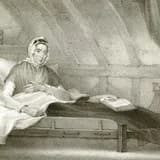
A public 16-day watch over Ann Moore's claimed total abstinence from food and drink began at her Tutbury home, supervised by physicians and local gentlemen.
On 21 April 1807, a formal and highly publicized surveillance of Ann Moore began at her home in Tutbury, Staffordshire. Moore had claimed she could survive entirely without eating or drinking, a assertion that had already begun attracting curious visitors and skeptical inquiry from the local community and beyond.
To settle the matter, a committee of physicians and local gentlemen arranged for continuous observation of Moore for sixteen days, watching her around the clock to determine whether she was secretly consuming food. This kind of formalized medical-social scrutiny was characteristic of the era's fascination with 'fasting girls' and bodily wonders, phenomena that straddled superstition, religious symbolism, and emerging scientific skepticism.
The 1807 watch, unlike the later and more famous 1813 test, did not conclusively expose her, and Moore emerged from it with her reputation as a miraculous faster largely intact — fueling years of further publicity, visitors paying to see her, and growing national notoriety. This episode set the stage for a phenomenon that would consume British newspapers for years and eventually implicate physicians, clergy, and even royalty-adjacent society figures who took interest in her supposed condition.
The event illustrates the porous boundary between medical investigation and public spectacle in early nineteenth-century Britain, and it foreshadowed the far more damning investigation that would unravel her claims six years later.