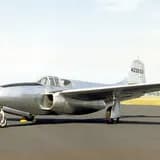
Born at Fort Gordon, Georgia, in a U.S. Army hospital; she would later become the first woman to fly a jet‑powered aircraft.
On August 27, 1918, Ann Gilpin Baumgartner was born at Fort Gordon, Georgia, in a United States Army hospital. Her birth into a military environment presaged a lifelong connection to the armed forces and aviation, though no one at the time could have foreseen her future as a pioneering test pilot of America’s first jet fighter.
Growing up, Baumgartner experienced the interwar years when aviation was rapidly developing but remained a largely male domain. A key early influence came when famed aviator Amelia Earhart visited her school, an encounter that helped ignite Baumgartner’s interest in flying. She later attended Smith College, where she studied pre‑med and English, combining scientific curiosity with strong communication skills—traits that would prove central to her later careers in test flying and science journalism.
Her birth date is historically relevant because it places her among the generation of women who came of age just as global conflict created unexpected openings in traditionally male professions. By the time she learned to fly in 1940, the United States was on the brink of entering World War II, and military demand for pilots created the conditions that allowed women like Baumgartner to step into the cockpit in unprecedented ways.
Knowing her exact birth date enables historians to contextualize her achievements within the timeline of aviation history. She was 26 when she flew the Bell YP‑59A Airacomet in October 1944, becoming the first woman to pilot a jet‑powered aircraft, and nearly 90 at her death in 2008 after witnessing immense technological change. Her life arc—from a child born on an Army post to a jet‑age pioneer—illustrates how the opportunities and constraints of her era shaped and were reshaped by her own determination and skill.