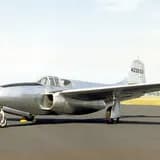
Gen. Hap Arnold publicly cites Ann Baumgartner Carl as the first woman to fly a U.S. jet fighter when addressing the final WASP class.
On December 7, 1944, as the Women Airforce Service Pilots (WASP) program neared its end, General Henry "Hap" Arnold, Commanding General of the U.S. Army Air Forces, addressed the final WASP graduating class. In that speech, Arnold publicly recognized Ann G. Baumgartner Carl as the first woman to fly a U.S. jet fighter, referring to her historic October flight in the Bell YP‑59A Airacomet.
This moment of recognition occurred less than two weeks before the WASP were disbanded, at a time when the women’s contributions were not yet formally acknowledged with veteran status or equal benefits. Arnold’s commendation effectively placed Baumgartner’s achievement on the official record of the wartime air arm, highlighting that a woman test pilot had flown the nation’s first operational jet fighter prototype.
The event is historically significant for two reasons. First, it served as high‑level validation from the top of the Army Air Forces that women pilots had performed critical, technically demanding duties—including experimental jet testing—during the war. Second, by singling out Baumgartner’s jet flight, Arnold helped ensure that her pioneering role would be preserved in institutional memory rather than lost when the program closed.
In the broader context of mid‑20th‑century military culture, such recognition was rare. Women pilots were civilians, not commissioned officers, and many of their records were scattered or minimized after the WASP were dissolved. Arnold’s words on that December day later became a key source for historians documenting women’s roles in aviation, supporting efforts to secure long‑overdue acknowledgment of WASP service and underscoring Baumgartner’s place at the forefront of the jet age.