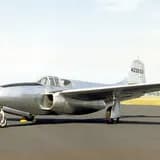
Flies the Bell YP‑59A Airacomet at Wright Field, becoming the first woman and first American woman to pilot a jet‑powered aircraft.
On October 14, 1944, Ann G. Baumgartner Carl, serving as a WASP and assistant operations officer in the Fighter Section, Flight Test Division at Wright Field, made an evaluation flight in the Bell YP‑59A Airacomet, America’s first operational jet fighter prototype. During this flight she became the first woman—and first American woman—ever to pilot a jet‑powered aircraft.
The YP‑59A represented the cutting edge of wartime aeronautical engineering, with turbojet propulsion radically different from the piston‑engined aircraft Baumgartner had previously flown. Jet flight demanded new techniques in handling, energy management, and systems understanding, and the Airacomet’s performance characteristics were still being explored. By strapping into the cockpit for a formal test evaluation, Baumgartner stepped into a role that had been the exclusive domain of male military test pilots.
This flight was a genuine barrier‑breaking first. Contemporary and later institutional accounts—from the Smithsonian’s National Air and Space Museum to Women in Aviation International and WASP commemorative groups—identify Baumgartner as the first American woman to fly a jet‑powered aircraft, and Virginia aviation historians further describe her as the world’s first woman to fly a turbojet‑powered aircraft.
The legacy of this event extends far beyond a single sortie. Her Airacomet flight demonstrated that women could master the same advanced technology as their male counterparts and helped undermine cultural assumptions that confined women to less demanding aviation roles. For a decade, her record as the first woman jet pilot remained unchallenged, cementing her place as a pioneer of the jet age and a central figure in the history of women in military aviation.