← All women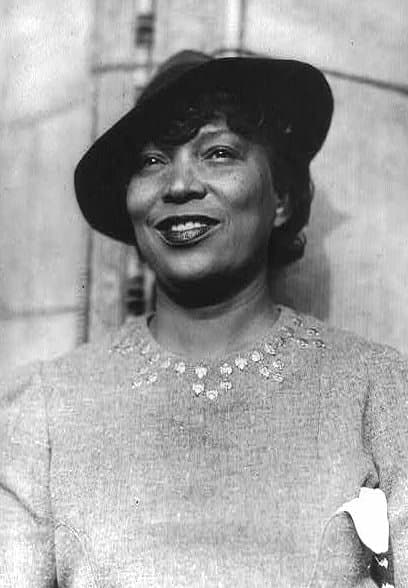
American · Literature · Activism
Zora Neale Hurston
January 7, 1891 – January 28, 1960
Early Life and Background
Zora Neale Hurston (January 7, 1891 – January 28, 1960) was an American writer, anthropologist, folklorist, and key figure of the Harlem Renaissance.[3][4][8] She was born in Notasulga, Alabama, to parents John Hurston and Lucy Potts Hurston, both of whom had been enslaved before emancipation.[2][3][9] Zora was the fifth of eight children.[13][14] When she was still a toddler, her family moved to Eatonville, Florida, one of the first incorporated, self-governing all-Black towns in the United States, where her father served as a carpenter, Baptist minister, and sometimes mayor, and her mother was a teacher and seamstress.[2][11][14]
Eatonville played an essential role in Hurston’s formation. Growing up in a community where Black people held civic and social power gave her an enduring sense of racial pride and autonomy.[2][9] She later used Eatonville as the setting for many of her works, depicting it as a vibrant Black cultural center unshadowed by direct white control.[11] Hurston frequently identified Eatonville, rather than Notasulga, as her hometown, and in her autobiography she claimed to have been born there on January 7, 1901; subsequent archival research confirmed the 1891 Alabama birth record.[1][6][11]
Hurston’s mother encouraged her intellectual curiosity and independence, but her death when Zora was a teenager destabilized the family. Hurston’s relationship with her father and stepmother became strained, and she left home to work various jobs and continue her schooling, experiences that deepened her sense of self-reliance.[9][14] Her early exposure to Black oral traditions—stories, sermons, songs, and jokes—would later form the bedrock of both her literary and anthropological work.
Education and Early Development
After leaving Eatonville, Hurston worked as a maid and in other positions while seeking educational opportunities. She attended Morgan Academy in Baltimore before enrolling at Howard Universityassociate’s degree in English in 1920.[1][4][7][9]
Howard provided Hurston with an intellectual and literary community. There she co-founded the student drama organization and began publishing fiction and poetry. In 1921, she saw her first works in print: the short story “John Redding Goes to Sea” and the poem “O Night” in the campus literary magazine Stylus.[2][4][6][7][9][14] These early publications demonstrated her talent for capturing Southern Black life and emotional complexity.
Hurston’s ambitions soon drew her northward. In 1925 she moved to New York City, where she quickly became associated with the Harlem Renaissance.[1][5][13] She began publishing in major African American periodicals and entered the Urban League’s literary networks, often under the mentorship of figures such as Alain Locke. Her short story “Spunk” appeared in Opportunity and gained her recognition among Harlem writers and patrons.[1][5][13]
Determined to deepen her anthropological training, Hurston enrolled at Barnard College, Columbia University’s women’s college. She studied under renowned anthropologist Franz Boas, as well as Ruth Benedict and Gladys Reichard.[1][3][5][6][11] Hurston graduated in 1928, becoming the first Black woman to earn a degree from Barnard College
In New York, Hurston pursued a dual career as a writer and anthropologist, immersing herself in Harlem’s creative milieu. She wrote short stories, essays, and plays that appeared in journals such as Opportunity and The Crisis, gaining a reputation for her use of Black vernacular speech and humor.[7][9] She also worked intermittently for the Black press, including the Pittsburgh Courier, reporting on cultural events. Hurston’s anthropological work developed alongside her literary efforts. In 1927, she was awarded a $1,400 fellowship from Carter G. Woodson’s Association for the Study of Negro Life and History to collect Black folklore in the American South.[4][14] Beginning that year, and notably from February 1927 onward, she undertook extensive fieldwork in Florida, traveling among turpentine camps, small towns, and rural communities to record tales, songs, and rituals.[4] She combined Boasian methods with her own insider status, often presenting herself as a friend rather than an external observer. During this period, Hurston also collaborated and sometimes clashed with other Harlem Renaissance artists. She worked with Langston Hughes on the play Mule Bone around 1930, but a dispute over authorship and copyright led to a rupture in their friendship and delayed the play’s production for decades.[1][5] Her insistence on maintaining control of her work reflects both a personal commitment to artistic autonomy and the difficulties Black women faced in collaborative projects where their contributions were often underestimated. Hurston’s literary career blossomed in the 1930s. In 1934, she published her first novel, Jonah’s Gourd Vine, with J.B. Lippincott.[2][3][6] Based loosely on her parents’ marriage, the novel portrays a charismatic Black preacher whose personal failings complicate his spiritual leadership. It is noted for its rich depiction of Southern Black religious life and its use of dialect. The following year, Hurston produced her breakthrough work of folklore. Mules and Men, published in 1935, is widely regarded as the first collection of Black folklore authored and compiled by an African American.[14] Drawing on fieldwork in Florida and Louisiana, the book presents stories and hoodoo practices in the voices of the people who shared them, framed by Hurston’s conversational narrative. It remains a foundational text in African American folklore studies.[3][14] In 1937, Hurston released what would become her most celebrated novel, Their Eyes Were Watching God.[1][3][5][6][10][14][15] Set largely in Eatonville and the Everglades, the novel follows Janie Crawford’s journey through three marriages toward self-realization and autonomy. Written in a mix of lyrical standard English narration and Black Southern dialect dialogue, it explores themes of love, voice, and Black womanhood. Though some contemporary Black male critics accused Hurston of ignoring racial protest literature, the book later became a canonical work of African American and feminist literature. Hurston continued to publish prolifically. Her 1939 novel Moses, Man of the Mountain retells the biblical story of Moses through a Black folk lens, while Seraph on the Suwannee (1954) focuses on white Floridian characters, an unusual choice that nonetheless reflects her ongoing interest in Southern cultures.[1][5][14] She also produced Tell My Horse (1938), an ethnographic study of Caribbean religions and politics based on fieldwork in Jamaica and Haiti, where she researched Vodou and its social role.[4][14] In 1942, Hurston published her autobiography, Dust Tracks on a Road, offering her own account of her childhood in Eatonville, her education, and her rise as a writer.[1][4][5][11][14] Characterized by wit and selective self-fashioning, the book reveals much about Hurston’s perspective on race, gender, and individuality, even as later scholars have noted its omissions and strategic narrative choices. Beyond her books, Hurston made significant contributions to theatre, education, and folklore preservation. In the mid-1930s, she helped establish a department of dramatic arts at Bethune-Cookman College (now Bethune-Cookman University), working with Mary McLeod Bethune to foster Black performance and theatre education.[1][5][14] She directed college productions and encouraged students to draw on Black cultural traditions in their dramatic work. Hurston also collaborated with folklorists and musicologists. In 1935 she joined Alan Lomax and Mary Elizabeth Barnicle on expeditions in the U.S. South and the Bahamas to collect folktales, songs, and slave narratives for the Library of Congress.[1][5] This work contributed to national archives of Black oral culture and broadened the recorded repertoire of African American and Afro-Caribbean music and storytelling. Her essays, such as “Characteristics of Negro Expression”, articulated a theory of Black aesthetics rooted in improvisation, expressiveness, and metaphor, influencing later discussions of African American performance and literary style.[5][14] Throughout, Hurston insisted on celebrating Black life rather than portraying it solely through the lens of oppression, a stance that distinguished her from some contemporaries and later generated both admiration and criticism. During her lifetime, Hurston received critical attention and some institutional support but never achieved sustained financial security. Her early recognition included multiple prizes at the 1921 Opportunity literary awards dinner, where her story “Spunk” and play “Color Struck” received second-place awards and honorable mentions.[6][13] She secured fellowships for her anthropological work and was widely known in Harlem circles. Posthumously, her reputation grew substantially. Beginning in the 1970s, writers and scholars—most notably Alice Walker—rediscovered her work, republished out-of-print texts, and reclaimed Hurston as a major voice in African American literature and women’s writing. Walker’s essay "In Search of Zora Neale Hurston" and her efforts to mark Hurston’s grave helped spark a wide revival of interest. In 2010, Hurston was inducted into the inaugural class of the New York Writers Hall of Fame, reflecting her standing as one of the most important American writers of the 20th century.[2] Today she is frequently taught in literature, history, and gender studies courses, and her work has been honored by numerous institutions and literary organizations. Hurston’s personal relationships were complex and intertwined with her itinerant professional life. On May 19, 1927, she married Herbert Sheen, a jazz musician and medical student, in St. Augustine, Florida; the marriage ended in divorce in 1931.[4][8][14] She later married Albert Price III in 1939, a union that also ended in divorce by 1943.[14] Hurston had no children. Her personal correspondence and autobiographical writings reveal a woman fiercely protective of her independence. She often prioritized fieldwork, writing, and travel over domestic stability, moving between New York, Florida, the Caribbean, and other locales. Friends and colleagues described her as witty, flamboyant, and socially engaged, yet she also experienced periods of isolation and financial hardship.[9][14] Hurston’s political views were sometimes controversial. She criticized aspects of the civil rights strategies emerging in the mid-20th century, opposed certain forms of government intervention, and in some writings expressed skepticism about desegregation as it was then conceived. Her essays from the 1940s and 1950s reveal a libertarian streak and a commitment to local Black autonomy, views that have provoked ongoing debate among scholars.[4][5] By the late 1940s and 1950s, Hurston’s fortunes declined. Changing literary tastes, political controversies, and personal financial difficulties led to reduced publication and income. Some of her works went out of print, and she took a series of modest jobs, including teaching, domestic work, and occasional journalism, to support herself.[5][14] In 1959, Hurston suffered a stroke that severely affected her health. She entered the St. Lucie County Welfare Home in Fort Pierce, Florida, in October of that year, lacking the resources for private medical care.[2][5] On January 28, 1960, she died of hypertensive heart disease at the welfare home.[1][2][13][14] She was buried in the segregated Garden of Heavenly Rest cemetery in an unmarked grave, and friends and admirers had to raise money to cover her funeral expenses.[4][5] For a time after her death, Hurston’s work remained largely neglected. However, the rediscovery of her grave and writing by younger Black women writers, especially Alice Walker in the 1970s, transformed her posthumous reputation. New editions of Their Eyes Were Watching God and other works reintroduced Hurston to a broad readership, and scholars began to reassess her contributions to literature and anthropology. Today, Zora Neale Hurston is recognized as one of the foremost female writers of the 20th century and a pioneering Black woman anthropologist.[2][9][11] Her novels, particularly Their Eyes Were Watching God, have become central texts in African American, women’s, and American literature, celebrated for their complex portrayals of Black women’s interior lives, their innovative use of dialect, and their affirmation of Black cultural expression.[1][3][5][6] Hurston’s ethnographic work reshaped understandings of Black folklore. Mules and Men and Tell My Horse demonstrated that African American and Afro-Caribbean traditions deserved serious scholarly attention and could be presented in ways that respected their internal logic and artistry.[3][4][14] Her insistence on embedding herself within the communities she studied, and her refusal to present Black culture simply as an object of study for white audiences, helped lay groundwork for later Black and feminist anthropology. In literary history, Hurston has been reinterpreted as a key figure whose work complicates the notion that Black writing of her era was exclusively protest-oriented. She celebrated joy, love, humor, and everyday life, even as she acknowledged structural racism. Her emphasis on Black women’s voices and experiences anticipated later feminist and womanist thought, and writers such as Toni Morrison, Alice Walker, and Gloria Naylor have cited her as an influence. Hurston’s legacy is visible in multiple domains: in ongoing scholarly work on her manuscripts and letters; in institutions and festivals named in her honor; and in the widespread teaching of her texts in schools and universities. The creation of the Zora Neale Hurston Trust
From her beginnings in Notasulga and Eatonville to her complex career as a writer and anthropologist, Zora Neale Hurston’s life reflects both the obstacles and the possibilities facing Black women in the United States in the first half of the 20th century. Her commitment to depicting Black life on its own terms, and her pioneering dedication to Black folklore, ensure her continuing importance in women’s history and cultural studies.Career Beginnings: Harlem and Folklore Fieldwork
Major Works and Accomplishments
Academic and Cultural Contributions
Awards, Honors, and Recognition
Personal Life
Later Life and Decline
Legacy and Historical Impact
Dated achievements
8 indexed.
- Jan071891Literature
Birth of Zora Neale Hurston
Zora Neale Hurston is born in Notasulga, Alabama, the fifth of eight children.
View details Wikipedia: Zora Neale Hurston - May011921Literature
Wins multiple awards at Opportunity literary awards
Hurston's short story 'Spunk' and play 'Color Struck' win awards at Opportunity literary awards in NYC.