← All women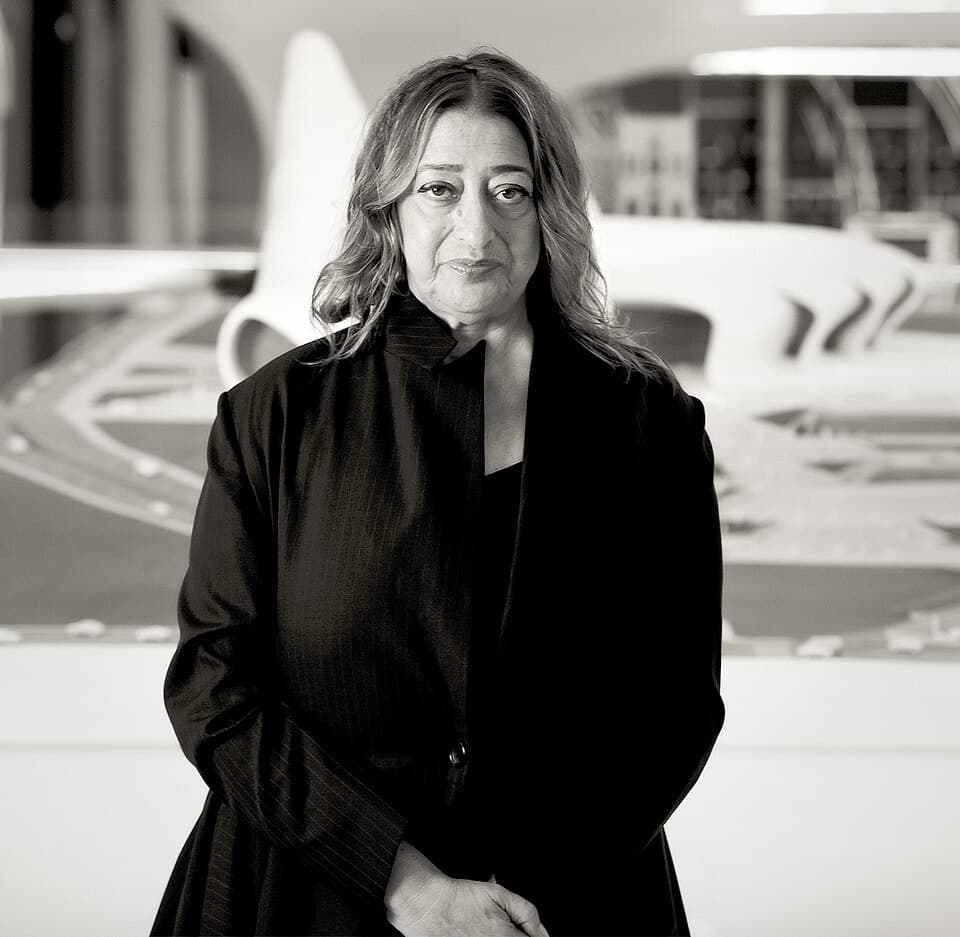
Iraqi, British · Arts
Zaha Hadid
October 31, 1950 – March 31, 2016
Early Life and Background
Zaha Mohammad Hadid was born on 31 October 1950 in Baghdad, Iraq, into a well-connected, secular and politically active family.[5][1][7] Her father, Mohammed Hadid, was an industrialist and prominent liberal politician who served as finance minister and was associated with Iraq’s Progressive Democratic Party.[10][7] Her mother, Wajiha al‑Sabunji, had a strong interest in the arts and encouraged her daughter’s creativity.[7] Growing up in Baghdad during a period of modernization, Hadid was exposed to new civic architecture, infrastructure projects, and the optimism of mid‑20th‑century urban development.[13][6]
Hadid attended progressive Catholic and secular schools in Baghdad and spent time at boarding schools in Switzerland and England, which contributed to her cosmopolitan outlook.[8][10] She later studied mathematics at the American University of Beirut, graduating in the early 1970s.[2][8][10] Her mathematical training would deeply inform her architectural work, underpinning the complex geometries and fluid forms that became her signature.
In 1972, she moved to London to study at the Architectural Association School of Architecture (AA), then one of the most experimental schools in Europe.[2][3][9] At the AA she studied under influential figures including Rem Koolhaas, Elia Zenghelis, and Bernard Tschumi, becoming associated with the emerging deconstructivist discourse.[2][3][10] She graduated with a Diploma in 1977, receiving the AA Diploma Prize for her outstanding work.[10]
Career Beginnings and Development
After graduating, Hadid joined the Office for Metropolitan Architecture (OMA) in Rotterdam, founded by Rem Koolhaas and Elia Zenghelis.[2][3] She also taught at the AA, working within a milieu that encouraged theoretical speculation and radical experimentation.[2] In 1980, she opened her own practice, Zaha Hadid Architects (ZHA), in London, and became a naturalized British citizen.[8][6] Early in her career, painting and drawing were central investigative tools; she produced large, abstracted visual studies of cities and building forms that were vital to her design process.[2][7]
Hadid’s early professional years were marked by influential but often unbuilt competition entries. In 1983, she won the international competition for the Peak Leisure Club in Hong Kong, a vertically layered, fragmented complex on a mountainside.[2][3] Though never constructed, the proposal gained widespread attention and established her reputation as a visionary architect whose work challenged conventional ideas of structure, geometry, and space.
Throughout the 1980s and early 1990s she taught at leading institutions, including the AA in London and later the Harvard Graduate School of Design and the University of Illinois at Chicago, among others.[3][5] Her teaching helped disseminate her ideas about landscape‑like buildings, dynamic circulation, and non‑orthogonal design. She became associated with the broader deconstructivist movement, alongside architects such as Peter Eisenman, Daniel Libeskind, and Frank Gehry, though her work remained distinct in its emphasis on continuous surfaces and fluidity.[3][5]
First Major Built Works
For many years, Hadid was known as a "paper architect" because so few of her radical designs were realized. This changed in the early 1990s. In 1993, the Vitra Fire Station in Weil am Rhein, Germany, was completed and is widely regarded as her first major built commission.[4][8] The building’s sharply angled planes and dynamic, frozen-motion quality served as a manifesto for her deconstructivist approach. Though later repurposed as an exhibition space, the Fire Station demonstrated that her conceptual language could be translated into built form.
Her reputation grew through subsequent projects. In 2003, the Rosenthal Center for Contemporary Art (now the Contemporary Arts Center) opened in Cincinnati, Ohio, one of her earliest completed public buildings in the United States.[4][5] The center features interlocking gallery volumes and a "lobby as urban carpet" that invites the city into the museum.[5] That same year she received the Mies van der Rohe Award for the Hoenheim‑Nord Terminus and Car Park in Strasbourg, recognizing her contribution to European architecture.[4]
By the mid‑2000s her practice was delivering increasingly ambitious projects. In 2005, major works such as the Phaeno Science Center in Wolfsburg and the BMW Central Building in Leipzig were completed, enhancing her international reputation.[4][8] The BMW building integrated production lines, offices, and circulation into a single fluid volume, reinforcing the idea that industrial architecture could be experientially rich and formally avant‑garde.
Key Projects and Global Expansion
Hadid’s work in the 2000s and 2010s spanned continents and building types. She designed transport infrastructure such as the Nordpark Railway stations in Innsbruck, Austria, opened in 2007, whose glacier‑like forms and smooth canopies reimagined everyday transit spaces.[4][6] She engaged with healthcare architecture through the Maggie’s Centre in Kirkcaldy, Scotland, which opened in 2006, emphasizing a humane, supportive environment for people living with cancer.[4]
One of her most celebrated cultural projects was the MAXXI – National Museum of 21st Century Arts in Rome. Completed around 2009, MAXXI earned her first RIBA Stirling Prize in 2010 for the best building by a British architect completed in the previous year.[5][6] The museum’s sinuous galleries, overlapping bridges, and flowing routes exemplified her commitment to "complex, dynamic and fluid spaces," a phrase often associated with her design ethos.[7]
In London, Hadid designed the London Aquatics Centre for the 2012 Summer Olympic Games, a major civic project featuring a distinctive undulating roof that evokes the movement of water.[8][9] The building was later adapted for public use, contributing to the legacy of the Olympic Park. Her work also reached the Middle East and the Caucasus, notably through the Heydar Aliyev Center in Baku, Azerbaijan, completed in the early 2010s. The center’s flowing, continuous surfaces and lack of visible corners made it an emblem of her style. In 2014, it won the Design Museum London’s Design of the Year Award, the first time a building had received the overall prize.[15][6]
Hadid’s portfolio also included cultural and commercial projects in China, South Korea, and the United Arab Emirates, among other locations.[3][8] She worked on masterplans and tall buildings, educational facilities, and interiors. Her practice, Zaha Hadid Architects, grew into a large international firm handling hundreds of projects, with design teams led by long‑time collaborators such as Patrik Schumacher.[6][7]
Awards, Honors, and Recognition
Hadid’s groundbreaking work earned extensive recognition. In 2002, she was appointed Commander of the Order of the British Empire (CBE) for services to architecture.[4][9][7] In 2004, she formally became the first woman to be awarded the Pritzker Architecture Prize, architecture’s most prestigious international award.[1][5][16] The prize cited her radical deconstructivist designs and her influence on the direction of contemporary architecture.
She received national honors such as the Austrian Decoration for Science and Art and the German Architecture Prize for the BMW plant’s central building in Leipzig, both in 2005.[15] In 2009, she was awarded the Praemium Imperiale in Architecture by the Japan Art Association, one of the world’s major arts distinctions.[8][15] These accolades situated her not only as an architect but as a major figure in the global arts.
Hadid’s work continued to receive top architectural honours. In 2010, the RIBA Stirling Prize recognized MAXXI in Rome as the UK’s leading architectural work of the year.[5][6] In 2011, she won the Stirling Prize again for the Evelyn Grace Academy in London, becoming the first architect to receive the award in consecutive years.[6][4] In 2012, she was made a Dame Commander of the Order of the British Empire (DBE) for services to architecture, cementing her status in British public life.[6][9]
In 2015, Hadid received the Grand Decoration of Honour for Services to the Republic of Austria, reflecting the importance of her built work and collaborations in that country.[15] That same year, she became the first woman to be awarded the RIBA Royal Gold Medal in her own right, with the medal approved in 2015 and presented at a ceremony on 3 February 2016.[7][16] This honor recognized her lifetime contribution to architecture and her profound influence on the built environment.
Personal Life
Hadid was widely described as intensely dedicated to her work, often spending long hours in the studio and on travel for projects and lectures.[3][7] She did not marry and had no children, a fact occasionally noted in profiles that highlighted her focus on her career and practice.[3][5] Friends and colleagues described her as charismatic, demanding, and witty, with a strong sense of style that extended from her buildings to her clothing and interiors.[3][9]
Her personal life was closely intertwined with her professional world. Long‑term collaborators, including architects and designers at Zaha Hadid Architects, formed an extended professional family that carried forward her design philosophy.[6][7] She maintained deep connections to the Middle East, frequently visiting and working in the region, while also embracing London as her primary base of operations.
Design Philosophy and Historical Impact
Hadid is recognized as a key figure in the architecture of the late 20th and early 21st centuries.[3][17] Her work is often described as neo‑futuristic, characterized by curving forms, multiple perspective points, and fragmented geometry that seeks to evoke the complexity and "chaos" of modern life.[16] She drew on mathematics, landscape forms, and digital design tools to create buildings that appear to flow, bend, and stretch, challenging traditional notions of orthogonal space.
Her early engagement with deconstructivism—visible in her paintings and competition entries—evolved into a broader exploration of continuous surfaces and dynamic motion. She was among the first architects to integrate advanced digital modeling and parametric design into mainstream architectural practice, helping to shift the profession toward computational methods.[7][6] Her buildings often blur boundaries between architecture, urbanism, and infrastructure, treating sites as three‑dimensional fields rather than static plots.
From a historical perspective, Hadid’s impact extends beyond form and technology. As an Iraqi‑born British woman working at the top of a male‑dominated profession, she confronted structural and cultural barriers.[1][11] Early criticism sometimes framed her work as impractical or overly theoretical, and she faced skepticism about her ability to deliver large, complex projects.[3][5] Her persistence in winning competitions and realizing demanding buildings altered perceptions of what women and non‑Western architects could achieve.
Her Pritzker Prize win in 2004 and her later honours influenced how institutions think about diversity and recognition in architecture. She became a role model for many women, students, and practitioners from the Middle East and beyond, inspiring them to pursue ambitious careers in design and engineering.[1][11][7] Scholarly and popular treatments of her career now routinely position her as one of the most important women in the history of architecture.
Later Life and Death
In her later years, Hadid continued to expand her practice’s reach. Zaha Hadid Architects handled major projects worldwide, including museums, cultural centers, stadiums, bridges, and skyscrapers.[6][8] She also ventured into product and furniture design, collaborating with fashion houses and manufacturers to create shoes, seating, lighting, and installations, further blurring the boundaries between architecture and design.[7]
Despite occasional controversies—such as debates about labour conditions on large infrastructure projects or critiques of the political symbolism of certain commissions—her work remained highly sought after by governments, cultural institutions, and private clients.[3][5] She was elected a Royal Academician in 2005, joining the Royal Academy of Arts in London.[16] Public and professional perception of her evolved from viewing her as an outsider to regarding her as a central figure in contemporary architecture.
Zaha Hadid died on 31 March 2016, in a hospital in Miami, Florida, after suffering a heart attack while being treated for bronchitis.[5][3][16] She was 65 years old.[5][16] Her sudden death came shortly after her Royal Gold Medal presentation, prompting an outpouring of tributes from architects, artists, institutions, and the broader public. Obituaries emphasized her role as a trailblazer for women in architecture and as a designer who expanded the vocabulary of the built environment.
Following her death, Zaha Hadid Architects continued under existing leadership, completing projects that had been designed under her direction and pursuing new work informed by her legacy.[6][7] The Zaha Hadid Foundation was established to preserve her archive, support research, and promote education about her work and the broader field of architecture.[7] Her name remains synonymous with innovation, fluid form, and the breaking of boundaries—in design and in professional representation.
Legacy
Zaha Hadid’s legacy is multifaceted. As a designer, she fundamentally altered expectations about what buildings can look like and how they can function, demonstrating that complex geometries and flowing spaces can serve everyday needs while creating memorable experiences.[3][7] Her work influenced a generation of architects and designers who adopted digital tools and pursued expressive, non‑orthogonal forms in museums, infrastructure, and housing.
As a historical figure, she is one of the most celebrated women in architecture, repeatedly cited in surveys and educational materials as a pioneering role model.[1][11] Institutions such as Encyclopædia Britannica and the BBC’s educational resources present her as central to understanding the evolution of contemporary architecture and the progression of women’s roles within it.[1][11][5] Her recognition through honours like the Pritzker Prize, the Praemium Imperiale, multiple Stirling Prizes, and the RIBA Royal Gold Medal has reshaped award histories that were once overwhelmingly male.
In women’s history, Hadid stands as a compelling example of how talent, education, and persistence can overcome entrenched barriers—but also as a reminder of the systemic obstacles that remain. Her career invites ongoing discussion about access to architectural education, visibility of women and minority architects, and the responsibilities of global practices engaged in complex social and political contexts.
Decades after her first built work, her buildings continue to attract visitors, scholars, and practitioners. They remain active participants in civic life—hosting exhibitions, performances, educational programs, and everyday activities—while serving as enduring testaments to her belief in "complex, dynamic and fluid spaces" as engines of cultural and social transformation.[7]
Dated achievements
8 indexed.
- Oct311950Arts
Birth of Zaha Hadid
Zaha Hadid was born in Baghdad, Iraq, on October 31, 1950.
View details Britannica Biography of Zaha Hadid - Mar312004Arts
First woman named Pritzker Architecture Prize laureate
Zaha Hadid was awarded the Pritzker Architecture Prize on March 31, 2004, marking a gender milestone.
View details