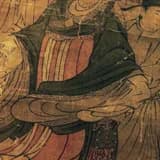
Death of Wu Zetian in Luoyang on 16 December 705, shortly after her abdication and the restoration of the Tang dynasty.
On 16 December 705, Wu Zetian died in Luoyang, ending one of the most remarkable and controversial careers in Chinese imperial history.[1][9] Just months earlier she had been forced to abdicate in favor of Emperor Zhongzong during the Shenlong coup, which restored the Tang dynasty after fifteen years of Wu Zhou rule.[1][18]
Her death closed a chapter in which a woman had ruled China as emperor, initiating far-reaching reforms and reshaping the political landscape. Under her policies, the government moved further toward a professional bureaucracy, with officials increasingly selected by examination rather than aristocratic birth.[1][9] She also patronized Buddhism and sponsored monumental projects such as works at the Longmen Caves, embedding her image and ideology in stone.[1][15]
Following her death, Wu was buried alongside her husband, Emperor Gaozong, at the Qianling Mausoleum, marked by the famous "Wordless Stele" that bears no inscription.[1] Some historians interpret the stele as a symbolic acknowledgment that her legacy defied simple moral judgment; others see it as a deliberate erasure by later Tang rulers who wished to minimize her memory while retaining the benefits of her administrative reforms.
The date 16 December 705 is significant not only as the end of Wu Zetian’s life but as a pivot in the historiography of women and power. After her death, no woman again held the title of emperor in China, and subsequent narratives—shaped by Confucian scholars—often vilified her to warn against female rule.[2][6] Modern scholarship has revisited this moment to reassess her effectiveness as a ruler, her role in advancing meritocratic governance, and the enduring symbolism of a woman who, for a time, held the Mandate of Heaven.