← All women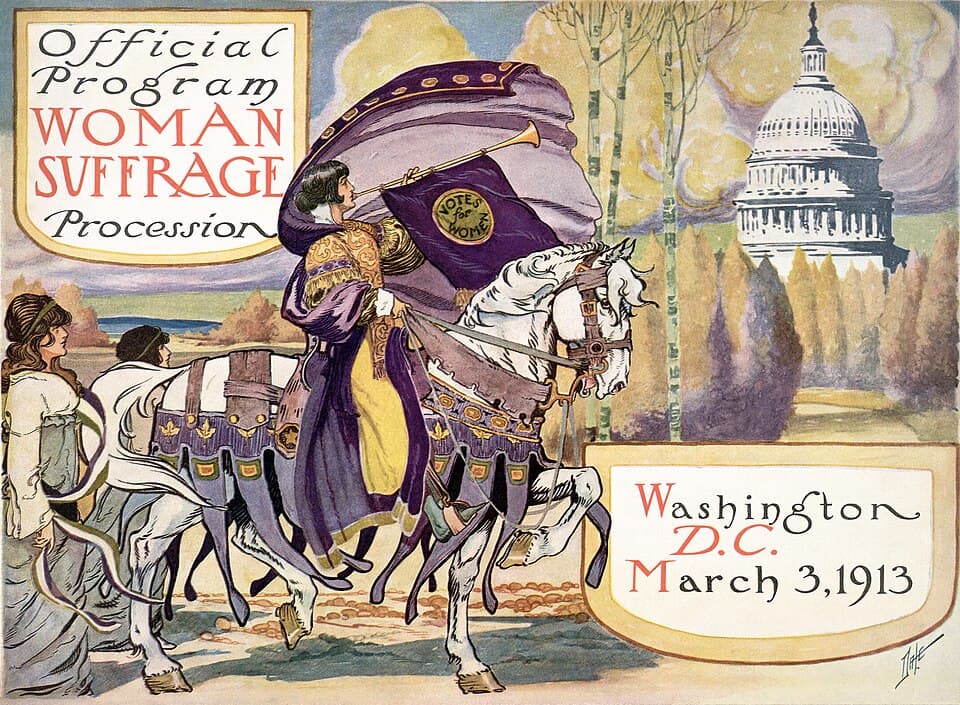
American · Activism · Politics
Woman Suffrage Procession
Unknown – present
Overview
The Woman Suffrage Procession was a landmark suffrage parade and political demonstration held in Washington, D.C., on March 3, 1913, the day before the inauguration of President Woodrow Wilson.[1][2] Organized under the auspices of the National American Woman Suffrage Association (NAWSA) and spearheaded by younger activists such as Alice Paul and Lucy Burns, the procession brought approximately 5,000 women—and perhaps many more—onto Pennsylvania Avenue to demand a federal constitutional amendment enfranchising women.[1][2][4][15] It is widely recognized as the first suffragist parade in Washington, D.C. and the first large-scale civil rights demonstration and organized political march on Washington, establishing the capital as a stage for mass popular protest.[2][10][12][15]
The event combined elaborate pageantry—bands, floats, allegorical tableaux, and the iconic figure of Inez Milholland on a white horse—with disciplined marching by state and occupational delegations.[3][4] Violent harassment by hostile crowds and the failure of local police to protect the demonstrators turned the day into a near-riot, resulting in more than 100 hospitalizations and subsequent U.S. Senate hearings.[5][13][18] Yet this crisis only amplified the parade’s impact, generating extensive press coverage and public sympathy. Historians regard the procession as a turning point that reinvigorated the U.S. woman suffrage movement, ushered in its final, more militant phase, and helped set the course toward the passage and ratification of the Nineteenth Amendment in 1919–1920.[1][2][13][15]
Background and Origins
By the early twentieth century, the American woman suffrage movement had been campaigning for the vote for more than sixty years. Organizations such as NAWSA pursued a mix of strategies, including state-level referenda, constitutional challenges, and lobbying for a federal amendment often referred to as the Susan B. Anthony amendment.[1][2] While the turn of the century brought some successes in Western states, many observers believed that the movement had grown stagnant, with limited national visibility and slow progress in the more populous East and South.
Into this context stepped a younger generation of suffrage leaders influenced by British militant tactics and new understandings of mass publicity. Alice Paul, a Quaker activist who had worked with the Women’s Social and Political Union in Britain and experienced arrest and force-feeding there, returned to the United States determined to inject fresh energy into the American campaign.[2] With fellow activist Lucy Burns, she argued that suffragists needed more dramatic, attention-grabbing tactics to force the federal government to act.[2][13]
In late 1912, NAWSA created a Congressional Committee to focus on the federal amendment, and Paul was appointed to head it.[1][2] Although some NAWSA leaders were wary of confrontational tactics, Paul secured permission to organize a major demonstration in Washington, timed to coincide with the March 1913 inauguration of President-elect Wilson. She envisioned a national procession that would bring suffragists from across the country to the capital, symbolically confronting the new administration and Congress with women’s demand for the vote.[1][3]
Planning and Organization
The planning of the Woman Suffrage Procession was ambitious and complex. Paul and Burns established headquarters in Washington, D.C., and worked under NAWSA’s name while cultivating their own network of volunteers and donors.[1][2] They obtained permits to march along Pennsylvania Avenue, the most prominent ceremonial route in the capital, traditionally used for presidential inaugural parades and other official functions.[1][15] Choosing this avenue was itself provocative, signaling that suffrage activists claimed the right to occupy the nation’s premier political stage.
Organizers devoted careful attention to the procession’s visual design. The official program, printed and sold as a souvenir, outlined a highly structured sequence of divisions: heralds, mounted brigades, state delegations, professional groups, and organizations, followed by men’s leagues and foreign representatives.[3] Marchers were urged to wear white or coordinated colors, and to carry banners indicating their state or profession. The procession would culminate in an allegorical tableau on the steps of the U.S. Treasury Building, featuring women personifying ideals such as Columbia, Liberty, Justice, Charity, Hope, and Peace.[3]
Fundraising was a constant concern. Paul and her colleagues solicited donations from sympathetic individuals and organizations, sold programs and badges, and recruited volunteers to help with logistics such as housing out-of-town participants, arranging bands, and building floats.[1] The organizers also engaged in extensive publicity, sending press releases to newspapers nationwide and emphasizing that the march was a national “procession” aiming to win a constitutional amendment.
One of the most striking decisions was to have Inez Milholland, a charismatic New York lawyer and suffrage orator, lead the parade on horseback. Clad in a white cape and riding a white horse, Milholland would personify a kind of modern womanly heroism, creating a vivid image for photographers and illustrators.[4][7] This attention to spectacle reflected Paul’s belief that suffrage needed to be visually compelling to capture national attention.
Route, Symbolism, and Participation
On Monday, March 3, 1913, participants gathered near the Garfield Monument by the U.S. Capitol in the afternoon.[11] At 3:00 p.m., Grand Marshal Jane Burleson gave the signal to step off, and the procession moved onto Pennsylvania Avenue.[11] At its head rode Inez Milholland in white, followed by heralds, bands, and five mounted brigades.[4][7] Behind them stretched state delegations from across the country, each carrying banners and often arranged in a geographic sequence from West to East, symbolizing the spread of woman suffrage victories from western states eastward.[3]
Professional groups included sections of teachers, nurses, artists, actresses, and members of newly expanding professions open to women, such as law and medicine.[3] College women marched in academic caps and gowns, visually linking women’s higher education to claims for political rights. Men supportive of woman suffrage, including members of men’s suffrage leagues, marched as a separate division toward the rear.[3]
One notable contingent was the newly founded African American sorority Delta Sigma Theta from Howard University, whose members joined despite the hostile racial climate and pressure to segregate Black marchers.[3][8] The presence of Black suffragists, including figures like Ida B. Wells-Barnett, highlighted both interracial cooperation and the persistence of racism within the movement, as some white organizers sought to relegate Black women to the back of the line to appease southern supporters.[3]
The route itself underscored the parade’s symbolic aims. Marchers advanced from the Capitol—seat of legislative authority—down the avenue toward the Treasury Building, near the White House and other executive offices. There, an elaborate tableau of women in classical dress dramatized ideals associated with the nation and with suffrage rhetoric. The official program framed the parade as a protest “against the present political organization of society, from which women are excluded,” explicitly linking women’s disenfranchisement to the structures symbolized by the surrounding government buildings.[14][3]
Hostile Crowds and Police Failure
The procession’s organizers had anticipated large crowds of spectators, especially with thousands of visitors in Washington for Wilson’s inauguration the next day. However, they did not foresee the degree of hostility and the failure of local authorities to maintain order. As the march progressed, spectators—many of them men who had been drinking—poured into the street, blocking the marchers’ path and subjecting them to jeers, insults, and physical assaults.[5][13]
Contemporary testimonies describe women being shoved, tripped, pelted with debris, and groped as they attempted to keep formations.[5][13] Some marchers were forced into single file to squeeze through gaps in the crowd; others were separated from their groups. The Washington police, who had been tasked with keeping the route clear, were widely reported as indifferent or even mocking. Some officers allegedly joined in taunting or refused to intervene when women asked for help.[5][3]
As the situation deteriorated, members of the U.S. Army Cavalry from Fort Myer were called in to restore order. Mounted soldiers rode along the route, pushing back the crowds and enabling at least part of the procession to reach the Treasury Building for the planned tableau and speeches. By the end of the day, more than 100 women had been treated at local hospitals for injuries sustained during the march.[5][13]
Congressional Hearings and Public Reaction
The violence and apparent dereliction of duty by the police generated immediate outrage. Suffrage leaders lodged formal complaints, and newspapers across the country carried stories about the mistreatment of peaceful marchers. In response, the U.S. Senate Committee on the District of Columbia opened an investigation into the conduct of the police and city officials.[18]
During the hearings that followed, more than 150 witnesses testified, including marchers, spectators, police officers, and city administrators.[18] Witnesses described in detail the crowd’s abuse and the failure of law enforcement to enforce a Senate directive that the parade route be cleared and protected.[18] The final report criticized the District’s police chief and highlighted systemic bias and incompetence in the handling of the event.
Ironically, this crisis worked in the suffragists’ favor. Reports of women being attacked for demanding the vote stirred public sympathy and broadened support for their cause. The controversy kept woman suffrage in the news for weeks after the parade, precisely the sustained attention that organizers such as Alice Paul had hoped to generate, though not by such painful means.[5][13][15]
Relationship with NAWSA and Movement Politics
The Woman Suffrage Procession also played a critical role in reshaping the internal politics of the suffrage movement. Although the demonstration was formally organized under NAWSA’s Congressional Committee, tensions between Alice Paul’s more militant, publicity-oriented approach and the older organization’s leadership soon surfaced.[2][13] Some NAWSA officials were uncomfortable with the risks and confrontational tone of the march, as well as with Paul’s willingness to defy political conventions.
In the months after the parade, Paul and her allies increasingly operated semi-independently, using the momentum from March 3 to build a new organization focused solely on the federal amendment. This effort culminated in the creation of the Congressional Union for Woman Suffrage and later the National Woman’s Party, which would adopt even more assertive tactics, including White House picketing during World War I.[2]
The procession thus stands at the hinge between NAWSA’s traditional, incremental methods and the emerging militancy of the 1910s. It demonstrated the power of large-scale public spectacle and helped legitimize strategies that framed woman suffrage as a national civil rights issue demanding immediate federal action.
Art, Imagery, and the Official Program
The cultural legacy of the Woman Suffrage Procession is preserved in its visual artifacts, especially the official program and promotional poster. The program’s cover—designed by artist Benjamin Moran Dale—depicts a robed female figure, often interpreted as Columbia or the spirit of liberty, leading a procession of women toward the Capitol, surrounded by suffrage colors and national symbols.[15] This imagery encapsulates the parade’s message that women’s political claims were integral to American democracy.
Inside, the program listed the order of march, the allegorical tableau at the Treasury, and the speeches to be delivered by prominent suffragists such as Anna Howard Shaw and Helen Keller.[3] It also included statements of purpose, notably the declaration that the procession aimed to protest women’s exclusion from the political organization of society. Collectors and institutions such as the Library of Congress and the U.S. Capitol Visitor Center preserve copies of the program, which has become an iconic artifact of the suffrage movement.
Photographs and newsreel footage from the day—showing Milholland on horseback, crowds pressing in on marchers, and the elaborate floats and banners—were widely circulated in newspapers and later in historical exhibits. These visual sources have shaped popular memory of the event and underscore how central spectacle and media imagery were to the procession’s strategy.[4][7][15]
Impact on the Federal Suffrage Amendment
Although the Woman Suffrage Procession did not immediately change the law, historians agree that it significantly influenced the trajectory of the federal suffrage campaign. By bringing thousands of women to Washington and making the federal amendment the centerpiece of a major national demonstration, the parade helped shift the movement’s focus from state-level campaigns to direct pressure on Congress and the president.[1][2]
The parade’s resonance contributed to a broader wave of activism in the 1910s. In 1913 and subsequent years, suffragists organized additional parades, lobbying campaigns, and, later, pickets and arrests that kept the issue before the public and lawmakers.[8][12][13] While the exact causal chain is complex, many scholars argue that the heightened national visibility and sense of urgency fostered by the 1913 procession formed part of the context in which Congress finally passed the suffrage amendment in 1919 and the states ratified it as the Nineteenth Amendment in 1920.[2][5][15]
Contemporary commentators and later analysts often describe the procession as marking the beginning of the movement’s “final phase,” during which coordinated national strategies, sophisticated media work, and willingness to endure arrest and violence pushed woman suffrage over the threshold to constitutional change.[13][11][15]
Legacy and Historical Significance
The Woman Suffrage Procession is remembered today for several interlocking reasons. First, it was a pioneering event in the history of civil rights demonstrations in the United States. By mounting a large, explicitly political parade in Washington, D.C., suffragists helped establish the capital as a central stage for mass protest by disenfranchised groups, a pattern later followed by labor activists, civil rights leaders, antiwar protesters, and many others.[2][10][12][15]
Second, the procession reshaped the visual and tactical repertoire of American social movements. Its combination of disciplined marching, symbolic costumes and colors, allegorical performance, and strategic use of photography and film created a powerful model for later demonstrations. The image of Inez Milholland on horseback, in particular, has become one of the most enduring icons of the suffrage era.[4][7]
Third, the march exposed both the courage of women activists and the resistance they faced, not only from anti-suffrage crowds but also from indifferent or hostile authorities. The violence and subsequent Senate hearings revealed how deeply gender bias permeated public institutions, reinforcing suffragists’ argument that women needed the vote to defend their own interests and secure fair treatment.[5][18]
At the same time, the event’s racial dynamics—especially the pressures placed on Black women to march at the back—have prompted critical reflection among historians and activists about the intersection of race and gender in the suffrage movement. The participation of Black suffragists despite segregationist pressures highlights both the breadth of the demand for voting rights and the limitations of some white leaders’ commitment to equality.[3][8]
Commemoration and Public Memory
In the decades since 1913, the Woman Suffrage Procession has been commemorated in books, films, museum exhibits, and educational materials. Institutions such as the National Park Service, the Smithsonian’s National Museum of American History, and the Library of Congress feature the parade in exhibits on woman suffrage and the broader history of American democracy.[1][4][15] The parade is also highlighted in timelines and teaching materials about civil rights marches and the Nineteenth Amendment.[4][9]
Anniversaries of the event, particularly centennial observances in 2013, have prompted reenactments and public programs in Washington and around the country. These commemorations often emphasize the procession’s role as a forerunner of later mass marches, including the 1963 March on Washington for Jobs and Freedom and the 2017 Women’s March, which also filled the capital’s streets with demonstrators demanding expanded rights.[14]
Digital humanities projects and online exhibits have further broadened access to primary sources about the procession, including scanned programs, photographs, news accounts, and scholarly analyses. These resources allow students, researchers, and the public to explore the event in detail and to situate it within larger narratives of gender, race, citizenship, and protest in the United States.[4][12][15]
Assessment
Although it was a single-day event, the Woman Suffrage Procession of March 3, 1913 occupies an outsized place in the history of the U.S. woman suffrage movement and the evolution of mass protest in the American capital. It marked the first suffrage parade in Washington, the first large, organized political march on the city, and the first civil rights demonstration to use its ceremonial core as a backdrop.[2][10][12][15] The procession dramatized women’s exclusion from political power, exposed the hostility they faced, and helped catalyze a final, successful push for a constitutional guarantee of women’s right to vote.
At the same time, the event’s complexities—its mix of visionary leadership and internal tensions, its inspiring interracial participation and painful racial compromises—make it a rich subject for historians and activists seeking to understand how social movements work, who they include and exclude, and how they transform public space and political possibility. As such, the Woman Suffrage Procession remains a central reference point in women’s history and in the broader story of American democracy.
Dated achievements
11 indexed.
- Mar031913Activism
Woman Suffrage Procession held in Washington, D.C.
On March 3, 1913, the Woman Suffrage Procession took place in Washington, D.C., demonstrating for a federal suffrage amendment.
View details National Park Service Article - Mar031913Activism
First suffragist parade in Washington, D.C.
The Woman Suffrage Procession on March 3, 1913, was the first suffragist parade in the capital.