← All women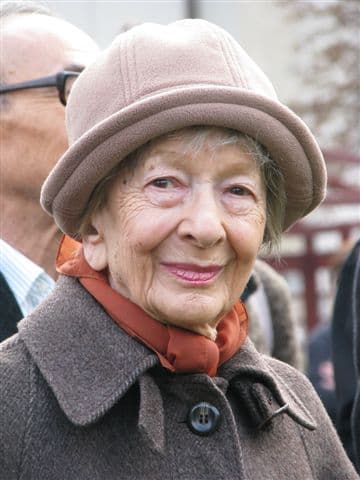
Polish · Literature
Wisława Szymborska
July 2, 1923 – February 1, 2012
Early life and background
Wisława Maria Szymborska was born on 2 July 1923 in Prowent, then associated with Bnin and now part of Kórnik, in western Poland near Poznań.[1][5][6][16] Her father, Wincenty Szymborski, worked as an estate steward for Count Władysław Zamoyski, which meant that the family lived on landed estates and moved with the employer’s needs.[2][5] Her mother was Anna Szymborska, née Rottermund.[5] Wisława was the younger of two daughters.[6]
In the late 1920s and early 1930s, the family relocated to Kraków, the historic royal capital of Poland; most sources indicate that she lived there from 1931 onward.[3][4][8] Growing up in interwar Kraków, she encountered a rich cultural environment shaped by both traditional Polish literary heritage and the modernist currents of the time. Her schooling was disrupted by the outbreak of World War II and the German occupation of Poland in 1939. During the war, she attended clandestine classes and, according to Polish sources, worked for the railway as a clerk, an experience that brought her into contact with ordinary workers and the everyday realities of occupation, themes that later informed her attention to anonymous individuals in her poetry.[5][12]
After the war, Szymborska pursued higher education at the Jagiellonian University in Kraków. From 1945 to 1948 she studied Polish philology (literature) and sociology, although she did not complete a degree, leaving for financial reasons.[3][4][8] Her university years were formative: she became involved in Kraków’s literary scene, met writers and critics, and encountered the work of figures such as Czesław Miłosz, whose poetry influenced her early thinking about literature.[4] She also began writing short stories and songs as a child and continued developing her craft in these years, refining the concise, ironic style that would later become her hallmark.[6][18]
Career beginnings and development
Szymborska made her poetic debut in March 1945 with the poem "Szukam słowa" ("Looking for Words") published in a supplement to the Kraków daily newspaper Dziennik Polski.[8] This debut placed her within the new postwar literary institutions emerging under socialist rule. In the late 1940s and early 1950s, as the communist authorities tightened control over culture, she initially aligned with the officially sanctioned doctrine of socialist realism, like many young writers of her generation. Her first book manuscript was rejected by censors for not being sufficiently ideologically correct.[5]
Her first published collection, Dlatego żyjemy ("That’s Why We Are Alive"), appeared in 1952.[8][16] It contained poems that reflected the rhetoric and optimism of early socialist construction. A second volume, Pytania zadawane sobie ("Questioning Yourself"), followed in 1954.[8][16] During this period she was a member of the Polish United Workers’ Party, but she began to distance herself from strict ideological writing as the political climate changed, especially after the Stalinist era ended in 1956.[5]
From 1953 she worked for the influential Kraków weekly Życie Literackie (“Literary Life”), remaining on its staff for nearly thirty years.[4][5] She served as an editor, columnist and reviewer, curating and commenting on literature for a broad readership. One of her most distinctive contributions was a series of short prose pieces, often titled "Lektury nadobowiązkowe" (“Nonrequired Reading”), which surveyed books of all kinds with wit and curiosity. These pieces later formed several essay collections and revealed her wide-ranging interests beyond poetry.[5][16]
Szymborska’s poetic voice changed markedly with her third collection, Wołanie do Yeti ("Calling Out to Yeti"), published in 1957.[8][16] This book signalled a break from socialist realism and an embrace of irony, skepticism and philosophical questioning. The "Yeti" of the title became a metaphor for an absent addressee through whom she explored memory, history and the absurdities of totalitarianism. Subsequent volumes such as Sól ("Salt", 1962), Sto pociech ("No End of Fun", 1967), and later books consolidated her reputation as a poet whose compact, often conversational poems probed large questions of existence while remaining grounded in everyday objects and situations.[8][16][18]
Across the following decades, Szymborska published a relatively small but carefully crafted body of work—about a dozen major collections in Polish—while maintaining a modest public profile. She avoided overt political pronouncements, yet her poems subtly interrogated ideological language, historical myths, and human responsibility. Her work was widely read in Poland and gradually translated abroad, especially after the 1980s, when international interest in Central European literature grew.[6][18]
Major works and literary accomplishments
Szymborska’s major works include a sequence of poetry collections that trace her evolving perspective on history, chance and everyday life. Among them, Calling Out to Yeti (1957) is often cited as a turning point, using the imaginary figure of the Yeti to question both personal and collective memory in the shadow of totalitarianism.[8][16] Salt (1962) introduces many of the techniques and themes that became characteristic: paradox, understatement, and an interest in seemingly minor phenomena as entry points to philosophical reflection.[8][16]
Sto pociech ("No End of Fun", 1967) continues this approach, juxtaposing humour with serious commentary on human folly and vulnerability.[8] Later collections such as Ludzie na moście ("People on a Bridge", 1986) and Koniec i początek ("The End and the Beginning", 1993) deepen her focus on the aftermath of historical catastrophe and the persistence of everyday life.[8][16] The poem "The End and the Beginning" in particular has been widely anthologised for its depiction of postwar reconstruction and selective memory.
Selections of her work in translation significantly shaped her international reception. In English, collections such as Sounds, Feelings, Thoughts (1981), People on a Bridge (1986), and View with a Grain of Sand (1995) introduced her to Anglophone readers.[16] These volumes, translated primarily by Stanisław Barańczak and Clare Cavanagh, helped preserve the wit and subtlety of her Polish idiom. Her poems are typically brief, use everyday language, and employ surprising logical turns that complicate initial assumptions—techniques that led the Nobel committee to describe her as allowing "historical and biological context to come to light in fragments of human reality."[6]
Beyond poetry, Szymborska’s "Nonrequired Reading" essays represent a major contribution to Polish literary culture. These short, humorous and thoughtful texts discuss books ranging from popular science and history to literary classics, demonstrating her curiosity and resistance to disciplinary boundaries.[5][16] They also reveal her ethical stance: she favoured close, patient reading over ideological judgments, mirroring the attentiveness found in her poems.
Her editorial work at Życie Literackie further shaped the postwar literary landscape in Poland, as she influenced which books and authors were discussed in a widely read weekly. Although she avoided a managerial or institutional leadership role, her taste and judgment indirectly affected the reception of many writers during the communist period.[5]
Awards, honours and recognition
Szymborska’s literary achievements earned numerous awards over several decades. In 1954 she received the City of Kraków Prize for Literature, recognising her early volumes.[7][19] The following year she was awarded the Gold Cross of Merit of the Republic of Poland for accomplishments in literature and art, a state honour reflecting her status within official cultural policy at the time.[8][19] In 1963 she gained the Polish Ministry of Culture Prize, confirming her position as a leading poet of the postwar generation.[7][19]
With the liberalisation of cultural life and the internationalisation of Polish literature, Szymborska began receiving foreign recognition. In 1990 she obtained the Zygmunt Kallenbach Prize, a special Kościelski Foundation award, for her book Ludzie na moście ("People on a Bridge"), praised as one of the most significant Polish books of the decade.[8][5] That same year she was given the ZAiKS literary prize for translators, reflecting her work in translation and her engagement with world literature.[5]
In 1991, the city of Frankfurt am Main selected her for the Goethe Prize.[8][19] The ceremonial presentation took place on 28 August in Paulskirche, underscoring the German recognition of a Polish poet whose work resonated with Goethean humanism and European intellectual traditions.[8] In 1995 she received the Austrian Herder Prize for literature, an award aimed at Central and Eastern European writers whose work had contributed significantly to their national cultures.[8][6]
The pinnacle of her recognition came in 1996, when she was awarded the Nobel Prize in Literature, becoming the first Polish woman to receive this honour.[1][5][6] In the same year she obtained the Polish PEN Club Prize and the Samuel Bogumił Linde Prize, a Polish-German literary award celebrating cultural ties between the two countries.[8][19] A Polish weekly, Wprost, named her "Person of the Year," reflecting the national pride and media attention surrounding her Nobel.[7]
Subsequent honours continued to accumulate. In 1997 she was made an honorary resident of the Royal Capital City of Kraków, formally integrating her into the civic identity of the city she had long inhabited.[7] Around the turn of the millennium, she became an honorary foreign member of the American Academy of Arts and Letters, with sources differing on whether this occurred in 1999 or 2001; the Wisława Szymborska Foundation indicates 2001.[8][19] In 2005, she received Poland’s Gloria Artis Gold Medal for Merit to Culture and was elected a foreign honorary member of the American Academy of Arts and Sciences in Boston.[8][19] Finally, in 2011, she was awarded Poland’s highest national decoration, the Order of the White Eagle, symbolising her status as a preeminent cultural figure.[8][7][19]
Her legacy was further institutionalised in 2013 with the establishment of the Wisława Szymborska Award, an international prize granted annually for a volume of poetry published in Polish, created to honour her memory and support contemporary poets.[8][17]
Personal life
Szymborska’s personal life was marked by a combination of strong intellectual relationships and a preference for privacy. In 1948, she married the poet Adam Włodek, who was associated with the writers’ collective at Dom Literatów (Writers’ House) on Krupnicza Street in Kraków.[5][6] The couple lived there in an environment frequented by leading Polish writers of the time. Their marriage later ended in divorce, but they maintained amicable relations, and the literary milieu of the house played a significant role in her development as a writer.[5]
She did not have children, and many biographical accounts describe her as a private or even reclusive figure, despite her public prominence after the Nobel Prize.[16] Friends and colleagues have noted her modesty, reluctance to give interviews, and preference for small, intimate gatherings over large public events. Her correspondence and friendships with critics and translators, including Stanisław Barańczak and Clare Cavanagh, were crucial for spreading her work internationally.[16][18]
Szymborska also cultivated a playful side in her personal interactions, creating humorous "collages" and mock certificates for friends. This lightness coexisted with the seriousness of her poetry and contributed to her image as someone who balanced philosophical depth with everyday humour.[5][11]
Later life and death
Following the Nobel Prize in 1996, Szymborska experienced a dramatic increase in international attention. She continued to write and publish, but maintained her characteristic restraint, releasing only a small number of new poems each year.[6][18] The growing demand for translations and readings did not fundamentally change her lifestyle; she remained based in Kraków, participated in selected public events, and used some of her resources to support literary initiatives.
In the 2000s, her health gradually declined, but she remained intellectually active. She published further collections, including late poems that continued to explore themes of time, mortality and chance with characteristic irony and clarity.[5] In addition to state honours such as the Order of the White Eagle, these years saw the consolidation of her status as a major world poet, with extensive critical engagement and translations across multiple languages.[7][8]
Szymborska died on 1 February 2012 in Kraków at the age of 88.[1][5][6] Her passing prompted wide-ranging tributes in Poland and around the world. Obituaries emphasised both her Nobel Prize and her distinctive poetic voice, often quoting poems that reflected on death and the everyday, such as "Cat in an Empty Apartment."[4][18] In the immediate aftermath, the Wisława Szymborska Foundation played a central role in managing her literary estate and promoting her legacy.[8]
Legacy and historical impact
Szymborska is widely regarded as one of the most important poets in post–World War II Polish literature.[15][18] Her work stands out for its combination of philosophical depth, ethical reflection and understated humour. Rather than directly narrating historical events, she often approached them obliquely, through everyday scenes or imagined scenarios that question the reliability of memory and the narratives constructed about the past.
Her recognition with the 1996 Nobel Prize in Literature was a watershed for Polish and women’s literary history. As the first Polish woman to receive the prize in literature, she expanded the international image of Polish writing beyond its dominant male figures and demonstrated that a female poet, working in a relatively modest lyrical form, could be central to global literary conversations.[6][18] The Nobel citation, highlighting her "ironic precision," helped establish new criteria for evaluating contemporary poetry, foregrounding intellectual play and skepticism rather than grand ideological stances.
Szymborska’s influence extends through translations, critical studies and the institutional structures created in her name. The Wisława Szymborska Award, established in 2013, ensures continued engagement with contemporary Polish poetry and maintains her association with rigorous yet accessible literary art.[8][17] Her poems are frequently taught in schools and universities, where they serve as entry points for discussions about ethics, politics, and everyday life in the twentieth century.
For women’s history, Szymborska’s career illustrates the complex trajectories of female intellectuals in Central and Eastern Europe. She navigated a male-dominated literary culture, state censorship, and shifting ideological expectations, ultimately achieving the highest international recognition without adopting a public persona of prophetic authority. Her resistance to grandiose labels, including "national poet," and her emphasis on the ordinary can be read as a gendered critique of traditional models of literary fame.
Her legacy also includes the ongoing work of translators and scholars who argue for her central place in world literature. Through the continued circulation of her poems, essays and interviews, Szymborska remains a vital presence in global discussions about how literature can respond to history with both seriousness and playful doubt.
Dated achievements
6 indexed.
- Jul021923Literature
Birth of Wisława Szymborska
Born Maria Wisława Anna Szymborska in Prowent, Poland.
View details Wikipedia - Aug281991Literature
Received the Goethe Prize in Frankfurt
Presented with the Goethe Prize in Frankfurt on August 28, 1991.
View details