← All women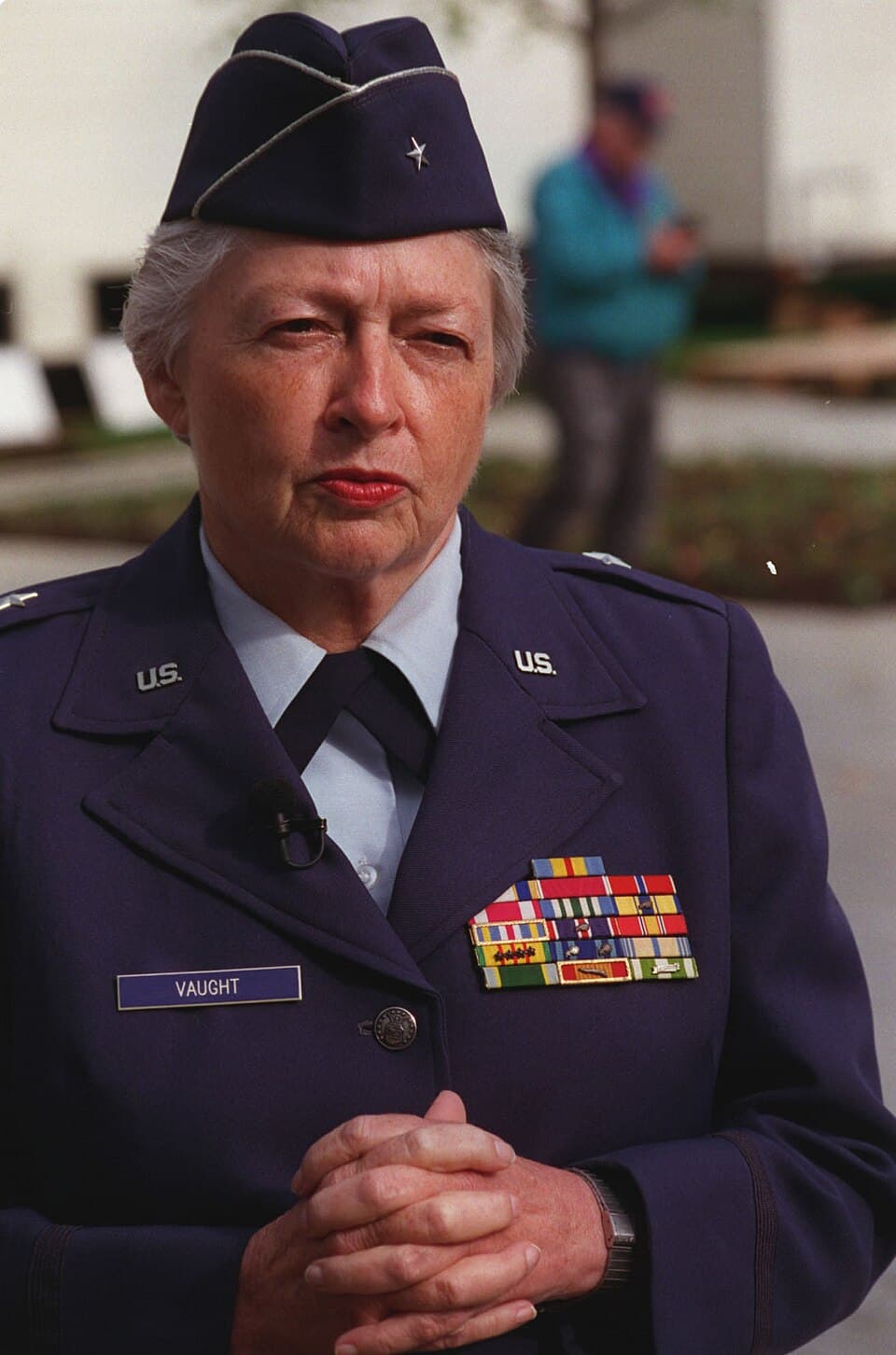
American · Aviation · Science
Wilma L. Vaught
March 15, 1930 – present
Early Life and Background
Wilma L. Vaught was born on March 15, 1930, in Pontiac, Michigan, United States.[1][7][8] She was raised primarily in the small rural community of Scotland, Illinois, where her family farmed and where she was the eldest of two daughters.[4] Growing up in a farming household during the Great Depression and World War II instilled in her a strong work ethic, resourcefulness, and a sense of responsibility that would later underpin her military career.
In Scotland, Illinois, Vaught attended local schools and helped with demanding farm work, experiences that accustomed her to long hours, physical rigor, and problem‑solving under pressure.[4] Her rural upbringing also exposed her to the limitations placed on women’s opportunities in mid‑20th‑century America, particularly in leadership and professional advancement. These constraints would later motivate her search for a career path that offered broader horizons than those typically available to women of her generation.
Determined to pursue higher education, Vaught attended the University of Illinois at Urbana‑Champaign, where she studied business. She earned a Bachelor of Science degree in Business in 1952.[1][3][4][8] At a time when relatively few women completed university degrees in business fields, her achievement was a significant step. After graduation she entered the civilian workforce, but, as multiple accounts note, she saw limited prospects for advancement as a woman in American industry.[4][6]
Education and Formative Influences
Vaught’s early post‑college experiences were formative. Working in the private sector made clear to her that women were often blocked from management roles and career progression.[6] This realization coincided with the U.S. military’s gradual post‑World War II expansion of opportunities for women, though still tightly constrained by law and policy.
Seeking a path to leadership, Vaught explored the possibility of military service. She first encountered a recruiting letter from the Army offering women the chance to serve as officers in management positions.[6] On advice, she investigated whether the Air Force offered similar opportunities. Learning that it did, she decided to pursue commissioning through the Air Force rather than the Army, a choice that would shape the rest of her life.[6]
While serving, Vaught continued her education. She later earned a Master of Business Administration (MBA) degree from the University of Alabama at Tuscaloosa in 1968.[1][2][8] The combination of professional military training and advanced business education positioned her uniquely for high‑responsibility roles in financial management and resource oversight—areas where she would become one of the foremost female leaders in the U.S. Air Force.
Career Beginnings in the U.S. Air Force
In 1957, Wilma Vaught entered the U.S. Air Force Reserve as a second lieutenant, beginning a military career that would eventually span nearly 29 years.[1][3][4][6][10] She transitioned to active duty and joined the Air Force’s comptroller field, a specialty focused on budgeting, finance, and resource management.[2][3] Her early assignments in the comptroller area took her to Barksdale Air Force Base, Louisiana, and other stateside installations.[2]
The comptroller field was, at the time, heavily male‑dominated and central to the financial integrity of Air Force operations. Vaught’s performance and expertise allowed her to rise steadily through the ranks, despite the formal and informal barriers faced by women in the armed forces during the late 1950s and 1960s.[3][4][6] Her assignments increasingly required her to manage complex budgets and support operational units, responsibilities that demonstrated her competence and reliability.
Throughout these early years, Vaught’s career coincided with significant changes in U.S. defense posture, including the growth of Strategic Air Command (SAC) and the expanding American involvement in Southeast Asia. Her willingness to accept challenging assignments and overseas deployments placed her at key nodes of Cold War and Vietnam War operations.
Breaking Barriers: SAC Deployment and Vietnam Service
One of Vaught’s most notable early accomplishments came in 1966, when she became the first woman to deploy with a Strategic Air Command (SAC) bombardment wing on an operational deployment.[3] At that time, women were largely restricted to support roles and were seldom assigned to units engaged in operational missions. SAC bombardment wings were central to U.S. nuclear deterrence and strategic bombing capabilities, and their deployments carried significant operational and symbolic weight in Cold War military planning.
This deployment marked a critical breakthrough in the integration of women into operational Air Force units. It demonstrated that a woman officer could serve effectively alongside male counterparts in a high‑stakes environment, helping to erode assumptions that women’s roles should remain confined to clerical or nursing positions.[3] Vaught’s performance during this deployment supported later expansions of women’s opportunities in operational and combat‑support assignments.
Vaught’s career also intersected directly with the Vietnam War. In 1968, she returned to Vietnam, serving in Saigon with the Headquarters, Military Assistance Command, Vietnam (MACV).[2][3] There she worked as a comptroller and analyst, managing financial and logistical aspects of the U.S. military presence. Her oral history confirms that she was one of the relatively few women in Vietnam who were not nurses, illustrating how unusual her assignment was in the gendered structure of the wartime military.[7][9]
Her Vietnam service earned her several decorations, including the Bronze Star Medal, the Vietnam Service Medal with four service stars, the Republic of Vietnam Gallantry Cross with Palm, and the Republic of Vietnam Campaign Medal.[2][3] These honors acknowledged the significance of her contributions in a theater where women’s roles were often overlooked or minimized in public accounts of the war.
Advanced Professional Education and Senior Staff Roles
In 1972, Wilma Vaught again broke new ground when she became the first female Air Force officer to attend the Industrial College of the Armed Forces, later part of the National Defense University.[2][3] The Industrial College was a premier institution for senior military and civilian leaders, focused on national security, industrial preparedness, and resource management. Admission signified recognition of high potential and placed students in networks of senior decision‑makers.
Her successful completion of this program made her the first Air Force woman graduate, further establishing her status as a trailblazer.[2] It also enhanced her expertise in large‑scale logistics, acquisition, and financial planning, skills she would use in subsequent high‑level assignments.
Following this education, Vaught held significant positions at major commands and headquarters. She served at Zaragoza Air Base, Spain; McCoy Air Force Base, Orlando, Florida; U.S. Air Force Logistics Command, Wright‑Patterson Air Force Base, Ohio; on the Air Staff at the Pentagon; and as Deputy Chief of Staff, Comptroller, at U.S. Air Force Systems Command, Andrews Air Force Base, Maryland.[2] These roles placed her in charge of complex budgets and resource structures across multiple commands, reinforcing her reputation as a capable senior financial officer.
Promotion to Brigadier General and Command of MEPCOM
On September 8, 1980, Wilma Vaught was promoted to brigadier general, becoming the first woman in the comptroller career field in the U.S. armed forces to attain that rank.[4][3][10] The promotion ceremony held deep personal significance: her father attended and pinned the general’s star on her shoulder.[4] Professionally, it represented a major milestone for women in military finance and for women officers more broadly.
At the time of her promotion, only a handful of women across the branches had achieved general or flag officer rank. Vaught’s advancement signaled that a woman could rise to senior leadership in a technical, non‑traditional field—not just in roles historically associated with women, such as nursing or personnel. This promotion broadened the perceived scope of women’s potential contributions in the armed services.[3][4][6]
In 1982, Vaught assumed what would be her final military assignment as Commander, U.S. Military Entrance Processing Command (MEPCOM), headquartered in North Chicago, Illinois.[2][3] MEPCOM was, by geographic extent, the largest command in the U.S. military, responsible for overseeing entrance processing stations across the country and ensuring that new recruits met standards for enlistment.[3]
As commander, Vaught directed a nationwide network of stations and personnel, overseeing medical examinations, aptitude testing, and administrative processing of incoming service members.[2] Her leadership at MEPCOM was recognized as exemplary. In July 1985, she became the first woman to command a unit receiving the Joint Meritorious Unit Award, an honor described as the nation’s highest peacetime unit award.[2][3] This distinction underscored that her command had achieved exceptional performance under her leadership.
Military Decorations, Retirement, and Standing Among Women Generals
Across her service years from 1957 to 1985, Vaught accumulated an extensive record of military decorations. She received both the Defense Distinguished Service Medal and the Air Force Distinguished Service Medal, as well as the Air Force Legion of Merit, Bronze Star Medal, Meritorious Service Medal, Joint Service Commendation Medal, and the Air Force Commendation Medal with Oak Leaf Cluster.[2][3] Her campaign medals included the Vietnam Service Medal with four service stars, the Republic of Vietnam Gallantry Cross with Palm, and the Republic of Vietnam Campaign Medal.[2]
Vaught retired from the U.S. Air Force in August 1985, concluding a military career of nearly 29 years.[2][3][4][10] At her retirement, she was one of only three female generals in the U.S. Air Force and one of seven female generals in the entire U.S. Armed Forces.[3][6][10] This statistic highlights the rarity of women at the highest levels of military leadership at that time and the degree to which she had broken through institutional barriers.
Her retirement did not signal a withdrawal from public service. Instead, it marked the beginning of a second phase of her career focused on memorialization and advocacy for women veterans.
Post‑Retirement Work and the Women in Military Service for America Memorial
After leaving active duty, Vaught briefly worked as a consultant with the Strategic Defense Initiative Organization, continuing to apply her knowledge of defense planning and resource management.[2] Soon, however, her attention turned to a new mission: ensuring that women’s contributions in the armed forces were publicly recognized.
Vaught became the driving force behind the creation of the Women in Military Service for America Memorial, a national memorial located at the ceremonial entrance to Arlington National Cemetery.[3][5][9][10] As President of the Women In Military Service For America Memorial Foundation, she led the complex, multi‑year effort to gain approval for the memorial site, design the memorial, and raise the necessary funding.
Sources credit her with spearheading a campaign that raised more than $20 million to build the memorial, ultimately known as the Women’s Memorial.[3][5][9][10] The project involved extensive outreach to veterans, legislators, and donors, as well as coordination with architects, planners, and federal agencies. Vaught’s leadership ensured that the memorial would honor all women who have defended the United States, across all branches and eras of service.
The memorial opened in the late 1990s and has since served as the nation’s central site for highlighting women’s roles in the military. It houses exhibits, a register of servicewomen, and educational programs. Vaught’s commitment to the memorial extended far beyond its construction: she served as foundation president for approximately 29 years, stepping down as president on January 1, 2016, and subsequently serving as president emeritus.[2][10]
Awards, Honors, and Recognition
In addition to her military decorations, Wilma Vaught has received numerous civilian honors. Her alma mater, the University of Illinois, awarded her the Distinguished Alumni Achievement Award in 1983.[2] She has also received honorary degrees, including an Honorary Doctor of Public Affairs from Columbia College, South Carolina, and an Honorary Doctorate of Letters from the National Graduate School.[2]
In October 1985, shortly after her retirement from active duty, Vaught received the Woman Who Made A Difference Award from the International Women’s Forum, recognizing her impact as one of the pioneering women in the armed forces.[2] She was later inducted into the National Women’s Hall of Fame, which highlighted her barrier‑breaking military career and her role in creating the Women’s Memorial.[3]
Her leadership and advocacy for women veterans have also been acknowledged by government institutions. The White House during the Obama Administration profiled her as a champion for women veterans, emphasizing her central role in building and sustaining the Women’s Memorial.[5] The U.S. Department of Veterans Affairs highlighted her many “firsts” and her influence in promoting recognition of women’s service.[8]
On July 7, 2025, Vaught’s contributions achieved one of the highest forms of national recognition when she received the Presidential Medal of Freedom from President Joe Biden.[1] This honor formally acknowledged both her trailblazing military career and her work to ensure that generations of women who served would have their stories preserved and honored.
Personal Life
Sources describing Wilma Vaught’s life focus predominantly on her military and memorial‑building careers. Public records and biographical profiles emphasize her professional achievements and pioneering status as a woman general, but provide limited detail regarding marriage, children, or other aspects of her private life.[1][2][3][4][5][10] This emphasis reflects a broader pattern in coverage of high‑profile military figures, where personal details often remain secondary to institutional and historical contributions.
Information that is available underscores her close relationship with her family of origin, particularly the significance of her father’s presence at her promotion to brigadier general and his role in pinning the general’s star on her shoulder.[4] Her continued connection to her rural Illinois roots and to the University of Illinois alumni community also appears in multiple accounts.[2][3][4]
Legacy and Historical Impact
Wilma L. Vaught’s legacy encompasses both her barrier‑breaking military career and her work as a architect of public memory for women in the U.S. armed forces. As one of the most highly decorated women in American military history, she demonstrated that women could excel in complex technical specialties, hold major commands, and attain general officer rank.[1][3][4][6][10]
Her “firsts” mark key turning points in military gender integration: the first woman to deploy with a SAC bombardment wing on an operational deployment (1966); the first female Air Force officer to attend and graduate from the Industrial College of the Armed Forces (1972); the first woman promoted to brigadier general from the comptroller career field (1980); and the first woman to command a unit receiving the Joint Meritorious Unit Award (1985).[2][3][4] Each of these milestones opened symbolic and practical space for other women to follow.
Equally significant is her work on the Women in Military Service for America Memorial. By designing and leading the effort to build a national memorial at Arlington National Cemetery, Vaught helped ensure that women’s military history would not remain fragmented or invisible.[3][5][9][10] The memorial’s archive, register, and exhibits now provide researchers, families, and the public with a central place to encounter the stories of women’s service, from the Revolutionary War to the present.
Her advocacy has influenced policy discussions and public understanding of women veterans. Profiles by the White House and the Department of Veterans Affairs frame her as a champion for women veterans whose work has enlarged the nation’s capacity to remember and honor their contributions.[5][8] In this sense, her impact extends beyond her own generation to affect how future generations will study and commemorate women in uniform.
Later Life and Continuing Influence
Following her long tenure as president of the Women In Military Service For America Memorial Foundation, Vaught stepped down from the presidency effective January 1, 2016, becoming President Emeritus.[2] This transition recognized both her decades of leadership and her desire to ensure continuity by passing day‑to‑day operations to successors, while remaining a symbolic and advisory presence.
Into the 21st century, Vaught has continued to serve as a public voice on the history of women’s military service. She has participated in oral history projects, interviews, and podcasts documenting her experiences as a Vietnam veteran, a female general, and the builder of the Women’s Memorial.[7][9] These narratives serve as primary sources for scholars and students seeking to understand both institutional change in the military and the lived experience of pioneering women officers.
Her Presidential Medal of Freedom in 2025 affirmed the national significance of her contributions long after her retirement.[1] As a living recipient and a retired brigadier general, she symbolizes the enduring presence of women in the highest echelons of military and civic life. For women considering military careers today, Vaught’s story offers a concrete example of how persistence, expertise, and leadership can transform both personal trajectories and institutional structures.
As of the mid‑2020s, Wilma L. Vaught remains a central figure in the historiography of women in the U.S. military. Her life’s work—spanning operational deployments, senior command, and the creation of a national memorial—has permanently reshaped both the reality and the remembrance of women’s roles in defense of the United States.
Dated achievements
3 indexed.
- Mar151930Aviation
Birth of Wilma L. Vaught
Wilma L. Vaught was born in Pontiac, Michigan. She became a retired U.S. Air Force brigadier general.
View details Wikipedia - Jan011966Aviation
First woman to deploy with a SAC bombardment wing
Wilma Vaught was the first woman to deploy with a SAC bombardment wing, breaking gender barriers in military deployments.