← All women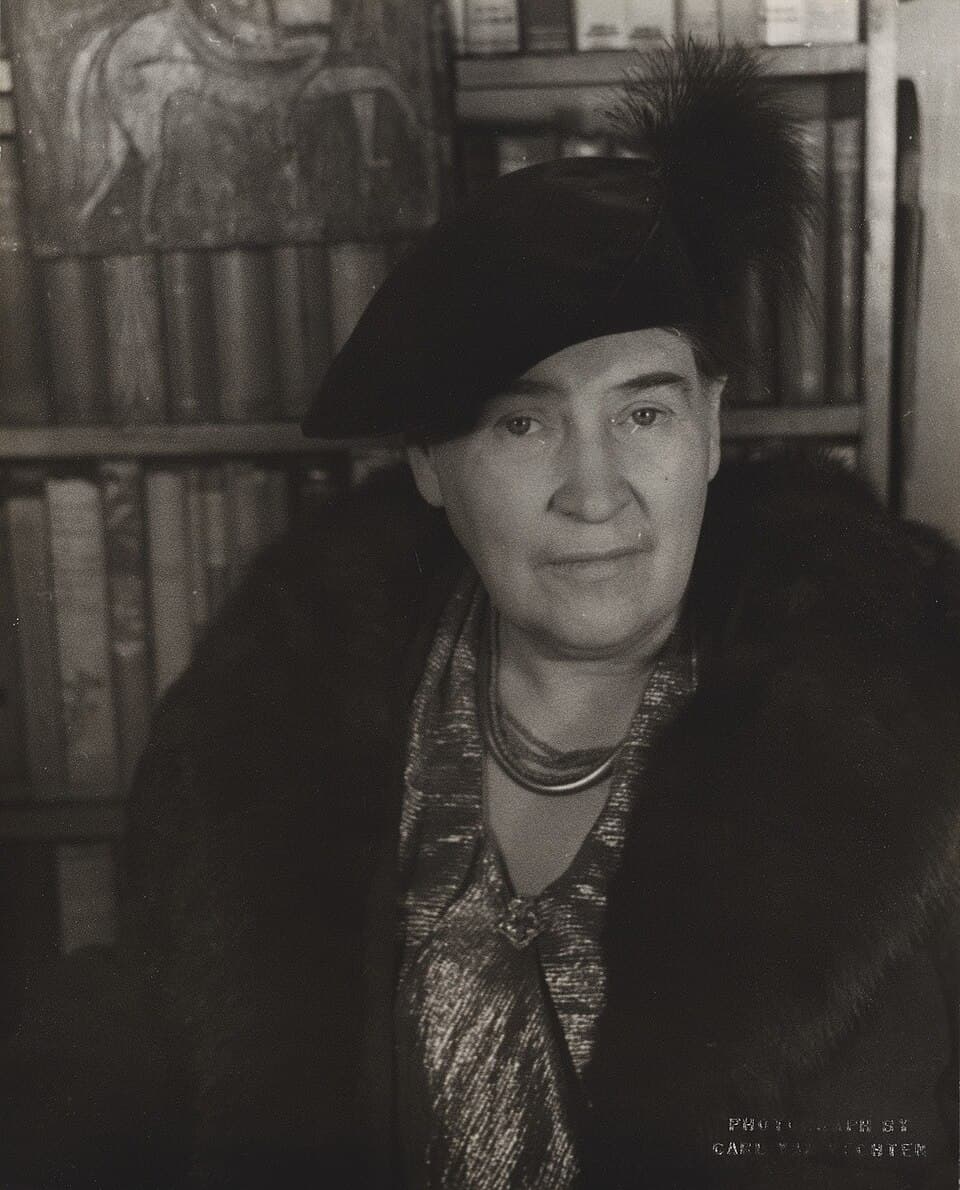
American · Literature
Willa Cather
December 7, 1873 – April 24, 1947
Early Life and Background
Willa Sibert Cather (born Wilella Sibert Cather) was born on December 7, 1873, in Back Creek Valley near Gore, in Frederick County, Virginia.[3][4][6][14] She was the first of seven children of Charles F. Cather, a farmer and businessman, and Mary Virginia Boak Cather, a former schoolteacher.[6][7] The family lived in a rural community shaped by the lingering effects of the Civil War and Reconstruction, surrounded by extended kin and the rolling landscape of the Shenandoah Valley.
In April 1883, when Cather was nine, her father followed his parents and brother west and moved the family to Catherton, Nebraska, on the Great Plains.[4][8][11][12] They settled on a homestead just outside Red Cloud, a small railroad town whose diverse immigrant population and prairie environment would provide the raw material for much of Cather’s later fiction.[2][5] The move from wooded Virginia to the open Nebraska prairie was a profound imaginative shock for the young Willa, who later described the Plains landscape as both exhilarating and austere.
In Red Cloud, Cather developed close relationships with immigrant families from Bohemia, Sweden, and other parts of Europe, observing their struggles to adapt to frontier life.[2][4][5] These communities and the town’s main street, farms, and Catholic and Protestant churches became the basis for characters and settings in novels such as O Pioneers! and My Ántonia.
Cather’s early education took place in Nebraska. She completed high school in Red Cloud, demonstrating strong interests in science and literature.[11] As a teenager she sometimes dressed in masculine clothing and signed herself "William," reflecting a nonconformist temperament and resistance to conventional gender roles—traits echoed in some of her later, unconventional heroines.[4][17]
Education and Intellectual Formation
After graduating from high school, Cather moved to Lincoln, Nebraska, and enrolled at the University of Nebraska in 1890.[2][11] Initially intending to study science and possibly pursue medicine, she soon gravitated toward literature and writing. While at the university, Cather worked as a theater and drama critic for the Nebraska State Journal and the Lincoln Courier, covering plays and cultural events with a sharply opinionated style.[11][17]
She also wrote for the student newspaper The Hesperian, becoming its managing editor in 1893.[11] These experiences honed her skills in criticism and prose style, and brought her into contact with contemporary drama and fiction. Cather graduated from the University of Nebraska in 1895.[11][2]
During her college years, Cather began publishing short stories and essays, demonstrating an emerging ability to combine precise descriptive detail with psychological insight. Her work reflected both the cosmopolitan influences she encountered in Lincoln and the rural frontier world she had known in Red Cloud.[4][14]
Career Beginnings: Teaching and Journalism
After graduation, Cather embarked on a career in teaching and journalism. In the late 1890s she lived in Pittsburgh, Pennsylvania, where she taught high school Latin and English and served as a magazine editor and critic.[2][4][5] Her Pittsburgh years were important for both professional and personal reasons: she gained experience shaping texts for publication and met people whose stories would later inform her fiction.
Cather’s first book, the short-story collection The Troll Garden (1905), drew on her critical understanding of the arts and presented characters struggling with aesthetic ambition and social constraint.[11] Around the same time, she increasingly envisioned herself as a full-time writer rather than primarily a teacher or journalist.
In 1906, Cather moved to New York City to become an associate editor at McClure’s Magazine, then one of the leading muckraking and literary periodicals.[2][4][9] At McClure’s she edited investigative articles, profiles, and fiction, gaining insight into magazine culture and the national literary marketplace. Her editorial work was demanding but broadened her professional network.
A key turning point came through her friendship with New England writer Sarah Orne Jewett. Jewett encouraged Cather to leave journalism and devote herself to imaginative writing grounded in the places and communities she knew best.[4][9] Cather later credited Jewett’s advice with helping her shift from derivative, urban-centered stories to the distinctive regional novels that made her reputation.
Major Works and Literary Development
Cather’s first novel, Alexander’s Bridge (1912), was published while she was still working closely with McClure’s.[9][11] Influenced by Henry James and contemporary commercial fiction, it is set in Boston and London and focuses on an engineer facing personal and professional crisis. Cather later considered it apprentice work, not yet fully her own voice.
Her breakthrough came with O Pioneers! (1913), the first of her great Nebraska novels.[3][9][11] Set among Scandinavian immigrant farmers in Nebraska, it centers on Alexandra Bergson, a determined woman who successfully develops her family’s land. The novel blends regional realism with mythic overtones, presenting the Great Plains as both harsh and generative. It established Cather’s signature focus on frontier women, community memory, and the moral complexities of land and inheritance.
Cather followed with The Song of the Lark (1915), tracing the artistic development of Thea Kronborg, a Colorado-born singer who rises to international renown.[3][11] Drawing partly on the life of Swedish-American soprano Olive Fremstad, the novel explores artistic vocation, sacrifice, and the tension between small-town origins and cosmopolitan success. In 1929, it was later recognized as a Newbery Honor Book, reflecting its appeal to young readers.[11]
In 1918 Cather published My Ántonia, widely regarded as her masterpiece.[3][7][11][14] Narrated by Jim Burden, the novel reconstructs his friendship with the Bohemian immigrant girl Ántonia Shimerda and their shared Nebraska childhood. Through Ántonia’s resilience and Jim’s retrospective voice, Cather evokes themes of memory, cultural encounter, and the endurance of the land. The book has become a cornerstone of the American literary canon and is frequently taught in schools and universities.
Cather experimented with historical and religious themes in Death Comes for the Archbishop (1927), which recounts the lives of Catholic missionaries in nineteenth-century New Mexico.[3][11] Loosely inspired by the careers of Archbishop Jean-Baptiste Lamy and Father Joseph Machebeuf, the novel adopts an episodic, legend-like structure. It proved highly popular, selling tens of thousands of copies and later earning Cather the William Dean Howells Medal from the American Academy of Arts and Letters.[11]
Cather’s interest in French-Canadian history and Catholicism continued in Shadows on the Rock (1931), set in seventeenth-century Quebec.[11][17] French jurors later awarded her the Prix Femina Américain for this novel, recognizing her depiction of French culture in North America.[17] Other major works from her mature period include The Professor’s House (1925), a complex study of an academic confronted by past choices; My Mortal Enemy (1926), a short novel about marital disillusionment; and Lucy Gayheart (1935), which returns to Midwestern musical aspiration.
Her final novel, Sapphira and the Slave Girl (1940), revisits antebellum Virginia and the institution of slavery through the story of a white mistress and an enslaved young woman.[11] The book engages with race, power, and memory, reflecting Cather’s effort late in life to grapple directly with the South’s history.
In addition to novels, Cather published significant short-story collections, including The Troll Garden (1905), Youth and the Bright Medusa (1920), and Obscure Destinies (1932).[11] These collections contain some of her most admired shorter works, such as "Paul’s Case" and "Neighbor Rosicky," which further develop her interest in artists, outsiders, and immigrant farmers.
Awards, Honors, and Recognition
Cather’s work received major national and international honors across the 1920s and 1930s. In 1923, she was awarded the Pulitzer Prize for the Novel for One of Ours, her World War I novel focused on a young Nebraskan soldier.[3][1][11][14] The prize, first awarded only a few years earlier, placed her among the earliest American women novelists to receive this distinction.
Death Comes for the Archbishop (1927) later led to her receiving the William Dean Howells Medal for Fiction from the American Academy of Arts and Letters in 1930, honoring the best American novel of the preceding five years.[11][17] In 1931, she was further recognized with the Prix Femina Américaine (or Prix Femina Américain), acknowledging her distinguished literary achievement and her representation of French culture.[11][17] French jurors subsequently honored her again, awarding the Prix Femina Américain for Shadows on the Rock in 1933.[17]
In 1931, Princeton University conferred an honorary Doctor of Letters degree on Cather, the first honorary degree the university had ever granted to a woman.[15] This recognition marked a significant institutional milestone in the slow opening of elite universities to women’s intellectual contributions.
Cather was elected a member of the American Academy of Arts and Letters in 1938, reflecting her peers’ judgment that she belonged among the nation’s foremost writers.[17] In the mid-1940s, she reached the pinnacle of institutional recognition when the National Institute of Arts and Letters voted to award her its Gold Medal for Fiction, a lifetime achievement honor. Contemporary accounts, including a New York Times article dated January 28, 1944, and the Library of Virginia’s documentation, place the award in 1944.[6][10]
Posthumously, Cather’s legacy continued to be honored. In 1981, she was inducted into the National Women’s Hall of Fame, recognizing her enduring impact on American literature and women’s cultural history.[5]
Personal Life and Relationships
Cather never married and had no children. Throughout her adult life, she maintained close, sometimes intense friendships with both men and women, including Pittsburgh colleagues and literary contemporaries.[4][17] The most significant long-term relationship in her personal life was with Edith Lewis, an editor and advertising writer. Lewis and Cather shared a household in New York City for many years, and Lewis assisted Cather with editorial work, travel arrangements, and the management of her career.[4][5]
The exact nature of Cather’s relationship with Lewis has been the subject of scholarly discussion, with many modern critics viewing them as a committed same-sex couple. Because Cather was intensely private and lived in a period when public acknowledgment of such relationships was rare and risky, direct documentary evidence is limited. Nonetheless, their decades-long domestic partnership and Lewis’s role as Cather’s literary executor underscore the depth of their bond.[4][17]
Cather was also deeply attached to her family, frequently visiting Red Cloud and maintaining correspondence with relatives. Her fiction often draws on family stories and the emotional textures of kinship and community across generations.[2][4][5]
Protective of her privacy and of literary control, Cather was known to dislike biographical intrusion. In her will, she placed restrictions on the publication of her letters, which slowed the appearance of comprehensive biographies and shaped how critics approached her life for decades.[4][17] Only in the late twentieth and early twenty-first centuries have more of her letters and personal documents become available to scholars, allowing richer insight into her experiences and relationships.
Later Life and Artistic Concerns
In the 1920s and 1930s, Cather traveled widely, visiting New Mexico, Canada, and Europe.[11] These journeys informed the settings and cultural textures of works like Death Comes for the Archbishop and Shadows on the Rock. She increasingly balanced her Nebraska-based materials with historical, religious, and transnational themes, often focusing on Catholic communities and the moral demands of spiritual life.
Her later fiction, including Lucy Gayheart (1935) and Sapphira and the Slave Girl (1940), reveals a continuing preoccupation with memory, regret, and the long reach of past decisions. In Sapphira, she returned imaginatively to the Virginia of her childhood, confronting the history of slavery and the complex relationships between enslaved people and white families.[11]
During her later years in New York, Cather also faced the challenges of aging and changing literary fashions. As modernist experimentation and urban themes dominated much critical attention, some reviewers regarded her work as stylistically conservative. Yet she remained committed to her own aesthetic: a deliberate, classical prose style, careful structural composition, and a focus on character and place over formal innovation.[4][14]
Death
Cather lived her final years in Manhattan with Edith Lewis. On April 24, 1947, she died in New York City at the age of 73.[3][1][6][14] She was buried in Jaffrey, New Hampshire, a region she loved and frequently visited.[3][4] At the time of her death, she was widely recognized as a major figure in American letters, though the full extent of her influence had yet to be fully appreciated.
Legacy and Historical Impact
Cather’s legacy rests on her profound contribution to American regional and national literature. She brought the Great Plains, immigrant farm communities, and small towns of Nebraska and the Southwest into the center of the American canon, challenging coastal and urban dominance in literary culture.[1][2][4][14] Her fiction treats landscapes not merely as backdrops but as active forces shaping human character, memory, and moral choice.
As a woman writer in the early twentieth century, Cather achieved a level of recognition and institutional honor that was still rare for women. The Pulitzer Prize, the Howells Medal, the Prix Femina Américain, membership in the American Academy of Arts and Letters, and the National Institute’s Gold Medal collectively mark her as one of the most decorated American novelists of her generation.[1][10][11][17] Her honorary degree from Princeton—its first to a woman—symbolizes the gradual breakdown of gender barriers in elite academic institutions.[15]
Cather’s representations of women are central to her historical importance. Characters such as Alexandra Bergson and Ántonia Shimerda embody strength, resilience, and moral complexity, resisting stereotypes of passive or decorative femininity. Her focus on women’s work—on farms, in households, and in artistic careers—expanded the range of experiences depicted in American fiction.[4][14]
Critical reception of Cather has evolved considerably. Mid-century critics sometimes framed her primarily as a regionalist, but later scholarship—especially from feminist, queer, and cultural historians—has emphasized her sophisticated narrative structures, her explorations of identity and belonging, and the possible queer subtexts of her life and work.[4][16][14] The gradual publication of her letters and the appearance of major biographies, such as James Woodress’s Willa Cather: Her Life and Art and later studies, have deepened understanding of her artistic development and personal world.[4][18]
Institutions such as the National Willa Cather Center in Red Cloud, Nebraska, preserve sites associated with her life and promote study of her work.[5] The Willa Cather Archive, hosted by the University of Nebraska–Lincoln, provides extensive digital access to manuscripts, letters, and scholarly resources, supporting ongoing research and education.[4][8] Her novels remain widely read and taught, and they continue to inform discussions of immigration, frontier mythology, religious experience, and the ethics of memory.
In women’s history, Cather stands as a key figure who demonstrated that a woman could achieve sustained national prominence as a serious novelist while maintaining artistic independence from both commercial pressures and prescriptive gender roles. Her achievements helped open institutional doors and enriched the imaginative possibilities available to later generations of women writers.
Dated achievements
5 indexed.
- Dec071873Literature
Birth of Willa Cather
Willa Sibert Cather was born on December 7, 1873, in Virginia.
View details Willa Cather - Wikipedia - May131923Literature
Pulitzer Prize for "One of Ours" announced
Pulitzer Prize awarded to Willa Cather for "One of Ours."
View details