← All women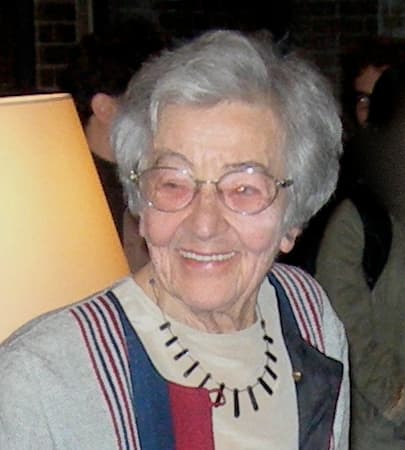
German, Canadian · Science · Activism
Ursula Franklin
September 16, 1921 – July 22, 2016
Early Life and Background
Ursula Maria Martius, later known as Ursula Martius Franklin, was born on 16 September 1921 in Munich, Germany.[1][2][9] She was the only child of a Jewish art historian mother and a Protestant ethnographer father, an intellectually rich and religiously mixed household that exposed her early to both the humanities and social sciences.[11][16] This background fostered an appreciation for culture, history, and critical inquiry that would inform her scientific career and her later activism.
Franklin grew up during the turbulent years of the Weimar Republic and the rise of National Socialism. As Nazi racial laws tightened, her mother’s Jewish heritage placed the family under increasing threat. Her parents attempted to send her to school in Britain to escape persecution, but British authorities refused her a student visa because she was under 18.[16] Remaining in Germany, Franklin studied chemistry and physics at Berlin University until she was expelled by the Nazi regime because of her background.[16]
During the Second World War, both of Franklin’s parents were interned in camps, and she herself was sent to a forced‑labor camp.[11][16] She later described surviving the Holocaust as a formative experience that shaped her understanding of violence, injustice, and the fragility of civil society. The stark contrast she observed between the immutable laws of nature, which drew her to science, and the arbitrary, brutal laws of human politics became a recurring theme in her reflections on technology and power.[14]
Education and Early Career
After the war, Franklin resumed her studies and completed a Ph.D. in experimental physics at the Technical University of Berlin in 1948.[4][8][11] Her doctoral work focused on the properties of metals and materials, laying the foundation for her later specialization in metallurgy and materials science. She soon recognized that postwar Germany offered limited opportunities for a woman scientist and for someone marked by Holocaust experience, and she began to look for possibilities abroad.[16]
In 1949, Franklin emigrated to Canada.[11][17] She initially came as a postdoctoral student to the University of Toronto, entering a scientific community that was still largely male and where women were often excluded from advanced research roles.[12] In 1951, she joined the Ontario Research Foundation as a senior scientist.[8][12] There she conducted extensive research on the structure and properties of metals and alloys, publishing widely and developing expertise in applying physical analysis to complex material systems.
During the 1950s and 1960s, Franklin’s work increasingly intersected with public policy. At the Ontario Research Foundation she participated in a pioneering project measuring radioactive strontium‑90 in children’s baby teeth, part of the multi‑year "Baby Tooth Survey" that tracked fallout from atmospheric nuclear weapons testing.[12][14][17] By analyzing materials with high sensitivity, Franklin and her colleagues produced evidence that strontium‑90 from nuclear tests was accumulating in human bodies, including those of children. Their findings contributed to public pressure for a nuclear test ban and provided scientific support for international agreements limiting atmospheric testing.[12][14]
Career at the University of Toronto
Franklin’s association with the University of Toronto became formal and long‑lasting when she rejoined the institution in 1967 as a member of what is now the Department of Materials Science and Engineering.[4][8][12] She is widely recognized as the first woman professor of metallurgy and materials science at the university, breaking a significant gender barrier in Canadian engineering.[6][8][12] She became a full professor in 1973, further consolidating her position in a field where few women held senior academic roles.[4]
At Toronto, Franklin pioneered the application of materials science to archaeology, helping to develop the field of archaeometry—the use of modern physical and chemical techniques to analyze and date archaeological artifacts.[12][15][17] By studying the microstructure of metals, ceramics, and other materials, she provided insights into ancient technologies, trade routes, and manufacturing practices. Her work showed how detailed analysis of materials could reconstruct aspects of past societies, linking laboratory science to historical and anthropological questions.
Franklin also maintained a strong commitment to teaching. Over more than forty years at the university, she taught courses in materials science, engineering, and the social aspects of technology, earning a reputation for intellectual rigor and a distinctive, justice‑oriented approach. Students and colleagues remembered her for integrating technical content with ethical reflection, encouraging engineers to consider the societal implications of their work.[6][12][17]
Major Works, Ideas, and Contributions
Although Franklin’s early career centered on metallurgy and materials science, she became widely known for her writings and lectures on the social and political impacts of technology. Her most influential work in this area is The Real World of Technology, based on the 1989 CBC Massey Lectures
Franklin distinguished between prescriptive and holistic technologies, contending that prescriptive systems break work into standardized, controlled steps and tend to suppress autonomy, while holistic approaches allow craftspeople and workers more control and creativity.[1][14] She warned that modern technological societies often privilege prescriptive systems, leading to environments that undermine democracy, justice, and individual agency. Her analysis anticipated later discussions of surveillance, algorithmic control, and the politics of infrastructure. Her research on strontium‑90 in children’s teeth remained central to her scientific legacy. By demonstrating that radioactive fallout from nuclear tests was entering human bone tissue, Franklin’s work helped galvanize public opposition to atmospheric testing and contributed to the conditions that led to treaties such as the Partial Test Ban Treaty.[12][14][17] This project exemplified her belief that scientific evidence should be used in the service of peace and public health. In materials science and archaeometry, Franklin advanced methods for examining the microstructure of metals and ceramics to infer manufacturing techniques and usage histories. Her studies helped clarify how ancient societies produced and used tools and artifacts, linking physical properties to social and economic contexts.[12][15] This interdisciplinary approach reinforced her broader conviction that technology and society are inseparable. Franklin received numerous honours recognizing both her scientific accomplishments and her activism. In 1984, she was appointed a Fellow of the Royal Society of Canada, a major distinction in Canadian scholarship.[6][12] That same year, or shortly thereafter, she became the first woman to hold the title of University Professor at the University of Toronto, the institution’s highest academic rank.[6][12] This appointment acknowledged her research excellence, teaching, and broader contributions to the university community. Her public recognition extended beyond academia. Franklin was invested as a Companion of the Order of Canada, the country’s highest level of civilian honour, in 1992, acknowledging her work in science, education, and peace advocacy.[1][8][9] She later received the Order of Ontario, recognizing her impact at the provincial level.[1] In 1995, she was awarded the Pearson Medal of Peace (also known as the Pearson Peace Medal) for her longstanding efforts to promote peace and justice.[1][12] In 1996, she received the Governor General’s Award in Commemoration of the Persons Case, honoring her contributions to women’s equality in Canada.[1][8] Franklin also received more than forty honorary doctorates from Canadian universities, reflecting widespread recognition of her intellectual and moral leadership.[12] Institutions such as the University of Toronto celebrated her as a "world‑renowned materials scientist, educator and activist," emphasizing her role in inspiring young women and men in science and engineering.[6] Her influence is further commemorated through the Ursula Franklin Academy, a Toronto secondary school named in her honour, whose educational philosophy draws on her emphasis on social responsibility, critical thinking, and technological literacy.[4] Various biographies and institutional profiles continue to highlight her achievements and her integration of scientific and humanitarian concerns.[1][2][8] Franklin’s scientific work was inseparable from her activism. A committed Quaker, she understood peace as "not so much the absence of war but the presence of justice… the absence of fear… a commitment to the future," a definition cited by Quaker organizations discussing her life.[5] This conception of peace led her to engage with issues ranging from nuclear disarmament and environmental protection to human rights and economic justice. She was a prominent pacifist, speaking and organizing against militarism and the arms race. Her scientific credibility lent weight to her arguments for disarmament, particularly when she drew on evidence of nuclear fallout’s impact on children.[12][14][17] She participated in organizations advocating for peace and often linked technological systems—such as weapons production and surveillance—to broader patterns of domination and inequality. Franklin was also deeply involved in feminist activism. She advocated for women in science and engineering, mentoring female students and colleagues and challenging institutional barriers that kept women out of senior positions.[2][6][11] Her receipt of the Governor General’s Persons Case Award underscored her contributions to advancing women’s equality.[1][8] In her writings, she connected feminist concerns with critiques of technology, arguing that prescriptive technological systems often marginalize the voices of women and other less powerful groups. As an environmentalist, Franklin spoke out against technologies that degraded ecosystems or externalized costs onto vulnerable populations. She framed environmental protection as a matter of justice and peace, emphasizing the long‑term consequences of technological choices for future generations.[11][18] Her Quaker faith reinforced her commitment to simplicity, stewardship, and community decision‑making, themes that appear throughout her analyses of technological development. Details of Franklin’s personal life are less extensively documented than her public career, reflecting her preference for privacy. It is known that she married Fred Franklin
Franklin’s survival of the Holocaust and her experiences of internment were central to her identity. She occasionally spoke about these experiences, not to foreground personal suffering, but to underline the dangers of authoritarianism and the necessity of civic courage. Her reflections on war, displacement, and rebuilding informed her emphasis on listening, consensus, and nonviolence in both personal and public life.[11][12] As a teacher and mentor, Franklin cultivated close relationships with students and colleagues. Many remembered visiting her office for discussions that ranged from materials science to politics and ethics. She often encouraged younger scholars to see their work as part of a broader search for justice and to resist narrow, technocratic definitions of scientific success.[6][11] Ursula Franklin’s legacy spans multiple domains: science, technology studies, peace activism, and feminism. In materials science and archaeometry, she demonstrated how meticulous analysis of metals and ceramics could reveal the practices of past societies, helping to establish archaeometry as a respected interdisciplinary field.[12][15][17] Her work on strontium‑90 in children’s teeth stands as a classic example of science used effectively to influence public policy and advance global health and peace.[12][14] In the realm of ideas, The Real World of Technology and her related essays have had enduring influence on scholars, engineers, and activists. Franklin’s distinction between prescriptive and holistic technologies, her emphasis on technology as a system of social relations, and her critique of technological determinism anticipated later debates about digital infrastructure, platform capitalism, and algorithmic governance.[1][14][15] Her insistence that evaluations of technology must include questions of justice and power remains a touchstone in science and technology studies. As a woman in engineering and physics, Franklin broke significant barriers, becoming the first woman professor of metallurgy and materials science and the first woman University Professor at the University of Toronto.[6][8][12] Her example has been widely cited as encouraging women to enter and remain in scientific fields, and the school named in her honour extends that influence to secondary education.[4][6] Her activism in peace, feminism, and environmental justice, grounded in her Quaker faith, has inspired generations of advocates. Franklin’s articulation of peace as the presence of justice and the absence of fear reframes pacifism as an active, structural project rather than a passive refusal of violence.[5] This perspective continues to inform peace studies and social movements. Historians of women’s history and science often highlight Franklin as a figure who combined experimental physics with a sophisticated critique of technology’s role in society, demonstrating that scientific expertise can coexist with, and indeed require, ethical and political engagement.[1][2][9][11] In her later years, Franklin remained intellectually active. Even into her nineties, she gave interviews, such as a notable 2014 conversation in which she reflected on her childhood, her attraction to the "permanence and unchangeability of nature’s laws," and her concerns about contemporary technological systems.[14] She continued to write and speak on issues of peace, justice, and technology, drawing on decades of scientific and activist experience. Franklin lived in Toronto, maintaining ties to the University of Toronto and to Quaker and peace communities. She received additional honours, including recognition from the United Nations Association for her humanitarian work and numerous tributes from professional societies and universities.[12][20] Her ideas were increasingly cited in discussions of digital technology and globalization, demonstrating their relevance beyond the industrial and nuclear contexts in which they were first developed. On 22 July 2016, Franklin died in Toronto at the age of 94.[1][2][9] The university issued an "In Memoriam" notice highlighting her pioneering role in materials science, her development of archaeometry, and her influence as a teacher and activist.[12] Newspapers such as The Globe and Mail emphasized her devotion to science, education, and pacifism.[19] On 3 August 2016, the student newspaper The Varsity published a memorial article reflecting on her legacy for students and the broader community.[17] Franklin’s death marked the end of a remarkable life that connected the traumas of twentieth‑century Europe to the challenges of technological society in the twenty‑first century. Yet her work continues to shape discussions of science, technology, and justice. Her combination of experimental rigor, interdisciplinary curiosity, and moral clarity secures her place in the history of women in science and in the broader intellectual history of Canada and the world.Awards, Honours, and Recognition
Activism, Feminism, and Quaker Witness
Personal Life
Legacy and Historical Impact
Later Life and Death
Dated achievements
5 indexed.
- Sep161921Science
Birth of Ursula Franklin
Birth of Ursula Martius Franklin in Munich, Germany.
View details Ursula Franklin Biography - Jan011967Science
First woman Professor of Metallurgy and Materials Science at U of T
Franklin becomes the first female Professor of Metallurgy and Materials Science at the University of Toronto.