← All women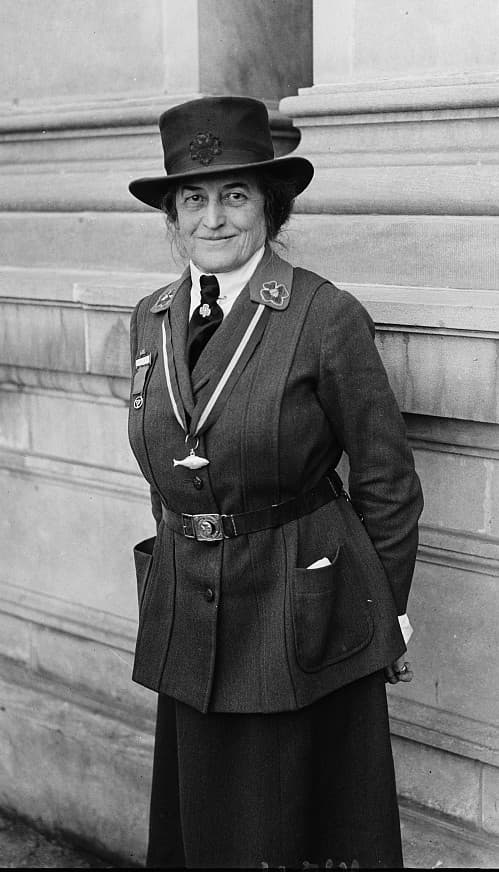
American · Activism
The Girl Scouts
October 31, 1860 – January 17, 1927
Early Life and Family Background
Juliette Magill Kinzie Gordon Low, affectionately known as "Daisy," was born on October 31, 1860, in Savannah, Georgia.[10][2][16] She was the second of six children of William Washington Gordon II, a businessman, Confederate officer, and later civic leader, and Eleanor "Nellie" Kinzie Gordon, who came from an influential Chicago family with deep pioneer roots.[10][16] Her maternal grandfather, John Kinzie, was among Chicago’s earliest settlers, and this blended Southern and Midwestern heritage exposed Juliette to diverse regional perspectives and stories of frontier resilience.[10]
Juliette’s childhood coincided with the American Civil War and the tumultuous Reconstruction era. Savannah’s occupation by Union troops and the broader economic dislocation affected the Gordon family, instilling in her a sense of adaptability and perseverance in times of crisis.[10] Her parents emphasized education, manners, and civic duty. She attended several schools, including boarding schools in Virginia and New York, where she studied literature, languages, and the arts and developed an early interest in drawing and sculpture.[10][2]
Family letters and later biographical accounts describe Juliette as lively, imaginative, and independent-minded, with a strong sense of humor and an inclination to defy convention.[10][18] She enjoyed outdoor activities and adventure, experiences that would later shape her vision for girls’ programs centered on camping, physical skills, and nature.
Health Challenges and Formative Experiences
A defining aspect of Juliette Gordon Low’s life was her progressive hearing loss. She began to lose hearing in one ear in her late teens and suffered further damage after ear infections and medical treatments.[14] A mishap on her wedding day in which a grain of rice lodged in her ear, followed by an operation, exacerbated her condition, eventually leaving her almost totally deaf in adulthood.[2][14] Despite this substantial disability in an era with limited accommodations, she remained socially active and determined to contribute meaningfully to public life.
Her impaired hearing forced her to rely on lip-reading and careful observation, skills that some biographers argue sharpened her attention to detail and deepened her empathy for those excluded or underestimated.[14][18] The combination of family privilege and personal adversity would later inform her belief that girls, regardless of background or physical challenges, deserved opportunities to develop confidence and competence.
Marriage, Social Life, and International Exposure
In 1886, Juliette married William Mackay Low, a wealthy Englishman from a prominent family that divided time between Britain and the American South.[2][10] The marriage drew her into transatlantic high society and introduced her to aristocratic circles in London and Europe. She lived in England for extended periods, participating in social functions and charitable work typical of upper-class women, while also chafing against constraints placed on women’s ambitions and autonomy.[18]
The marriage proved troubled. William Low’s infidelities and lavish spending created emotional strain, and the couple eventually lived largely separate lives.[2][10] During these years Juliette increased her involvement in charity and civic work, including hospitals and war relief efforts, gaining practical experience in organizing volunteers and fundraising.[10][18] Her international travel broadened her worldview and exposed her to emerging movements in youth work and social reform.
William Low died in 1905, following a contentious period during which Juliette sought to protect her financial interests in an environment where married women’s property rights were limited.[2][10] The resolution of his estate left her with some resources but also underscored the precarious position of women dependent on husbands for economic security. This experience strengthened her desire to chart her own path and find a vocation of genuine significance.
Encounter with Scouting and the Girl Guides
Juliette’s turning point came through her acquaintance with Sir Robert Baden-Powell, the British war hero and founder of the Boy Scouts, whom she met in the early 1910s.[2][18] She was captivated by his concept of organized youth training that combined outdoor skills, moral instruction, and service, and she became particularly interested in the sister organization, the Girl Guides, which sought to offer comparable opportunities for girls.[10][16]
While living in England, Juliette volunteered with the Girl Guides and helped organize companies (troops) there, gaining firsthand experience in the emerging movement.[15][18] She quickly grasped that such programs could transform girls’ lives by encouraging initiative, physical courage, and civic engagement. Her involvement coincided with the broader Progressive Era reforms and women’s suffrage campaigns, which increasingly pressed for women’s fuller participation in public life.[16]
Juliette came to believe that American girls needed similar opportunities. Drawing on her organizing skills, international contacts, and personal wealth, she began to plan how she could transplant the Girl Guides concept to the United States, adapting it to American conditions and her own ideas about girls’ capabilities.
Founding of Girl Scouting in the United States
In 1912, Juliette Gordon Low returned to Savannah from England determined to launch a new girls’ organization.[11][16][15] Upon arrival at her family home, she famously telephoned her cousin, educator Nina Pape, saying, "I've got something for the girls of Savannah, and all of America, and all the world, and we're going to start it tonight!"[11] This declaration reflected both her global ambition and her conviction that girls should not be confined to domestic roles.
On March 12, 1912, she held the first official meeting of what she called the American Girl Guides at the Louisa Porter Home in Savannah.[1][6][15] Eighteen girls gathered from Pape’s school to hear Juliette outline a program of outdoor activities, skills training, and community service. At that meeting, the girls recited a Promise and Law, learned knot-tying, and then crossed the street to view the carriage house that would become the troop’s headquarters.[11]
Crucially, when Juliette invited the participants to help shape the organization, they chose to be known as "Scouts" rather than "Guides," signaling a desire for adventurous, less restricted identities.[11][6] This grassroots decision, encouraged by Juliette, laid the groundwork for the organization’s eventual name, Girl Scouts. The founding meeting of March 12, 1912 is widely recognized as the birth of Girl Scouting in the United States and the origin of what became Girl Scouts of the USA (GSUSA).[1][2][4]
Organizational Development and Leadership
From 1912 onward, Juliette Gordon Low devoted her energy, time, and personal resources to building the Girl Scouts movement. She organized additional troops, recruited volunteer leaders, and began to develop standardized programs and badges that rewarded proficiency in skills ranging from camping and first aid to signaling and domestic arts.[10][15] She traveled extensively to promote the organization, using her social connections and fundraising talents to secure support.
In 1913, the American Girl Guides officially changed their name to the Girl Scouts, reflecting the term the girls had favored from the beginning.[10][6][11] Juliette worked to create a national structure, opening an early headquarters in Washington, D.C., and later overseeing incorporation so the organization could operate across state lines with a clear governance system.[8][10] She served as the first president of the Girl Scouts and for years bankrolled operations with her own money, even selling a valuable pearl necklace to keep the organization afloat.[11][4]
Under her leadership, membership grew rapidly. From the initial 18 girls in March 1912, the movement reached about 1,000 members by 1914 and 10,000 by 1918, expanding into multiple regions.[9] By 1920, membership had surged to approximately 90,000, and by the time of Juliette’s death in 1927, it had reached around 168,000 girls.[9][12][15] This growth reflected both the appeal of the program and Juliette’s persistent efforts to convince communities that girls’ outdoor training, leadership development, and service could coexist with, rather than threaten, traditional norms.
Philosophy and Program: Empowering Girls
Juliette Gordon Low’s philosophy emphasized that girls should be prepared for active citizenship and capable self-reliance. In the early decades of the 20th century, when women lacked voting rights and were often excluded from formal leadership roles, she created a space where girls could practice decision-making, teamwork, and public service.[16][10]
Girl Scouts’ activities included camping, nature study, first aid, signaling, and physical fitness, alongside homemaking skills and community projects.[10] These programs challenged stereotypes that girls were inherently fragile or suited only for domestic spheres. Juliette encouraged girls to engage in tasks such as hiking, knot-tying, and emergency preparedness, which were then strongly associated with boys.
At the same time, she insisted on a moral and civic framework. The Girl Scout Promise and Law stressed loyalty, helpfulness, honesty, and responsibility, reflecting Progressive Era values about character and citizenship.[10][11] Her vision combined practical skills with a strong emphasis on service, encouraging girls to undertake projects for hospitals, the poor, and wartime relief efforts.
Relationship with National Institutions and Public Recognition
From its early years, the Girl Scouts cultivated relationships with national institutions, including the White House. First Ladies such as Lou Henry Hoover became prominent supporters, and later First Ladies continued the tradition of serving as honorary presidents of Girl Scouts.[5] This association helped legitimize the organization and linked its mission to broader national themes of civic responsibility and youth development.
On August 11, 1976, long after Juliette’s death, First Lady Betty Ford became the eleventh honorary president of Girl Scouts, continuing a pattern of high-level endorsement that reinforced the movement’s visibility and prestige.[5] These later recognitions, while not directly part of Juliette’s lifetime, testify to the institutional strength and public esteem of the organization she founded.
Juliette herself received growing recognition over the 20th century. She was posthumously inducted into institutions such as the National Women’s Hall of Fame, which highlighted her role as an educator and humanitarian who created the largest girl-serving organization in the United States.[4] Commemorative biographies and historical markers, including those installed by the Georgia Historical Society, further cemented her status as a central figure in American women’s history.[12][15]
Personal Life, Character, and Leadership Style
Juliette Gordon Low’s personal qualities deeply influenced the nature of the Girl Scouts. Friends and contemporaries described her as energetic, charismatic, and imaginative, with a flair for storytelling and drama that she often used to inspire girls and adults alike.[10][18] She could be whimsical and artistic, designing insignia and badges, while also being pragmatic about fundraising and organizational structure.
Her hearing loss could have isolated her, but she instead leveraged it as a motivation for inclusive leadership. She embraced girls with different abilities and backgrounds, and stories about her interactions with girls emphasize that she took their ideas seriously—embodied in her frequent advice to "ask the girls" when facing organizational decisions.[11] This participatory ethos differentiated Girl Scouts from more rigid, top-down youth programs and laid the groundwork for its later emphasis on girl-led activities.
Juliette never had children of her own, which may have intensified her investment in the organization as a means of nurturing generations of girls.[2][10] She lived for periods with family and later at her Savannah home on Lafayette Square, where she conducted much of her Girl Scout business and hosted meetings. Her personal sacrifices, including the sale of jewelry to fund operations, demonstrate a level of commitment that went beyond conventional charity toward full vocational dedication.[11]
Later Life and Final Years
In the 1920s, as Girl Scouts matured into a national organization with a growing administrative structure, Juliette gradually stepped back from day-to-day leadership but remained a symbol and active advocate.[5][10] She continued to travel, speak, and support new troops, while working behind the scenes to ensure continuity and stability.
Juliette was diagnosed with breast cancer, a disease poorly understood and stigmatized at the time.[1][11] She chose to keep her illness relatively private, continuing her work as much as possible. Despite her deteriorating health, she focused on the future of Girl Scouts, seeking to ensure that the organization would endure beyond her lifetime.
On January 17, 1927, she died at her Savannah home after this prolonged struggle.[1][11][15] Two hundred Girl Scouts attended her funeral, and she was buried in Laurel Grove Cemetery wearing her Girl Scout uniform, symbolizing her lifelong identification with the movement.[11] By then, Girl Scouts counted well over 100,000 members and had secured a stable place in American society.[12][15]
Legacy and Historical Impact
Juliette Gordon Low’s legacy is vast and multifaceted. The organization she founded, Girl Scouts of the USA, has grown into one of the largest voluntary associations for girls in the world, shaping the lives of tens of millions of women and girls.[4][13] From its origins in a single Savannah troop, it expanded nationally and internationally, offering programs that evolved with changing times but retained the core emphasis on leadership, service, and outdoor experiences.
Over the decades, Girl Scouts have engaged in projects addressing public health, environmental conservation, civil rights, and STEM education, often ahead of broader societal trends. The organization’s badge system and structured programs have encouraged girls to explore nontraditional fields, including science, technology, and business, reflecting Juliette’s foundational belief that girls are capable of any challenge they undertake.[10][13]
Juliette’s birthday, October 31, was officially established as Founder’s Day by the Girl Scouts in 1920.[10][2] This annual celebration keeps her memory alive within the organization and underscores the historical consciousness of a movement that honors its roots while continuing to adapt. Her Savannah birthplace has been preserved as the Juliette Gordon Low Birthplace Museum, a National Historic Landmark that educates visitors about her life, the origins of Girl Scouts, and the broader context of women’s history.[3][17]
Historians and educators recognize Juliette Gordon Low as a pivotal figure in the history of women’s activism and youth development. Although she did not see herself primarily as a political suffragist, her work effectively advanced women’s public participation by preparing generations of girls for leadership and civic engagement in a society that was slowly expanding women’s rights.[4][16]
In recent years, renewed interest in her story has led to new biographies and commemorations, including a U.S. quarter honoring her as the founder of Girl Scouts.[9] These recognitions highlight how her vision for girl-centered education and empowerment remains relevant, resonating with contemporary efforts to support girls in leadership, STEM fields, and community action.
Continuing Influence
The continued tradition of First Ladies serving as honorary presidents of Girl Scouts, exemplified by the acceptance of this role by Betty Ford on August 11, 1976, demonstrates the enduring national reach of the movement Juliette began.[5] The organization’s partnerships with schools, community groups, and national institutions reflect its embeddedness in American civil society.
Today, Girl Scouts of the USA serves millions of members and alumnae around the world, many of whom credit the program with building their confidence and leadership skills.[13] The core principles that Juliette Gordon Low introduced in 1912—girl-led activities, outdoor experiences, skill-building, and community service—continue to underpin the organization’s mission, even as specific programs evolve to address new challenges.
Through this enduring movement, Juliette Gordon Low’s impact extends far beyond her own lifetime. Her ability to transform an imported concept of Girl Guiding into a distinctively American Girl Scouting program, and to sustain it through personal sacrifice and visionary leadership, secures her place as one of the most significant figures in the history of women’s and girls’ organizations.
Dated achievements
4 indexed.
- Oct311860Activism
Birth of Juliette Gordon Low
Juliette Gordon Low was born in Savannah, Georgia, founder of the Girl Scouts USA.
View details Juliette Gordon Low Biography - Mar121912Activism
Founding of Girl Scouts of the USA
Juliette Gordon Low founded the Girl Scouts of the USA in Savannah, Georgia.