← All women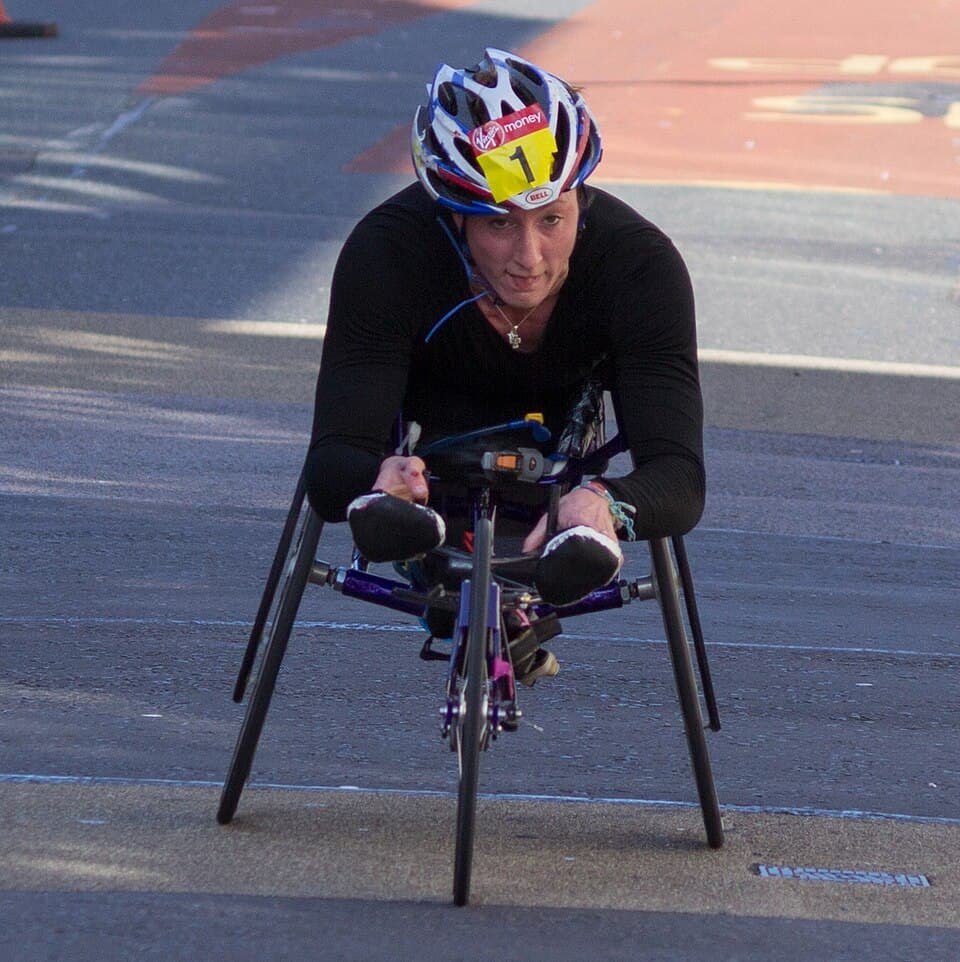
Russian, American · Sports · Activism
Tatyana McFadden
April 21, 1989 – present
Early Life and Background
Tatyana McFadden was born on 21 April 1989 in Leningrad, then part of the Russian Soviet Federative Socialist Republic in the Soviet Union, now Saint Petersburg, Russia.[3][2] She was born with spina bifida, a congenital malformation of the spine that left her paralyzed from the waist down.[3][8] Shortly after birth she was abandoned and spent her first six years in a state-run orphanage that lacked adequate medical care and even a wheelchair.[3][11] To move and keep up with other children, she taught herself to walk on her hands, a formative experience that later shaped both her physical strength and her understanding of structural barriers facing disabled children.[1][10]
Accounts from McFadden and her family describe the orphanage as under-resourced, with limited staff and few accommodations for children with significant impairments.[1][11] Her early life coincided with the final years of the Soviet Union and the turbulent post-Soviet period, when social services were under strain and disability rights frameworks were poorly developed.[12] These conditions contextualize the neglect she experienced and underscore the significance of the opportunities she would later receive.
In the mid-1990s, Deborah McFadden, an American disability-rights advocate and former commissioner in the U.S. Department of Health and Human Services, visited Russia on an aid mission focused on disability policy.[11][14] During a visit to the orphanage in St. Petersburg she met Tatyana and eventually adopted her, bringing her to the United States around age six.[8][11] McFadden has described the decision as motivated by both humanitarian concern and recognition of Tatyana’s resilience and potential.[14] The precise date of adoption is reported only by year and approximate age; sources agree that she moved to Baltimore, Maryland, with her new family in the mid-1990s.[8][11]
In Baltimore, Tatyana underwent multiple surgeries to address complications of spina bifida and received her first wheelchair.[1][5] Her adoptive mother emphasized physical activity as rehabilitation, introducing her to wheelchair sports through local programs and the Bennett Blazers, a Baltimore-based Paralympic sports club for youth with disabilities.[5][14] These early experiences provided structured coaching and peer communities and marked the beginning of her sporting life.
Education and Formative Influences
Growing up in Maryland, McFadden attended mainstream public schools where she encountered both support and discrimination.[17] She became active in wheelchair basketball, swimming, and track, but her participation in school athletics was initially restricted because many programs did not know how to integrate wheelchair athletes into existing teams.[14][17] Her mother, drawing on her background in disability advocacy, encouraged Tatyana to challenge these barriers.
In high school, McFadden attempted to join her school’s track team, but administrators resisted allowing her to compete alongside non-disabled students.[17] She eventually brought a landmark legal case arguing for equal access to school sports for students with disabilities. The resulting settlement and subsequent legislative changes in Maryland contributed to policies requiring schools to provide reasonable accommodations and equal opportunities for disabled athletes.[14][17] This episode, while not always documented with precise dates, is widely cited as a formative moment in McFadden’s activism and a significant development in U.S. disability-rights law in education.
After high school, McFadden enrolled at the University of Illinois at Urbana-Champaign, a major center for wheelchair athletics.[9] There she studied human development and trained with an elite collegiate program that has produced many leading Paralympians.[9][13] The combination of academic work on human growth and social systems with daily training in a high-performance environment helped refine both her intellectual and athletic approaches, reinforcing her commitment to using sport as a platform for broader social change.
Career Beginnings and Development
McFadden’s competitive career began in earnest in the early 2000s. By her mid-teens she had become one of the youngest members of the U.S. national wheelchair track team.[17] Her international breakthrough came at the Athens 2004 Paralympic Games, where, at age 15, she made her Paralympic debut in the T54 classification for athletes with spinal cord injuries and similar impairments.[13][3]
In Athens, McFadden won silver in the 100m T54 on 19 September 2004 and bronze in the 200m T54 on 21 September 2004.[13][3] These medals marked her arrival on the global stage and demonstrated that she could compete successfully against older and more experienced athletes. She also gained invaluable experience in racing heats and finals under Paralympic pressure.
By 2006, McFadden was competing at the IPC World Championships, where she won gold in the 100m and silver in the 200m and 400m, and on 2 August 2006 set a world record in the 100m T54.[7] The following year, on 14 July 2007, she added another world record in the 200m T54 at the Boiling Point Wheelchair Track Classic.[7] These performances established her as one of the fastest sprinters in women’s wheelchair racing.
McFadden expanded her range to include middle-distance and longer events over subsequent seasons. At the Beijing 2008 Paralympic Games, she competed in multiple distances and added four medals to her collection, solidifying her reputation as a versatile athlete.[3][4] Around 2009 she entered the professional marathon circuit, winning the Chicago Marathon wheelchair division—a key early step toward her later dominance of the World Marathon Majors.[4]
Major Achievements in Track and Road Racing
The period from 2012 to 2016 represents the core of McFadden’s competitive dominance. At the London 2012 Paralympic Games, she won three golds and one bronze in wheelchair racing across multiple distances, a breakthrough performance that moved her from consistent medalist to undisputed star in Para athletics.[3][9] London also marked her participation in the marathon, further integrating road racing into her Paralympic repertoire.[3]
In 2013, McFadden constructed one of the most extraordinary seasons in modern athletics. At the IPC Athletics World Championships in Lyon, she dominated the T54 events, winning gold in the 100m, 200m, 400m, 800m, 1500m, and 5000m.[3][15] By 25 July 2013, she had completed this sweep, becoming the first athlete ever to win six gold medals at a single World Championships in athletics.[3][15] On 21 July 2013, during the same meet, she set a world record in the 800m T54, underlining the historical scale of her performance.[7]
Simultaneously, McFadden turned to major city marathons. In 2013 she won Boston, London, Chicago, and New York City marathons in the women’s wheelchair division.[3][9] On 3 November 2013, her victory in New York completed what came to be known as the World Marathon Majors Grand Slam, making her the first athlete of any gender or disability status to win these four events in a single calendar year.[9][15] This achievement elevated wheelchair racing within global marathon culture and forced reconsideration of its relation to able-bodied competition.
McFadden continued to break records in 2014. On 21 June 2014, at the USA Track & Field Nationals, she set world records in the 1500m and 5000m T54.[7] Later that year, on 12 October 2014, she won the Chicago Marathon with a course-record time of 1:42:35 in the women’s wheelchair division.[3] She also demonstrated multi-sport versatility by competing at the Sochi 2014 Winter Paralympics, where she won silver in the sitting cross-country 1km sprint on 9 March 2014.[1][15] These accomplishments were part of a broader pattern in which she completed marathon Grand Slams in 2013, 2014, 2015, and 2016, winning Boston, London, Chicago, and New York four years in a row.[15]
At the Rio 2016 Paralympic Games, McFadden reached a new peak. She won gold in the 5000m T54 on 8 September, gold in the 1500m T54 on 10 September, gold in the 400m T54 on 12 September, and gold in the 800m T54 on 17 September, along with two silver medals in other events.[3][15] Her six-medal haul made her the top individual medal winner in Para athletics at the Games.[15] The breadth of her Rio performances—spanning sprint, middle-distance, and long-distance races—further solidified her reputation as one of the greatest wheelchair racers in history.
Remarkably, McFadden then resumed her marathon schedule. On 9 October 2016, she won the Bank of America Chicago Marathon wheelchair division, contributing to her fourth consecutive World Marathon Majors Grand Slam season.[3][10] Her ability to transition from multi-event track championships to elite road marathons exemplifies the demanding nature of her training and competitive commitments.
McFadden’s career continued through the Tokyo 2020 Paralympic Games, delayed to 2021 by the COVID-19 pandemic. There she won gold in the 4x100m universal relay on 31 August 2021, silver in the 800m T54 on 2 September, and bronze in the 5000m T54 on 4 September.[13][3] These medals pushed her total into the twenties and reaffirmed her status as Team USA’s most decorated track and field Paralympian.[3][18]
Her road racing success was underlined again in 2021. On 10 October 2021, McFadden’s victory in the Chicago Marathon wheelchair division brought her to 24 Abbott World Marathon Majors wins, more than any other female wheelchair athlete.[4] This record provides a clear quantitative measure of her long-term dominance in elite marathon racing.
At the Paris 2024 Paralympic Games, McFadden added further achievements. On 6 September 2024 she won silver in the 100m T54, and a Nike release highlighted that this medal made her the most winning American track and field athlete of all time, Olympian or Paralympian.[18] Two days later, on 8 September 2024, she earned bronze in the mixed 4x100m universal relay, bringing her Paralympic medal total to 22.[18][3] These Paris results demonstrate her sustained competitiveness and historical stature into the mid-2020s.
Awards, Honors, and Advocacy
McFadden’s competitive achievements have been accompanied by significant recognition. On 11 February 2015, she received the Laureus World Sportsperson of the Year with a Disability award for 2014 at a ceremony in Shanghai, honoring her marathon Grand Slams and World Championships sweep.[3] The Laureus award placed her among an elite group of globally recognized athletes and highlighted the importance of Paralympic achievements within mainstream sporting narratives.
In 2015, she also received the Laureus disability sport award more broadly for her combined 2013–2014 achievements, although sources do not specify another ceremony date beyond February.[3] Her story has been widely profiled by major outlets such as CNBC, Newsweek, the BBC, and Runner’s World, which have emphasized both her life journey—from Russian orphanage to world champion—and her advocacy role.[5][7][12][10]
McFadden has been a leading advocate for disability rights in sport. Together with her mother, she worked to advance legislation in Maryland that requires schools to provide equal access to athletic programs for students with disabilities, a development arising from her own exclusion from high school track.[14][17] Their efforts contributed to broader national conversations about inclusive physical education and extracurricular sports, and some policies inspired by their work have influenced federal guidance on disability in school athletics.
Beyond legislation, McFadden launched the Tatyana McFadden Foundation to support youth with disabilities, particularly by providing racing chairs and access to sport.[13] She co-authored a children’s book, "Ya Sama! Moments from My Life", designed to share her story with younger audiences and encourage resilience and ambition among disabled children.[13] In 2020 she co-produced and appeared in the Netflix documentary "Rising Phoenix", which profiles Paralympic athletes and the broader movement for disability inclusion in sport.[13]
On 15 April 2025, McFadden received the AAU James E. Sullivan Award, one of the United States’ highest honors for amateur athletes.[3] The award recognized not only her record-setting performances but also her leadership and character. Historically dominated by Olympic and collegiate athletes, the Sullivan Award’s recognition of a female Paralympian underscores changing attitudes toward disability sport in the United States.
Personal Life
Public sources focus primarily on McFadden’s athletic and advocacy work, and details of her personal life beyond her relationship with her family are limited. She has a sister, Hannah, who also competes in Paralympic track and field; together they became the first siblings to compete in the Paralympics, a milestone in family participation in Paralympic sport.[13]
McFadden has spoken in interviews about the central role of her mother, Deborah, in shaping her life, describing their relationship as both familial and collaborative in advocacy.[14] They appear together in oral histories and public events discussing disability rights, adoption, and the development of inclusive sports policy.[14] McFadden’s social media presence, including a verified Instagram account, reflects her ongoing engagement with fans, sponsors, and advocacy campaigns.[20]
Available sources do not document marriage, children, or other personal relationships in detail, and editorial standards for historical biography suggest focusing on verifiable public information rather than speculation. McFadden’s personal narrative, as presented in media and autobiographical materials, centers on her journey from orphanage to global athlete, her family relationships, and her identity as a disability-rights advocate and role model.
Legacy and Historical Impact
Tatyana McFadden’s legacy in women’s and disability sports history is multifaceted. Athletically, she is one of the most decorated Paralympic track and field athletes, with 22 Paralympic medals across Summer and Winter Games as of Paris 2024, including eight golds, eight silvers, and multiple bronzes.[3][18][1] Her record includes historic performances such as six golds at a single World Championships and four consecutive marathon Grand Slam seasons.[3][15]
Her marathon record is equally remarkable. With at least 24 Abbott World Marathon Majors wins by 2021, McFadden holds more majors victories than any other female wheelchair athlete.[4] These wins, combined with course records and repeated titles in Boston, London, Chicago, and New York, have reshaped expectations about what disabled women can achieve in endurance sport and forced major races to treat wheelchair divisions as central competitive events.
In 2024, Nike publicly recognized her as the most winning American track and field athlete of all time, Olympian or Paralympian, following her 100m T54 silver at Paris 2024.[18] This designation situates a disabled woman at the pinnacle of U.S. track and field history, challenging the traditional bias that has centered able-bodied Olympic achievements in assessments of national sporting greatness.
McFadden’s advocacy has had lasting policy impact. Her lawsuit against her high school and her subsequent legislative work in Maryland helped establish principles of equal access to school sports for students with disabilities.[14][17] These efforts have influenced broader educational practice and provided a model for integrating disabled athletes into mainstream teams rather than segregating them into separate programs.
Through the Tatyana McFadden Foundation, her children’s book, and her participation in "Rising Phoenix", she has contributed to a cultural shift in how disability and athleticism are represented, particularly for girls and young women.[13] Her story is often used in educational and motivational contexts to illustrate resilience, the importance of structural support, and the need for inclusive design in sports and public spaces.
McFadden’s legacy also includes her role as a symbol of transnational adoption and disability rights. Born in Russia and raised in the United States, she embodies the intersection of global inequality, humanitarian intervention, and personal agency. Her journey highlights how changes in policy, resources, and attitudes can transform the life trajectories of disabled children.
Later Career and Continuing Influence
In the 2020s, McFadden has continued to compete while expanding her advocacy and public speaking work. Her Tokyo 2020 and Paris 2024 medals demonstrate sustained elite performance over more than two decades, a rarity in track and field.[3][18] As health and social systems respond to the COVID-19 pandemic and evolving understandings of disability, her experiences as an athlete navigating disruptions, medical challenges, and training adjustments have informed discussions about resilience and support structures.
McFadden’s recognition with the AAU James E. Sullivan Award in 2025 symbolizes the growing institutional acceptance of Paralympic excellence as integral to American sports history.[3] Her presence in oral history projects, including interviews with the U.S. Olympic & Paralympic Museum, ensures that future scholars will have direct testimonial sources documenting her life, achievements, and perspectives on disability rights.[14]
While she remains active, her historical impact is already clear: Tatyana McFadden has helped reshape the landscape of women’s wheelchair racing, advanced disability-rights legislation in school sports, and challenged long-standing hierarchies between Olympic and Paralympic achievement. Her story continues to influence athletes, policymakers, educators, and cultural producers who seek to build more inclusive sporting worlds.
Dated achievements
24 indexed.
- Apr211989Sports
Birth in Leningrad, Russia
Birth of Tatyana McFadden in Leningrad, Russia, with spina bifida, later becoming a leading Paralympic wheelchair racer and advocate.
View details Tatyana McFadden – Wikipedia - Sep192004Sports
First Paralympic medal – Athens 2004 T54 100m silver
Wins first Paralympic medal, silver in women’s T54 100m at Athens 2004 on 19 September 2004.