← All women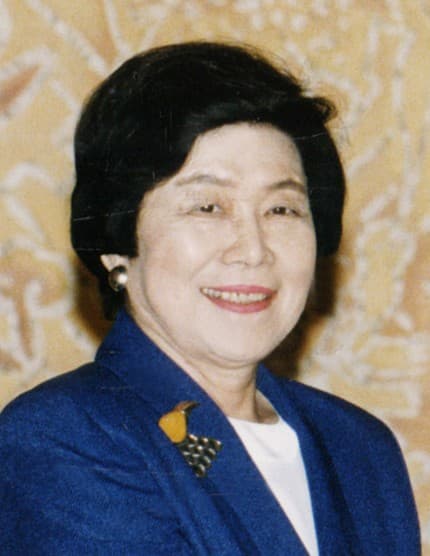
Japanese · Politics · Activism · Law
Takako Doi
November 30, 1928 – September 20, 2014
Early Life and Education
Takako Doi was born on November 30, 1928, in Kobe, Japan, the daughter of a physician. She grew up in an era of profound national upheaval, coming of age during the militarist period, World War II, and the subsequent Allied occupation of Japan. These formative experiences of national defeat, devastation, and reconstruction under a new, pacifist constitution left a deep imprint on her political outlook, one that would define her entire public career.
Doi pursued a legal education at Doshisha University in Kyoto, a path highly unusual for a woman of her generation in a society where higher education, let alone the study of law, remained overwhelmingly the province of men. She went on to specialize in constitutional law, eventually becoming a university lecturer on the subject. Her academic focus on Japan's 1947 "Peace Constitution," and in particular its famous Article 9 renouncing war as a sovereign right, became the ideological cornerstone of her later political life. She emerged from academia as a committed pacifist and progressive, sympathetic to the democratic socialist tradition that the Japan Socialist Party (JSP) represented in the postwar political landscape.
Entry into Politics
Doi entered electoral politics in 1969, when she was elected to the House of Representatives, the lower and more powerful chamber of Japan's bicameral National Diet, representing a constituency in Hyōgo Prefecture on the JSP ticket. She would go on to be re-elected repeatedly, serving continuously in the Diet for over four decades, an extraordinary run in a career marked by numerous historic firsts.
Throughout the 1970s and early 1980s, Doi built a reputation within the JSP as a sharp legal mind, a fierce debater, and an unflinching defender of the pacifist constitution against attempts by conservative governments to reinterpret or revise it, particularly regarding the status and role of Japan's Self-Defense Forces. Her combination of legal rigor and combative rhetorical style distinguished her within a party, and a parliament, still dominated overwhelmingly by men.
Leadership of the Japan Socialist Party
The defining turn in Doi's career came on September 6, 1986, when she was elected chairperson of the Japan Socialist Party, becoming the first woman in Japanese history to lead a major political party. She assumed the leadership at a low point for the JSP, following a crushing defeat in the 1986 general election, and undertook the difficult task of rebuilding party morale and public support.
Doi proved to be an unusually charismatic and popular leader by the standards of Japanese politics at the time. Nicknamed "Don Takako" for her forceful, no-nonsense style, she cultivated a media presence that broke sharply with the staid, consensus-oriented image typical of Japan's political establishment. She was particularly effective in mobilizing public anger over government scandals and unpopular policies, including a controversial new consumption tax introduced by the ruling Liberal Democratic Party (LDP).
Her leadership reached its high-water mark in the 1989 House of Councillors election, when the JSP scored a stunning upset victory over the LDP. Central to this success was what the Japanese press termed the "Madonna boom" or "Madonna strategy": Doi actively recruited a large slate of female candidates, many of them political newcomers, to run for office, and voters responded enthusiastically. The 1989 result was widely seen as one of the most significant electoral setbacks the LDP had suffered since its formation, and it catapulted Doi to the height of her national popularity and influence, arguably making her the most powerful woman in Japanese political history up to that point.
She led the JSP into the 1990 general election as well, though the party's fortunes proved harder to sustain in the lower house. She stepped down from the party leadership in 1991 after electoral setbacks but remained one of the most prominent and respected figures within the party and in the wider political sphere.
Speaker of the House of Representatives
In a further landmark for gender representation in Japanese governance, Doi was elected Speaker of the House of Representatives on August 6, 1993, becoming the first woman ever to hold this position. The Speaker's role, one of the most senior and ceremonially significant offices in the Japanese state, involves presiding over the deliberations of the lower house and maintaining institutional order and protocol; in the order of state precedence, the Speaker ranks near the very top of the government hierarchy.
Doi held the Speakership during a politically turbulent period, as the LDP's uninterrupted 38-year hold on power had just been broken by a coalition government, marking a rare moment of political realignment in postwar Japan. She presided with a widely acknowledged fairness and command of parliamentary procedure that won her respect from members across the political spectrum, including from her ideological opponents in the LDP.
Her tenure as Speaker further cemented her legacy as a pioneer who repeatedly shattered institutional barriers that had long excluded women from the uppermost tiers of Japanese public life. She later returned to leading her party (by then renamed the Social Democratic Party, or SDP, as the JSP rebranded in 1996) from 1996 to 2003, continuing to advocate for pacifism, constitutional protections, and social democratic policies.
Political Philosophy and Advocacy
Doi was, throughout her career, an outspoken and consistent defender of Article 9 of Japan's constitution, opposing efforts by successive conservative governments to expand the role of Japan's Self-Defense Forces or to revise the constitution's pacifist clauses. She was also a vocal advocate for women's political representation, using her own visibility and influence to encourage greater numbers of women to run for and hold public office in a system that remained (and remains) heavily skewed toward male representation.
She was affiliated internationally with social democratic and socialist political networks, and organizations such as the Socialist International recognized her as an important global figure in the social democratic tradition upon her death.
Personal Life
Doi never married, a fact that was frequently remarked upon by the Japanese press and international media covering her career; a 1993 Time magazine profile referred to her pointedly as "an unmarried woman," reflecting the scrutiny to which prominent unmarried women in politics were often subjected. She was known for her dedication to public service and her direct, unpretentious personal style, which contributed to her broad popularity with the Japanese public even among those who did not share her party's politics.
Later Life, Death, and Legacy
Doi remained active in Diet politics into the 2000s, continuing to represent her Hyōgo constituency and to serve as a senior figure within the Social Democratic Party even after stepping down from formal party leadership. She retired from electoral politics in 2005 after losing her seat, closing out a parliamentary career that had spanned more than three and a half decades.
She died on September 20, 2014, in Tokyo at the age of 85. Her death was marked by tributes from across the Japanese political spectrum as well as from international social democratic organizations, reflecting the breadth of respect she had earned over her long public career.
Takako Doi's legacy endures as one of the most significant in the history of women in Japanese politics. She broke barriers that had stood since the founding of Japan's postwar democratic institutions, becoming the first woman to lead a major political party and the first woman to serve as Speaker of the House of Representatives, positions that remain rare for women in Japan even decades later. Her "Madonna strategy" of recruiting women candidates left a lasting mark on Japanese electoral politics, and her unwavering defense of Japan's pacifist constitution kept alive a strand of postwar political thought that continued to shape debates over Japanese defense policy long after her death. She is remembered as a trailblazer whose career opened doors for the generations of Japanese women who followed her into public life.
Dated achievements
4 indexed.
- Nov301928Politics
Born in Kobe, Japan
Takako Doi was born on November 30, 1928, in Kobe, Hyōgo Prefecture, Japan.
View details Takako Doi - Wikipedia - Sep061986Politics
Becomes first woman to lead a major Japanese political party
Doi became chair of the Japan Socialist Party, the first woman to lead a major political party in Japan.
View details