← All women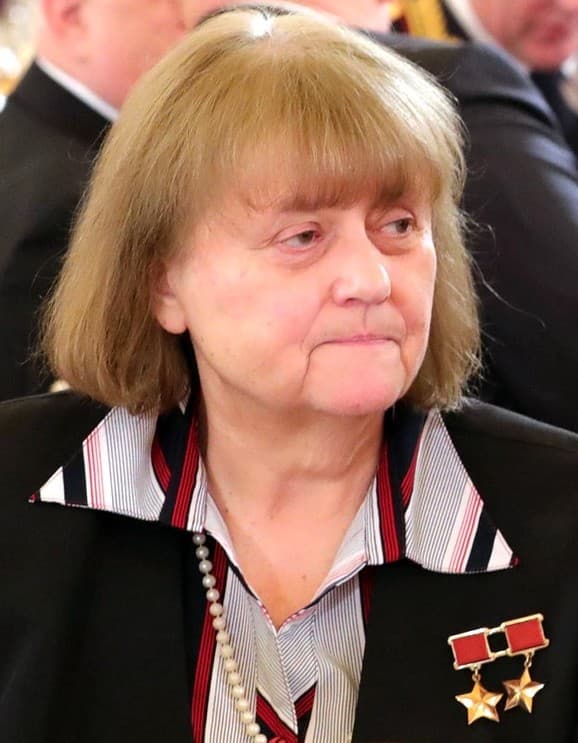
Soviet, Russian · Science · Exploration
Svetlana Savitskaya
August 8, 1948 – present
Early life and family background
Svetlana Yevgenyevna Savitskaya was born on 8 August 1948 in Moscow, in the Russian SFSR of the Soviet Union. She grew up in a family that was closely connected to aviation: her father, Yevgeny Savitsky, was an Air Marshal and twice Hero of the Soviet Union. That family environment placed flight, engineering, discipline, and military service at the center of her early life. Sources on her biography consistently identify Moscow as her birthplace and note her later career as a Soviet cosmonaut and aviator.
Her upbringing coincided with the early decades of the Cold War, when the Soviet Union invested heavily in aviation and space achievements as symbols of modernity and national strength. For a young woman with both talent and access to technical education, aviation offered a path into one of the most demanding and prestigious professions in the country. Savitskaya’s later career suggests that she absorbed not only a family tradition of flight, but also a cultural expectation that technical excellence could serve the state and push the boundaries of human capability.
Education and the making of a pilot
Savitskaya became a trained pilot and later a test pilot, a path that required exceptional skill, confidence, and tolerance for risk. By the 1970s she had established herself as a highly capable sport and test aviator. Contemporary summaries of her career note that she set multiple aviation records, including a large number of international records on MiG aircraft, and also achieved records in team parachute jumping. These accomplishments established her reputation well before her selection for cosmonaut training.
Her early aviation career was important because Soviet cosmonaut selection often favored candidates with elite flying credentials. In Savitskaya’s case, that meant she was already operating in an environment of intense technical scrutiny before entering the space program. Her record as a pilot made her a strong candidate for a program that valued precision, endurance, and the ability to perform under pressure. It also made her a visible example of women’s competence in fields that were still overwhelmingly male.
Selection as a cosmonaut
On 30 July 1980, Savitskaya was chosen for the second group of female cosmonauts in the Soviet Union. That selection marked the beginning of her formal preparation for spaceflight. Although the Soviet Union had famously placed Valentina Tereshkova in space in 1963, women remained rare in the cosmonaut corps. Savitskaya’s selection showed that the program was again willing to invest in female space travelers, but only after the candidate had already proven herself in aviation.
The selection date is historically significant because it marked the transition from accomplished pilot to prospective cosmonaut. It also reflects the highly selective nature of Soviet space training: candidates faced extensive medical screening, technical instruction, and mission preparation. Savitskaya’s acceptance into the program signaled institutional trust in her skills and set the stage for a series of firsts that would define her public legacy.
First spaceflight: Soyuz T-7 and Salyut 7
On 19 August 1982, Savitskaya launched aboard Soyuz T-7 and reached the Salyut 7 space station. This made her the second woman in space and the first woman to visit a space station. Her mission represented an important expansion of women’s participation in spaceflight, moving beyond a brief orbital journey to active station operations in a complex technical environment.
The mission was brief by later standards but historic in its implications. Space stations demanded sustained crew interaction, maintenance, and scientific work, so Savitskaya’s presence showed that women could take part in the operational life of orbital laboratories. She returned to Earth on 27 August 1982 after an eight-day mission, completing her first spaceflight successfully. That landing confirmed her status as a proven cosmonaut rather than a symbolic passenger.
Second mission and record-breaking spacewalk
Two years later, Savitskaya returned to orbit on 17 July 1984 aboard Soyuz T-12 for a second mission to Salyut 7. This launch made her the first woman to fly to space twice, a crucial step beyond the one-time breakthrough represented by her earlier flight. Repeated participation in space missions was a sign of professional confidence and demonstrated that women could occupy sustained roles in human space exploration.
Her most famous achievement came on 25 July 1984, when she conducted an extravehicular activity outside the station lasting about 3.6 hours. During the EVA, she performed welding and metal-cutting experiments and became the first woman to perform a spacewalk. The achievement was widely recognized because spacewalking was among the most demanding tasks in astronautics, requiring physical strength, training, and composure in a hostile environment. Savitskaya’s EVA proved that women could perform not only internal station work but also exterior operations of the highest complexity.
She returned to Earth on 29 July 1984, completing a mission that became one of the most important in the history of women’s spaceflight. Her second flight cemented her reputation as a barrier-breaking cosmonaut and made her an enduring figure in the global history of exploration.
Aviation records and sporting achievements
Beyond her space achievements, Savitskaya had already built an impressive aviation record. Biographical summaries note that beginning in the mid-1970s she set numerous international world records on MiG aircraft and additional records in parachuting. These feats reflected the breadth of her skill set as both a pilot and a competitive sports aviator. They also help explain why she was trusted with high-stakes flight assignments before her selection as a cosmonaut.
Her record-setting aviation background is significant in its own right because it shows that her fame was not created solely by spaceflight. She emerged from a deep culture of Soviet aerobatic and test-pilot excellence, where technical performance, bravery, and precision were closely linked. In that context, her later orbital accomplishments were the culmination of an already distinguished flying career.
Political career and public service
After her space career, Savitskaya remained a prominent public figure in Russia. She later served as a member of the Supreme Soviet and, from the 1990s onward, as a member of the State Duma of the Russian Federation. Sources note that she participated in defense- and space-related legislative work, reflecting the continued relevance of her expertise and public stature. Her political role extended her influence beyond aviation and exploration into the civic and institutional life of post-Soviet Russia.
Her presence in politics mattered because it linked space history to public policy. A former cosmonaut with technical credentials and a national reputation could speak with authority on aerospace, defense, and scientific matters. Even without exact dates for every legislative milestone, her parliamentary career demonstrated that women pioneers in science and exploration could continue to shape national life long after their record-setting years.
Honors, recognition, and cultural memory
Savitskaya has been widely recognized in histories of aviation and space exploration. She is frequently described in reference works as the first woman to walk in space, the first woman to fly to space twice, and the second woman in space. Those formulations have become part of the standard record of human spaceflight. Her achievement is also commemorated by space museums, institutional biographies, and popular history accounts that emphasize her role in expanding women’s access to space.
Her significance also lies in the broader symbolism of her career. In the Soviet era, women’s achievements in elite technical fields were often showcased as evidence of social progress, yet those opportunities remained scarce. Savitskaya’s success therefore carried a dual meaning: it was both a genuine personal breakthrough and a politically meaningful demonstration of women’s capability in one of the most demanding professions of the age. For later generations of astronauts, cosmonauts, engineers, and pilots, she remains a foundational figure.
Personal life and later years
Publicly available sources focus primarily on Savitskaya’s professional life rather than on private family details. What is clear is that she remained active in public affairs long after her final spaceflight, and that her legacy continued through her political and ceremonial roles in Russia. As of the most recent reliable sources, no date of death is reported, and she is generally treated as living.
Her later life illustrates the durability of certain twentieth-century scientific and exploratory legends. Savitskaya’s career began in the cockpit, reached its peak in orbit, and then continued in public service. Her name remains attached to a small number of decisive firsts that altered the history of women in space. Because those firsts were achieved in the Soviet 1980s, they also stand as testimony to the barriers women faced in technical fields and to the individuals who managed to overcome them through exceptional ability and persistence.
Legacy
Svetlana Savitskaya occupies a permanent place in the history of women’s achievement. Her 1982 and 1984 missions helped prove that women could do every stage of spaceflight, including launch, station operations, and spacewalking. Her career expanded the public imagination of who could be a cosmonaut and helped normalize the presence of women in roles once considered extraordinary exceptions.
Her legacy is not limited to a single dramatic moment. It lies in the sequence of milestones that defined her path: a record-setting aviator, a selected cosmonaut, the second woman in space, the first woman to visit a space station, the first woman to fly in space twice, and the first woman to walk in space. Together, those achievements make her one of the most consequential women in the history of aviation and exploration.
Dated achievements
7 indexed.
- Aug081948Exploration
Birth of Svetlana Savitskaya
Born in Moscow, she later became a famed Soviet pilot and cosmonaut.
View details Wikipedia: Svetlana Savitskaya - May131982Exploration
Participation in Soyuz T-5 mission
Listed as a participant in Soyuz T-5 mission logs on May 13, 1982.
View details