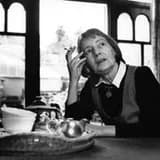
Stevie Smith died on March 7, 1971, at Ashburton, Devon, England, from a brain tumor, shortly after receiving the Queen's Gold Medal for Poetry.
Stevie Smith died on March 7, 1971, at Ashburton in Devon, England, at the age of 68, from a brain tumor. She had spent the final years of her life caring for her beloved aunt until the aunt's death in 1968, after which Smith's own health declined rapidly.
In the last year of her life, Smith received major public recognition for her decades of poetic work: in 1969 she was awarded the Cholmondeley Award for poetry, and shortly before her death she was awarded the prestigious Queen's Gold Medal for Poetry in 1969, presented to her by Queen Elizabeth II—a rare honor recognizing a lifetime's contribution to British verse. This recognition came late in her career, after decades in which her work had been regarded by many critics as too eccentric or minor for serious literary attention.
Her death prompted renewed critical reassessment of her body of work, and she has since come to be regarded as one of the most original and important English poets of the twentieth century. Her poem 'Not Waving but Drowning' (1957) remains one of the most widely anthologized and quoted poems in the English language, its title phrase entering common usage as an idiom for hidden distress masked by outward normalcy. Smith is buried in the churchyard of St James in Friern Barnet, near her lifelong home in Palmers Green.