← All women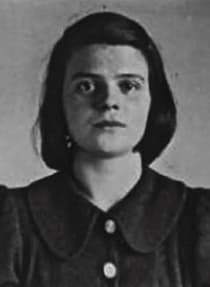
German · Activism · Politics
Sophis Scholl
May 9, 1921 – February 22, 1943
Early life and family background
Sophia Magdalena Scholl was born on 9 May 1921 in Forchtenberg, Württemberg, Germany, into a family that valued public service, education, and moral independence. Her father, Robert Scholl, served as the town’s liberal mayor, and the household was politically alert as well as culturally Christian. Scholl grew up with several siblings in a period of profound instability for Germany, shaped first by the aftermath of World War I and later by the rise of National Socialism.
As a child and adolescent, Scholl initially participated in Nazi youth organizations, including the League of German Girls, as was common for many German girls of her generation. That participation, however, did not last. By the late 1930s, she had become increasingly skeptical of the regime. Her brother Hans’s involvement in independent youth circles brought the family to the attention of the Gestapo in 1937, and that interrogation proved formative. From then on, Scholl distanced herself decisively from National Socialism and began to develop the ethical independence that would define her later life.
Scholl attended school in Ulm and completed her schooling in March 1940. She trained as a kindergarten teacher before beginning higher studies. These early years matter because they reveal that she did not emerge from a revolutionary environment; rather, she grew into opposition through observation, moral reflection, and increasing disillusionment with the Nazi state. Her background placed her within ordinary German society, which makes her later decision to resist even more historically striking.
Education and the road to resistance
After her training as a kindergarten teacher, Scholl’s path took her through periods of compulsory service before she entered the University of Munich in May 1942 to study biology and philosophy. During the summer of 1942, she also completed auxiliary war service in a munitions factory in Ulm, reflecting the demands placed on young Germans by the wartime regime. These experiences exposed her to the contradictions between official Nazi propaganda and the realities of war, exploitation, and repression.
At Munich, Scholl joined a circle of students and academics who were increasingly alarmed by Nazi crimes. The group that would become known as the White Rose formed in 1942 around Hans Scholl, Sophie Scholl, Alexander Schmorell, Willi Graf, Christoph Probst, and the philosophy professor Kurt Huber. The White Rose did not use violence. Instead, it relied on leaflets, moral appeals, and occasional graffiti to denounce dictatorship, war, and the persecution of Jews and other victims of the Nazi system.
Scholl’s role in the White Rose grew rapidly. She helped write, type, copy, and distribute leaflets, and she became one of the movement’s most visible members. Her participation was especially significant because the Nazi regime expected young women to conform to private, domestic, and obedient roles. Scholl’s public dissent challenged those expectations, demonstrating that women could be politically and morally central to resistance even in a hyper-masculinized dictatorship.
The White Rose leaflets
The White Rose produced a series of anti-Nazi leaflets that called on Germans to recognize the regime’s crimes and to oppose tyranny. Scholl was deeply involved in the production of the movement’s later leaflets, especially the fifth and sixth. In January 1943, she helped with the manufacture and distribution of the fifth leaflet. By that point, the group’s language had become more urgent, reflecting the worsening war and the mounting evidence of mass murder.
The sixth leaflet, linked to Scholl’s last action, called for resistance to Nazi crimes and urged readers to break with passive complicity. It was a risky form of communication in a society saturated by censorship, surveillance, and fear. The White Rose leaflets were extraordinary not because they could by themselves overthrow Hitler, but because they preserved the voice of conscience in a system built to extinguish it.
Scholl’s contribution to the leaflets was both practical and symbolic. She was a co-producer, distributor, and public witness. Her work showed that resistance under dictatorship can take the form of intellectual labor, persuasion, and personal courage rather than military force. That distinction has made the White Rose especially important in the history of non-violent opposition.
Arrest, trial, and execution
On 18 February 1943, Sophie Scholl and her brother Hans were arrested by the Gestapo after distributing the sixth White Rose leaflet at the University of Munich. According to contemporary and later accounts, they had placed copies of the leaflet around the building and thrown some into the atrium. A custodian observed the act and alerted authorities. The arrest was swift, and it marked the beginning of the end for the White Rose’s public campaign.
Just four days later, on 22 February 1943, Scholl, Hans Scholl, and Christoph Probst were tried before the Nazi People’s Court in Munich under the presiding judge Roland Freisler. The trial was not a genuine legal process but a political performance designed to crush dissent. The defendants were condemned for treason and for defaming Hitler. They were sentenced to death and executed the same day at Stadelheim Prison by guillotine.
Scholl was the first of the three condemned White Rose members to be executed that day. She was 21 years old. Her final words, as remembered in later accounts, have become part of her legacy as an emblem of moral steadfastness. The regime intended to silence the White Rose, but the severity and speed of the punishment instead made Scholl’s case one of the clearest symbols of Nazi terror and youthful resistance in all of German memory culture.
Personal life
Sophie Scholl did not marry and had no children. Her short life was dominated by family ties, education, friendships, and resistance work. The historical record centers less on intimate partnerships than on the intellectual and moral world she shared with her brother Hans, fellow White Rose members, and the wider student and academic environment of Munich.
Her family relationships were especially important. Her father’s liberal politics and her brother’s resistance activity both influenced her development. At the same time, Scholl’s decision to act independently was crucial. She was not merely following a family tradition; she was making a personal ethical choice in a context where such choices carried extreme danger. That autonomy is central to her historical significance.
Recognition and legacy
In the years after the war, Sophie Scholl became one of the most admired figures in German history. In 2003, readers of the German women’s magazine Brigitte voted her “the greatest woman of the 20th century,” underscoring her reputation as a moral exemplar rather than simply a wartime casualty. On 9 May 2014, Google Germany honored her with a commemorative Doodle for her 93rd birthday, and in 2021 major commemorations marked the centenary of her birth.
Scholl’s legacy rests on several intertwined elements. She stands for the courage of students who opposed a dictatorship through words rather than weapons; for women’s agency in a history often narrated through male leaders and soldiers; and for the idea that individual conscience can matter even when immediate political success seems impossible. The White Rose leaflets did not stop the Nazi regime, but they preserved an alternative German voice that refused complicity.
Her image has become central in schools, memorials, museums, documentaries, and public history projects. The White Rose and Sophie Scholl in particular are now widely used to teach democratic responsibility, the ethics of dissent, and the dangers of authoritarian rule. This continuing prominence explains why she remains one of the most recognizable women associated with German resistance to Nazism.
Historical importance
Sophie Scholl’s importance lies not only in what she did, but in the conditions under which she acted. She was a young woman in a regime that demanded conformity, suppressed speech, and criminalized criticism. She rejected that system through non-violent resistance, knowing the risks. Her arrest and execution show how dangerous even symbolic opposition could be in Nazi Germany, while her postwar remembrance shows how moral courage can outlast repression.
Scholl’s story continues to resonate because it combines youth, principle, and sacrifice. She is remembered as a student, a daughter, a sister, a resister, and a citizen who refused to accept evil as normal. In women’s history, her life is especially important because it demonstrates that women’s political significance is not confined to office, party leadership, or formal power. It can also reside in the refusal to obey injustice.
Dated achievements
9 indexed.
- May091921Activism
Birth of Sophie Scholl
Birth of Sophie Scholl in Forchtenberg, Württemberg, the future White Rose resistance member and symbol of civil courage.
View details Sophie Scholl | Britannica - Feb181943Activism
Arrest for White Rose leaflet distribution
Sophie Scholl and Hans Scholl were arrested at the University of Munich after distributing the sixth White Rose leaflet.