← All women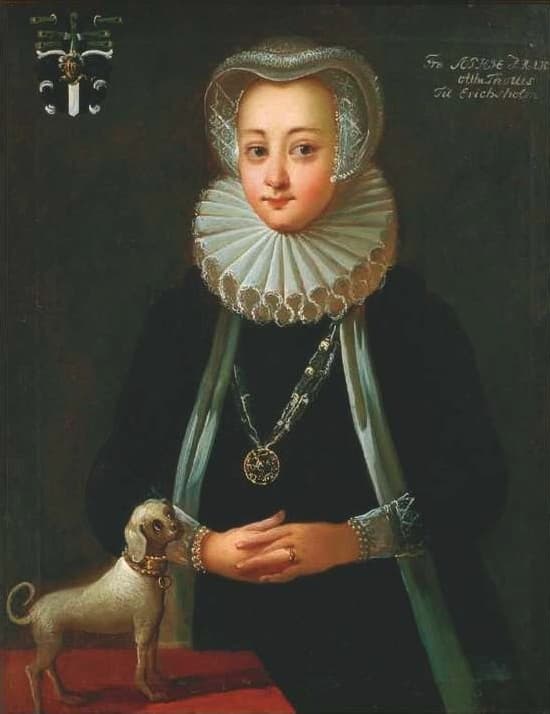
Danish · Science
Sophia Brahe
1559 – 1643
Early life and background
Sophia (Sophie) Ottesdatter Brahe was born at Knudstrup (Knutstorp) Castle in Scania, then part of the Danish kingdom, into one of the realm’s most powerful noble families. Sources disagree whether her birth occurred on 22 September 1556 or 24 August 1559, and some list only the year 1556 or 1559. Her father, Otto Brahe, was a privy councillor and landowner, and her mother, Beate Bille, belonged to another influential aristocratic house.[3][5][8][10][16] She was the younger sister—by about ten years—of the astronomer Tycho Brahe, whose fame would long overshadow her own.[3][5][10]
As a noblewoman, Sophia grew up in a milieu of courtly culture, political power, and household management, but intellectual pursuits by women were often discouraged. Formal university education was closed to her, yet she demonstrated an early interest in the natural world and in scholarly study. Later accounts report that she taught herself astronomy, astrology, chemistry, medicine, horticulture, and genealogy, drawing on books available in aristocratic libraries and on conversations with learned men, despite criticism from relatives who considered such studies inappropriate for a woman of her rank.[1][2][8][11]
The family’s estates, including Knudstrup and later her brother’s island observatory at Hven, provided both the physical space and the instruments necessary for systematic astronomical observation, as well as gardens for experimentation in horticulture. This environment, combined with her determination to learn, made her one of the most educated women in Scandinavia of her era.[1][8][11]
Career beginnings and development
Sophia’s scientific career began in close collaboration with her brother Tycho. Around 1573, when she was in her mid‑teens or late teens depending on the birth date accepted, she started assisting him with his astronomical observations.[2][6][9] Tycho had already been conducting systematic measurements of stars and planets, and Sophia joined this work as a student observer and calculator. Her participation quickly expanded from occasional help to regular involvement in multi‑year observational programs, particularly those focused on planetary positions and eclipses.[2][5][6][9]
On 11 November 1572, the siblings observed a striking "new star" in the constellation Cassiopeia, an event now known as the supernova SN 1572.[3][7][12] Modern accounts note that Sophia assisted Tycho that night, sharing in the astonishment and the labor of measuring its position relative to known reference stars.[3][7] Tycho’s Latin treatise De nova stella, published in 1573, was based on these observations and argued that the new star was located beyond the Moon, contradicting the Aristotelian doctrine of an unchanging, perfect celestial realm.[7][12] Although the book bore only Tycho’s name, Sophia’s contribution as an observer formed part of its empirical foundation.
On 8 December 1573, Sophia joined Tycho in observing a lunar eclipse, contributing to the precise positional data of the Moon and shadow that underpinned their developing planetary tables.[3][7] Her work in eclipse and planetary observations involved careful use of large instruments—quadrants, sextants, and armillary spheres—to measure angular distances and altitudes, as well as recording times and checking calculations.[5][6][9] The siblings’ regular, long‑term observations were unusual in Europe at the time and demanded sustained dedication.
Outside astronomy, Sophia developed expertise in chemistry and alchemy, using laboratory work typical of the period to investigate materials and remedies. She also practiced medicine, becoming known as a healer among local communities, though much of this work was informal and not published under her name.[1][8][10] Her gardening and horticultural interests led her to cultivate a wide variety of plants, including exotic species imported from abroad.[8][9] Later accounts credit her as the first known person to plant tulip bulbs in Denmark, a symbolic marker of the diffusion of new ornamental species across Europe, although sources do not provide an exact date.[9][13]
Major works, discoveries, and accomplishments
In astronomy, Sophia’s most important accomplishment was her role in the Brahe observational program, which produced the most accurate planetary and stellar data of the late sixteenth century. From the 1570s through the 1590s, she collaborated with Tycho on long‑term observations of planetary positions, comets, and eclipses.[1][2][5][6][9] Using custom‑built instruments and rigorous methods, they compiled a catalog of more than 1,000 fixed stars with unprecedented precision, as well as detailed tables of planetary motions.[5][9]
These data sets later enabled Johannes Kepler to derive his three laws of planetary motion. Kepler’s analysis of Mars’s orbit, based on the Brahe data, required accuracy to within about one arcminute—a level of precision achieved through the painstaking observational work that Sophia helped carry out night after night.[5][9][15] In turn, Kepler’s laws became essential for Isaac Newton’s theory of universal gravitation. In this indirect but profound way, Sophia’s careful measurements contributed to the foundations of modern celestial mechanics.[12][15]
While Tycho’s name appears on the major publications, contemporary and later sources stress that Sophia was more than a passive assistant. She understood the mathematical techniques, engaged in calculations, and assumed responsibility for parts of the observational program.[2][6][11] In a letter, Tycho praised her learning in chemistry and astrology and noted that she had pursued these studies in the face of family opposition.[11] Her work demonstrates how women’s contributions to early modern science were often embedded in collaborative projects and overlooked in formal authorship.
Beyond astronomy, Sophia produced one of the most significant genealogical manuscripts of Scandinavian nobility. During the late sixteenth and early seventeenth centuries she compiled an extensive genealogy of Danish and Scandinavian noble families, sometimes referred to in modern accounts as a 900‑page book.[1][6][8][9] This work traced lineages, estates, and alliances, meticulously verifying information from charters, letters, and oral histories. The manuscript is preserved and still used as a major source for the early history of Danish nobility, demonstrating her rigorous scholarly method.[1][6]
Her genealogical research required skills analogous to those used in science: critical evaluation of sources, systematic organization of data, and attention to detail. Historians note that her chronicle exemplifies early modern research methodology, especially remarkable coming from a woman who had no formal training and whose work had to overcome gendered skepticism.[1][10]
In horticulture, Sophia’s experiments with plant cultivation at noble estates contributed to the introduction and acclimatization of new species in Denmark. Her gardens combined practical kitchen crops, medicinal herbs, and decorative plants. Accounts that name her as the first to plant tulip bulbs in Denmark underscore her role in cultural transfers in botany, even though they lack precise dating.[8][9][13]
Awards, honors, and recognition
Sophia Brahe lived in an era before modern scientific societies and formal awards, so there is no record of her receiving medals or institutional honors comparable to those of later centuries. However, she did achieve social and intellectual recognition in several ways.
During her lifetime, she and Tycho were sometimes described as a "double star in the Danish sky," reflecting the perception that her talents and learning matched those of her famous brother.[10] She was recognized locally as a skilled healer and a woman of learning, and her genealogical work was respected among noble families whose histories she documented.[1][6][10]
In modern times, historians and educators increasingly highlight her as one of Denmark’s first female researchers and writers in scientific and scholarly fields.[6][11] National and international projects on women in science frequently include her among pioneering figures whose contributions were essential yet long marginalized.[2][8][14][19] Biographical entries in encyclopedias, women’s history databases, and educational resources now present her as an astronomer, scientist, and genealogist in her own right.[1][6][8][9]
Personal life
Sophia’s personal life intertwined closely with her intellectual pursuits and social position. As a noblewoman, marriage and household management were central expectations. She married first into the Thott family, one of the prominent noble lineages, and later took the name Sophie Thott Lange after another marriage; modern biographical notes often refer to her under these married names.[3][5][8]
Accounts of her romantic life describe a "whirlwind" relationship that resulted in periods of financial difficulty, particularly after becoming a widow. Despite reduced income and social challenges, she continued to study and write, using whatever resources she could secure.[11] Her correspondence and later narratives emphasize perseverance: she did not abandon her intellectual interests even when circumstances would have pushed many women back into purely domestic roles.
Her work in medicine and healing also had a personal dimension. As a practitioner of household medicine, she prepared remedies, treated illnesses, and applied knowledge drawn from both learned texts and empirical observation.[1][8][10] This role placed her at the intersection of family responsibility and scientific practice, mirroring the experiences of many early modern women whose medical work remained informal yet vital.
Later life and death
In the early seventeenth century, Sophia focused increasingly on her genealogical research and on managing estates and gardens, while continuing to maintain an interest in astronomy and natural philosophy.[1][8][13] The main period of her activity across astronomy, alchemy, medicine, horticulture, and genealogy is often described as spanning roughly 1573–1626, indicating decades of sustained engagement.[6][13]
She lived long enough to see significant changes in the scientific world she had helped shape. Both Tycho Brahe and Johannes Kepler died before her, even though their fame grew as the new celestial models gained acceptance.[15] Sophia, by contrast, remained largely invisible in public scientific narratives, her contributions embedded in data and manuscripts rather than in named publications.
Multiple biographical sources agree that she died in 1643 in Helsingør (Elsinore), Denmark, the port city famous as the setting of Shakespeare’s "Hamlet".[3][5][6][8][10][16] She was buried in Torrlösa church, in present‑day Sweden, where the Thott family burial chapel is located.[1][6][8][9] The exact day and month of her death are not known from surviving records, a common omission in the documentation of women’s lives in the period.
Legacy and historical impact
Sophia Brahe’s legacy is multifaceted, spanning astronomy, genealogy, horticulture, and the history of women in science. In astronomy, her observations and calculations contributed to the remarkably accurate body of data that underpinned Kepler’s laws of planetary motion and, indirectly, Newtonian mechanics.[5][9][12][15] Modern writers emphasize that the precision of these measurements—sometimes accurate to within one arcminute—required the sustained labor of observers like Sophia, whose efforts have too often gone uncredited.[15]
In genealogy, her extensive manuscript on Scandinavian noble families remains a primary source for historians studying the early history of Danish aristocracy. The work is preserved in major libraries, such as the Royal Library in Copenhagen, and continues to inform scholarly reconstructions of lineages, property relations, and political alliances.[1][6][9] Its methodological rigor marks her as a serious researcher, not merely a compiler of family stories.
Her horticultural and medicinal activities contributed to the development of gardens as sites of experimentation and to the diffusion of new plant species, reflecting the broader Renaissance fascination with botany and natural history.[8][9][13] The claim that she was the first to plant tulip bulbs in Denmark symbolizes her role in cultural and botanical exchange, even if precise dating is not available.[9][13]
From the perspective of women’s history, Sophia Brahe is significant as one of the earliest documented female scientists in Scandinavia. She exemplifies how women could engage deeply with science and scholarship despite legal and social barriers, often by embedding their work within family networks or household responsibilities.[6][8][11] Her life demonstrates that the Scientific Revolution was not solely the achievement of a small number of famous male figures, but relied on wider circles of collaborators, including women.
Recent scholarship, educational materials, and popular accounts have begun to restore Sophia to visibility. Projects focused on historical women in science and technology, as well as blogs and videos about overlooked scientists, now present her as an "invisible astronomer" whose eyes helped map the cosmos.[1][4][14][15][19] This renewed attention underscores the importance of revisiting historical records to identify and acknowledge women whose work was essential but whose names were marginalized.
Although she left no major published treatise under her own name, Sophia Brahe’s impact endures in the data that enabled transformative theories and in the genealogical manuscripts that continue to support historical research. Her story is a reminder that rigorous scientific and scholarly contributions can be made outside formal institutions and that recovering such contributions is crucial to a fuller understanding of the past.
Dated achievements
4 indexed.
- Sep221556Science
Probable birth of Sophia Brahe at Knudstrup Castle
Probable birth date of Sophia Brahe at Knudstrup Castle.
View details Wikipedia: Sophia Brahe - Aug241559Science
Alternative birth date of Sophia Brahe at Knudstrup Castle
Alternative documented birth date for Sophia Brahe at Knudstrup Castle.
View details