← All women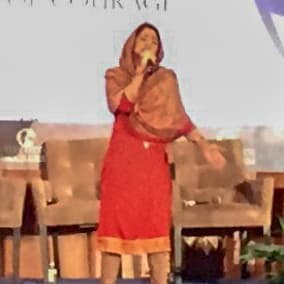
Afghan · Activism · Arts
Sonite Alizadeh
November 11, 1996 – present
Early life and background
Sonita Alizadeh was born on 11 November 1996 in Herat, Afghanistan, during the era of Taliban rule. She was born into a large family and spent her early childhood in a country marked by war, repression, and severe limits on women’s freedom. Her earliest years were shaped by the immediate threat of gender-based violence and by the insecurity that came with political upheaval.
When she was still young, her family fled to Iran to escape the Taliban. She grew up there as an undocumented Afghan refugee, a status that carried practical and emotional hardships. Refugee life often meant unstable housing, legal vulnerability, and restricted access to education and opportunity. Those conditions also exposed her to the broader social pressures that affect many girls in displaced communities, especially the expectation that daughters can be treated as economic assets through marriage arrangements.
As a child, Alizadeh was twice threatened with child marriage. The first attempt came when she was around ten years old, when her family considered selling her as a bride for money. A second attempt followed when she was about sixteen. These experiences became decisive in shaping her worldview. Rather than remaining silent, she began to understand her own life as part of a larger pattern of coercion faced by girls and young women.
Music became both an outlet and a form of resistance. In Iran, she began listening to and drawing inspiration from rappers such as Yas and Eminem. Rap offered her a language of urgency, protest, and self-definition. For a young Afghan girl living in exile, it was also a medium that crossed social boundaries and could carry political meaning even when formal avenues of expression were limited.
Career beginnings
Alizadeh’s early creative work developed in private before it became public. She learned to write, compose, and perform at a time when girls in her situation had little public space to speak about their own lives. Rap allowed her to transform personal pain into testimony. Rather than treating music as entertainment alone, she used it as a way to document coercion, shame, resistance, and hope.
Her breakthrough came with the release of “Brides for Sale” on 1 August 2014. The song and video directly confronted the practice of families marrying off daughters for money. The work was notable for its frankness and for the fact that it spoke from the perspective of someone who had nearly been subjected to the practice herself. It circulated widely online and brought her international attention as an activist and artist.
The video’s impact rested in part on its visual symbolism and its directness. In the context of Afghan and Iranian gender norms, a young woman publicly rapping against forced marriage was itself a challenge to expectations of female silence and obedience. The song became one of the most recognizable cultural expressions of opposition to child marriage in the 2010s.
Documentary recognition and international rise
Alizadeh’s story became the subject of the documentary Sonita, directed by Rokhsareh Ghaemmaghami. The film premiered at IDFA on 20 November 2015. By bringing her story into the documentary world, it created a durable record of both her personal struggle and the broader social issue of child marriage.
In January 2016, the film achieved two major honors at Sundance: the World Cinema Documentary Grand Jury Prize on 24 January and the Audience Award on 28 January. These awards helped make her name known to viewers, journalists, and human-rights advocates around the world. The Sundance recognition mattered because it did not merely reward a film; it legitimized a girl’s testimony as a document of global importance.
After these honors, Alizadeh emerged as a widely recognized public speaker, musician, and activist. Her story was repeatedly cited as an example of how art can resist oppression. Her music and public presence helped bring attention to the persistence of child marriage, forced marriage, and the specific vulnerability of Afghan girls in conflict and displacement.
Education, activism, and public work
By the late 2010s, Alizadeh was based in the United States and studying at Bard College. She used her platform to speak about girls’ education, refugee rights, and the social conditions that sustain child marriage. Her work increasingly combined performance with advocacy, showing that activism could be built not only through policy campaigns but also through cultural production and education.
On 19 November 2018, American University highlighted her in a profile about student activism and rap. The feature underlined the way she used music to challenge “old customs,” reflecting both her cultural roots and her role in contemporary anti-child-marriage advocacy. By that point, she had become a recognizable voice within university, nonprofit, and human-rights spaces.
She has also been associated with educational initiatives that seek to reach girls directly. One such effort is Arezo and The Dreams Book, a secret school for Afghan girls deprived of education. Bard College later highlighted her role as a co-founder of that initiative on 15 July 2025, confirming that her activism extended beyond individual performance into institution-building and educational access.
Alizadeh has reportedly worked with or spoken through major human-rights and public-interest channels, including NGOs and educational campaigns. Her advocacy has repeatedly centered the idea that girls’ education is a necessary condition for freedom, not a luxury or secondary goal. This focus has made her a significant voice in conversations about both Afghan women’s rights and global child-marriage prevention.
Honors, authorship, and later career
As her profile grew, Alizadeh received wider institutional recognition. In 2016 she was associated with the Changemaker Award from Girls Not Brides, an honor that aligned with her anti-child-marriage work. Later profiles also described her as receiving awards and honors including the MTV Europe Generation Change Award, the Freedom Prize, a Cannes Lions honor, and inclusion in Forbes 30 Under 30, reflecting the breadth of her public impact.
Her identity broadened further when she became an author. On 15 July 2025, Bard College announced the release of her memoir, Sonita: My Fight Against Tyranny and My Escape to Freedom. The book gave her an opportunity to tell her own story in extended form: her near-marriage as a child, her second escape from forced marriage as a teenager, her emergence as a rapper, and her life as a public advocate. Memoir also allowed her to preserve the complexity of her experience beyond the simplified narratives often attached to refugees or activists.
On 6 March 2026, Forbes published a feature framing her as a global voice for change. The piece reflected the continuing expansion of her recognition across mainstream media, business, and cultural institutions. By then, Alizadeh was widely understood as an activist whose influence stretched far beyond the initial viral success of Brides for Sale.
Barrier-breaking significance
One of the most important elements of Alizadeh’s historical significance is that her career challenged multiple barriers at once. She was an Afghan girl raised under Taliban rule, a refugee in Iran, a survivor of repeated attempts at child marriage, and a woman entering the male-dominated world of rap. Each of those identities carried social constraints. Her success therefore represents not just individual resilience but a challenge to the structures that limit girls’ speech, movement, and ambition.
On 17 June 2026, Cannes Lions described her as the first professional Afghan rapper, marking an institutional recognition of her pioneering role. Whether viewed as an artistic first or a symbolic first, the label underscores how unusual her career path has been in the Afghan context. Her example matters because it demonstrates that cultural production can be a form of rights advocacy and that women from politically constrained societies can help reshape public discourse globally.
Personal life
Alizadeh has spoken publicly about the attempts to force her into marriage and about the refugee experience that followed her family’s departure from Afghanistan. Those experiences are central to her life story and remain relevant because they explain the urgency of her activism. Her public identity has been closely tied to her survival, her education, and her decision to use music as testimony.
She has lived in the United States and studied at Bard College, and later public profiles placed her in New York. Available open-source material emphasizes her activism, education, and authorship more than conventional details of family life, marriage, or children. That itself is historically telling: her public significance lies primarily in her work and in her transformation of personal trauma into collective advocacy.
Legacy
Sonita Alizadeh’s legacy is rooted in the rare combination of artistic visibility and human-rights activism. She helped make child marriage visible to audiences that might never otherwise encounter the issue through policy reports alone. Her rap, her documentary, her speaking engagements, and her memoir all serve as forms of witness.
She is especially significant in women’s history because she represents the capacity of a young refugee woman to become an agenda-setting public figure. Her work has supported girls’ education, named the coercive economics of child marriage, and shown that resistance can emerge from within the very conditions designed to silence it. In that sense, her life has become part of the larger history of women who transformed private suffering into public change.
Dated achievements
10 indexed.
- Nov111996Activism
Birth of Sonita Alizadeh in Herat, Afghanistan
Born in Herat, Afghanistan, under Taliban rule, shaping her activism against child marriage.
View details Sonita Alizadeh - Wikipedia - Aug012014Activism
Release of "Brides for Sale" video
Released rap song/video "Brides for Sale," drawing international activism attention.