← All women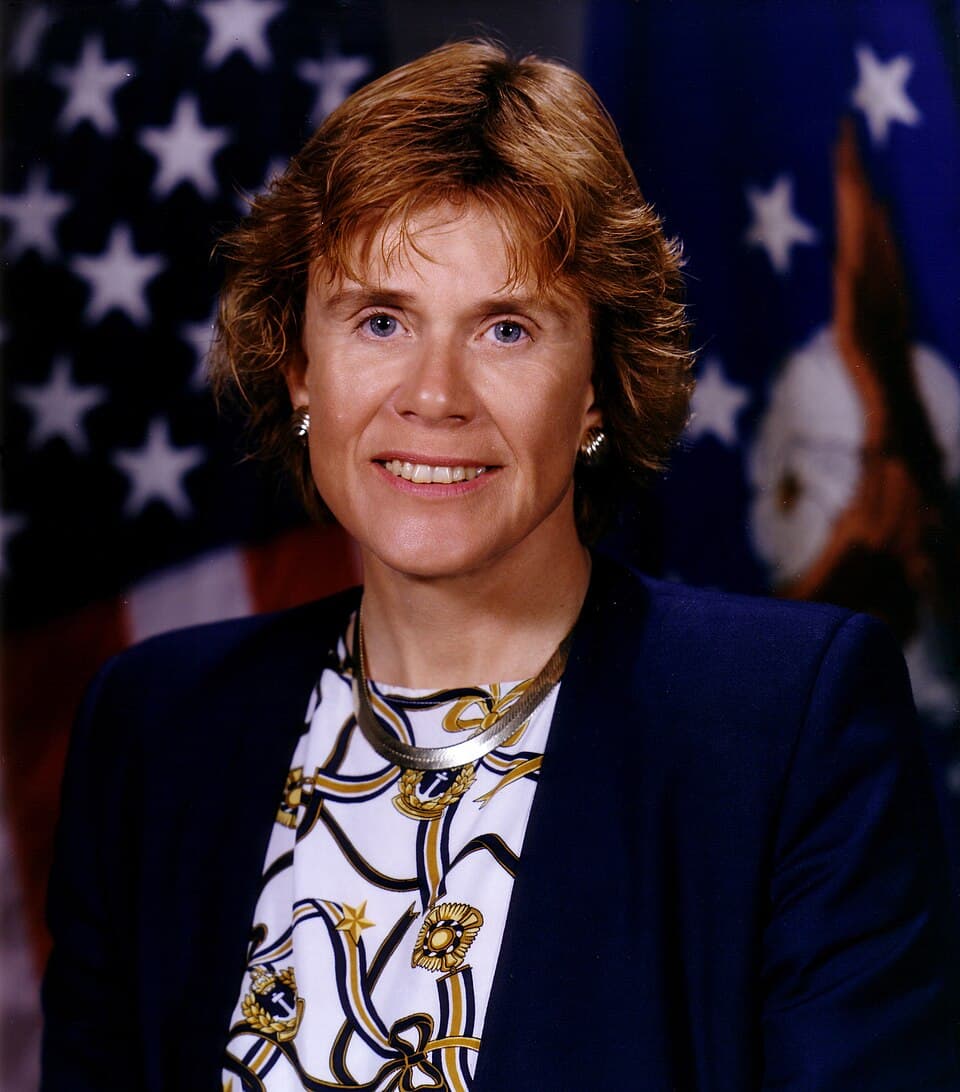
American · Science · Aviation
Sheila Widnall
July 13, 1938 – present
Early Life and Background
Sheila Marie Evans Widnall was born on July 13, 1938, in Tacoma, Washington, United States.[1][2][6] Growing up in the Pacific Northwest during the mid‑20th century, she came of age in an era when women were rarely encouraged to pursue engineering or scientific careers. Nonetheless, she developed an early interest in mathematics and science, interests that would eventually lead her to one of the most demanding technical fields: aeronautics and astronautics.
Details of her immediate family background are less prominently documented than her professional accomplishments, but biographical sketches emphasize that she was drawn to problem‑solving and the physical sciences from a young age.[6][13] This intellectual curiosity and aptitude for quantitative work positioned her to seize educational opportunities that were just beginning to open to women in the post‑war period.
Widnall enrolled at the Massachusetts Institute of Technology (MIT) in 1956, at a time when women were a small minority on campus and vanishingly rare in engineering programs.[4][6] Her decision to study aeronautics and astronautics placed her on a path toward both scientific discovery and institutional change, as she would later become one of MIT’s most prominent advocates for women in science and engineering.
Education and Formative Influences
At MIT, Widnall pursued a rigorous course of study in aeronautics and astronautics, the field that integrates fluid dynamics, structural mechanics, propulsion, and control systems for air and space vehicles.[4][6] She earned her Bachelor of Science degree in aeronautics and astronautics in 1960, followed by a Master of Science in 1961 and a Doctor of Science (ScD) in 1964, all from MIT.[3][4][6] These accomplishments were exceptional for any student, and particularly notable for a woman at a time when engineering remained deeply male‑dominated.
Her doctoral work and early research were grounded in fluid mechanics, with a focus on boundary‑layer stability and unsteady aerodynamic phenomena.[6][7] Mentored by senior figures in MIT’s Department of Aeronautics and Astronautics, she developed expertise in theoretical and applied aspects of flow behavior around lifting surfaces, including wings and rotor blades. As she moved from student to researcher, she was also exposed to the broader culture of aerospace innovation in the post‑Sputnik era, where advances in aerodynamics and guidance systems were central to both civil aviation and military aerospace programs.
Widnall’s formative years at MIT coincided with the growing presence of women on campus and the early stirrings of organized efforts to address gender disparities in higher education. Her experiences as one of very few women in advanced engineering studies informed her later roles as a faculty leader and advocate for equity within the institution.[4][6][13]
Career Beginnings at MIT
Widnall’s professional career began at MIT even before she completed her doctorate. She served as a Research Staff Engineer in the Department of Aeronautics and Astronautics in 1961–1962 and as a Research Assistant from 1962–1964.[6] After receiving her ScD, she was appointed an Assistant Professor in the department in 1964, marking the start of a long and influential academic career.
Significantly, Widnall became the first woman appointed to the faculty of the MIT School of Engineering, a milestone that reflected both her scholarly achievements and a gradual, but still tentative, institutional willingness to broaden the profile of its engineering faculty.[4][9][13] Her appointment broke a longstanding gender barrier in one of the world’s premier engineering schools. She advanced through the faculty ranks, serving as Associate Professor from 1970 to 1974 and then as Professor from 1974 to 1986.[6]
During this early period, she also undertook postdoctoral work as a Ford Postdoctoral Fellow at MIT from 1964 to 1966, further refining her research portfolio in fluid dynamics.[6] She gained experience outside academia through summer work at The Boeing Company, giving her exposure to industrial aerospace practice alongside her academic research.[6]
Research in Fluid Dynamics and Aeronautics
Widnall became internationally recognized for her research in fluid dynamics, particularly as it relates to aircraft turbulence and spiraling airflows known as vortices created by helicopters.[3][7][11] Her work addressed fundamental questions about the stability and behavior of flows around lifting surfaces and rotating blades, topics central to the safety and performance of helicopters and high‑speed aircraft.
Her research contributions included studies of:
- Boundary-layer stability, examining how small disturbances in the thin layer of fluid near a surface grow or dissipate, affecting drag and potential transition to turbulence.[6][7]
- Unsteady lifting‑surface theory, analyzing how aerodynamic forces change over time on wings and blades in motion, which is critical for maneuvering and control.[7]
- Unsteady leading‑edge vortex separation from slender delta wings, relevant to high‑angle‑of‑attack flight and advanced fighter configurations.[7]
- Tip‑vortex aerodynamics and helicopter noise, exploring how the vortices generated at rotor tips contribute to sound and structural loads.[6][7]
These investigations combined theoretical analysis, computational modeling, and physical insight. The work gained Widnall recognition as a leading figure in aerospace fluid mechanics and helped optimize rotorcraft design and understand complex flow phenomena in aviation.
Her scholarship contributed to the broader understanding of turbulence and vortex dynamics, subjects that have implications not only for aircraft and helicopters but also for energy systems, environmental flows, and basic physics. Through publications, conference presentations, and leadership within professional societies, Widnall became a central voice in the aerospace engineering community.[7][10][15]
Leadership Roles at MIT
Beyond her research and teaching, Widnall played a major role in MIT governance and academic leadership. She served as Associate Provost in 1992–1993, with responsibilities that included academic integrity, conflict‑of‑interest policy, federal relations, and international programs.[6][7] In this role, she worked at the intersection of research policy, government regulation, and institutional strategy at a time when universities were navigating complex relationships with federal agencies and industry.
Widnall also became the first woman to serve as chair of the MIT faculty, holding that post in 1979–1980.[9][13] As faculty chair, she represented the interests of the faculty to the administration, helped shape policy on academic affairs, and contributed to discussions about curriculum, governance, and equity. Her leadership helped normalize women’s presence in high‑level academic roles and set a precedent for subsequent generations of women faculty at MIT.
In 1986, she was appointed the Abby Rockefeller Mauze Professor of Aeronautics and Astronautics, an endowed chair recognizing her distinguished contributions to research and teaching.[6] Later in her career, she was named an Institute Professor, MIT’s highest faculty rank, signifying a level of accomplishment and influence shared by only a small number of scholars at the institution.[1][4][13]
Government Service and National Policy
Widnall’s expertise and leadership extended beyond academia into national science and transportation policy. In the mid‑1970s, she served as Director of the Office of University Research for the U.S. Department of Transportation, becoming the first person to hold that position and the first woman to occupy such a role in the department’s research structure.[1][6] In this capacity, she coordinated university‑based research relevant to transportation systems, bridging federal needs and academic capabilities.
Her most historically significant government role was as Secretary of the Air Force. Appointed by President Bill Clinton, she assumed office on August 6, 1993, and served until October 31, 1997.[2][3][11] As Secretary, she oversaw recruiting, training, and equipping of the Air Force’s active‑duty, Guard, Reserve, and civilian personnel, and managed an annual budget on the order of $62 billion.[3]
Widnall was the first woman to serve as Secretary of the Air Force and the first woman to head a branch of the U.S. Armed Forces within the Department of Defense.[1][11][13] Her tenure coincided with ongoing post‑Cold War reorganizations, increasing emphasis on space operations, and efforts to address issues of sexual misconduct and professional ethics in the military. She placed particular emphasis on strengthening space capabilities and ensuring the Air Force’s readiness for emerging strategic challenges.[3][7]
Professional Societies and National Academies
Widnall’s standing in the engineering community is reflected in her election to and leadership within major professional societies and academies. She was elected to the National Academy of Engineering (NAE) in 1985, recognizing her significant contributions to aerospace engineering and fluid dynamics.[7][15] She later served as Vice President of the NAE from 1998 to 2005, playing a key role in shaping its activities at the interface of engineering, public policy, and education.[10][15]
Within the American Institute of Aeronautics and Astronautics (AIAA), Widnall became a leading figure. She served as President of AIAA in 2000–2001, guiding the organization during a period of rapid technological change and evolving priorities in aerospace research and development.[7] Her presidency further solidified her influence in the global aerospace community.
Widnall has also been involved with broader scientific organizations. She served as a trustee of the Carnegie Corporation, The Aerospace Corporation, and Aerojet Rocketdyne, and as a director of Draper Laboratories.[7] She is identified as a past president of the American Association for the Advancement of Science (AAAS), reflecting her engagement with the wider scientific enterprise beyond aerospace.[7][10]
Awards, Honors, and Recognition
Over the course of her career, Widnall has received numerous honors. She was inducted into the National Women’s Hall of Fame in 2003, in recognition of her groundbreaking achievements in engineering and defense leadership.[5][10] This honor situates her among a select group of women whose work has had lasting national impact.
The National Academy of Engineering awarded her the Arthur M. Bueche Award in 2009, honoring her for leadership in science and technology policy and her contributions to engineering research and education.[10][15] The award highlights her role in shaping national discussions about engineering’s societal responsibilities and strategic direction.
Her prominence in aviation and aerospace is also reflected in her inclusion in the Women in Aviation International Pioneer Hall of Fame directory, where she is noted for her trailblazing service as the first female Secretary of the Air Force and for her fluid dynamics research.[12] MIT profiles emphasize her status as an Institute Professor and as a leader who helped transform the institution’s culture regarding women and underrepresented groups in engineering.[4][13]
Personal Life
Biographical sources primarily highlight Widnall’s professional achievements, and detailed information about her private family life is relatively limited in the public record. She is widely known by her full name, Sheila Marie Evans Widnall, indicating that "Evans" is part of her personal and possibly family heritage, but standard references focus on her work rather than on family background or marital status.[1][4][6]
Within MIT and the broader engineering community, she has been described as a committed mentor and colleague, actively supporting students and junior faculty. Profiles emphasize her engagement with interdisciplinary collaborations and her interest in both the technical and ethical dimensions of engineering practice.[4][7][13] Her personal values—particularly her commitment to integrity, fairness, and rigorous analysis—are reflected in the roles she accepted, such as Associate Provost with responsibility for academic integrity and conflict‑of‑interest policy.[6][7]
Legacy and Historical Impact
Sheila Widnall’s legacy is multifaceted, spanning aerospace research, academic leadership, and military and public service. In the technical realm, her work on boundary‑layer stability, vortex dynamics, and helicopter noise has contributed to a deeper understanding of complex flows and to the design and operation of safer, more efficient aircraft and rotorcraft.[6][7][10] These scientific contributions continue to inform research and engineering practice.
Institutionally, Widnall is celebrated as a pioneer for women in engineering and in the military. As the first woman faculty member in MIT’s School of Engineering and the first woman to chair MIT’s faculty, she helped open doors for female scholars and set precedents for inclusive leadership within an elite technical university.[4][9][13] Her visibility and effectiveness in these roles challenged assumptions about who could lead in such environments.
Her service as Secretary of the Air Force marked a watershed moment in U.S. defense history. As the first woman to head a branch of the U.S. Armed Forces, she demonstrated that women could hold the highest civilian positions in the military establishment, shaping policy, overseeing budgets, and commanding institutional respect.[1][3][11][13] Subsequent appointments of women to senior defense roles can be viewed, in part, as following the path that Widnall helped establish.
Widnall has also been a prominent voice in debates about engineering ethics, the responsibilities of scientists and engineers to society, and the importance of diversity within technical fields. Her speeches and writings emphasize the need for engineers to consider the broader consequences of their work and to engage constructively with public policy.[7][10][13] In retirement profiles, MIT highlights her "lifetime exploring the unknown" and her role in changing expectations about what women can do in engineering and leadership.[13]
Later Life and Retirement
After completing her term as Secretary of the Air Force in 1997, Widnall returned to MIT, resuming her faculty position in the Department of Aeronautics and Astronautics and continuing her work as an Institute Professor.[3][4][8] She remained active in teaching, research, and institutional service for many years, contributing to the education of new generations of aerospace engineers.
According to accounts of her career, Widnall ultimately retired from MIT in October 2020, after a remarkable period of approximately 64 years associated with the institution, spanning her student days, faculty appointments, and post‑government service.[8][13] Even in retirement, she has remained a reference point for discussions about women in engineering, leadership in academic and military contexts, and the evolution of aerospace research.
As of the mid‑2020s, Widnall is regarded as Institute Professor Emerita and Professor Emerita of Aeronautics and Astronautics at MIT.[1][4] There is no publicly reported date of death, and sources treat her as a living figure whose career and contributions are still within living memory.
Her long association with MIT and her service at the highest levels of national defense underscore the continuity in her life’s work: a commitment to using scientific and engineering knowledge in the service of both technological progress and public responsibility. Sheila Widnall’s story remains a powerful example in women’s history of how technical expertise, institutional leadership, and public service can be combined in a single, groundbreaking career.
Dated achievements
5 indexed.
- Jul131938Science
Birth of Sheila E. Widnall
Birth of Sheila E. Widnall, significant aerospace engineer and leader.
View details Wikipedia: Sheila Widnall - Jan011974Science
First Director of the DOT Office of University Research
First woman to direct the DOT Office of University Research.
View details