← All women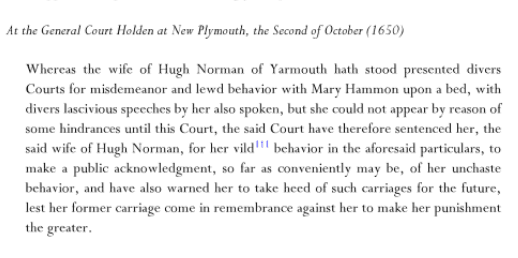
English · Law · Activism
Sarah White Norman
1623 – 1654
Early Life and Background
Sarah White Norman (often cited in scholarship as born circa 1623) was a seventeenth‑century English woman who lived in Plymouth Colony and became the central figure in one of the earliest documented legal proceedings involving erotic conduct between women in North America.[2][5] Little is known about her childhood, parentage, or migration, and no baptismal record or passenger list has been conclusively identified as hers. The surviving evidence places her in Yarmouth, a settlement within Plymouth Colony, as an adult woman by the late 1630s.[6]
Historians reconstruct her life largely from fragmentary court and town records. These documents reveal that she was known as Sarah White before marriage and that she later appears as the "wife of Hugh Norman" in colonial legal texts.[5][6] The colony was a deeply Puritan environment, structured around strict religious discipline and detailed regulation of sexual and domestic life, which shaped how women like Norman were viewed and controlled. Within this context, her later prosecution for "lewd behavior" placed her at the intersection of gender, sexuality, and emerging colonial legal practice.
Marriage, Family, and Community Standing
By 1639, records indicate that Sarah White married Hugh Norman, a relationship that situates her firmly within the patriarchal household structure typical of Plymouth Colony.[6] As a married woman, she would have been expected to embody Puritan ideals of chastity, obedience, and domestic order, under the legal and economic authority of her husband. The marriage produced at least one known child. A later account notes that their daughter Elizabeth, born in 1642, tragically died by drowning in a well in 1648, an incident reflecting the precariousness of everyday life in early colonial settlements.[6]
Sarah and Hugh appear in the records as residents of Yarmouth, which was a small, coastal community in present‑day Cape Cod. Like other colonists, they would have participated in subsistence agriculture, household production, and communal religious observance. The scant documentation suggests that during the period of Norman’s prosecution (from the late 1640s to 1650), her marriage became unstable. Hugh ultimately deserted his wife and children and returned to England, where later reports describe him as squandering an inheritance and living in debauched poverty.[6] This abandonment intensified the social and economic vulnerability that Norman already faced as a woman subjected to public moral discipline.
The Norman–Hammon Case: Background and Charges
Sarah White Norman is most widely known for her involvement with Mary Vincent Hammon, a younger woman born in 1633, who also lived in Yarmouth.[2][3][5] On the basis of Plymouth Colony records, scholars date the beginnings of their prosecution to the late 1640s. One detailed retelling notes that on 6 March 1648, the two women were presented to the court for "lewd behavior each with other upon a bed," language that would be repeated in later entries.[6][8]
Early modern England and its colonies maintained elaborate regulations against sexual immorality, but their secular law did not clearly articulate how to prosecute non‑penetrative erotic acts, especially between women.[1] Statutes and common‑law practice focused primarily on male sodomy and bestiality, while fornication and adultery were punished through a mix of religious and civil mechanisms. In this context, the decision to formally record Norman and Hammon’s behavior as "lewd" and to treat it as a misdemeanor signaled an attempt by colonial authorities to categorize female‑female intimacy within existing frameworks of moral discipline.[1][5]
A Library of Congress legal history blog describes the Norman–Hammon case as "the only known record of sexual relations between seventeenth‑century female English colonists in North America," highlighting its rarity in the surviving archive.[1] The initial charge, recorded in Plymouth Colony court books, identifies both women and specifies the locus of their conduct—"upon a bed"—which suggests that their relationship was understood in explicitly erotic terms by contemporaries. This record is the earliest dated piece of the case sequence that modern historians can trace.[1][4]
Proceedings in Plymouth Colony
The legal process against Sarah White Norman and Mary Vincent Hammon unfolded over several years, between roughly 1648 and 16506 March 1649, describing how both women were charged with "lewd behavior upon a bed," and Norman was additionally accused of "lascivious speech."[8] Another historical piece in American Heritage places the incident in 1649 and cites the wording "leude behauior each with other vpon a bed" to characterize the offense.[4]
Within this evolving sequence, 4 July 1649 stands out as the earliest clearly dated surviving record in later scholarly analysis, noting the presentment of "the wife of Hugh Norman, and Mary Hammon, both of Yarmouth, for lewd behavior with each other upon a bed."[1][4] This entry embeds the case within the routine business of the Plymouth courts, which routinely cataloged moral infractions alongside property disputes and other matters. By naming Norman explicitly as "the wife of Hugh Norman," the record emphasizes the perceived gravity of her alleged behavior in relation to marital norms and community expectations.
Throughout these proceedings, Hammon’s age and marital status shaped her treatment. She was younger, and sources suggest that she may have been under the local age of discretion, which in Plymouth was around sixteen.[6] This factor is often cited to explain why colonists handled her more leniently than Norman. As the investigation continued, Norman’s reputation appears to have suffered more severely, worsened by her husband’s eventual departure for England.[5][6]
Conviction and Sentencing on 2 October 1650
The culmination of the Norman–Hammon case came on 2 October 1650, when Plymouth Colony’s court rendered judgment.[1][5][8] Surviving accounts agree that both women were found guilty of "lewd behavior with each other upon a bed," but the sanctions imposed on them differed significantly. Mary Vincent Hammon was admonished—formally reprimanded and warned—whereas Sarah White Norman was convicted and ordered to make a public acknowledgment of her "unchaste behavior."[2][6][8]
Yesterqueers explains that Norman was sentenced "to publicly acknowledge her 'unchaste behavior' and warned against repeating it because she would receive much harsher punishment the next time."[8] The Library of Congress blog emphasizes that the trial had "a much more severe impact on Sarah White Norman than it did on Mary Hammon," noting the lasting stigma that attached to Norman following her conviction.[1] Katie Castagno’s essay on "Our Queer Elders" similarly describes this episode as "the first (and only) known conviction for lesbianism in the United States" and highlights that, while Mary went on to have children and a more conventional life course, Sarah’s situation deteriorated.[5]
The court’s choice of punishment—public confession rather than corporal or capital sanctions—reflects Puritan strategies of moral correction. Public acknowledgment was a form of ritual humiliation designed to restore communal order by making the offender an object lesson. In Norman’s case, it also reinforced the patriarchal logic that framed married women’s bodies as subject to both their husbands and the community’s discipline. Though modern historians avoid retroactively imposing the term "lesbianism" as a legal category, they note that this is likely the earliest and possibly only colonial conviction that contemporaries understood as involving erotic relations between women.[1][2][4][5]
Legal and Cultural Context
To appreciate the significance of Sarah White Norman’s case, it is essential to situate it within early modern legal regimes. In England, secular law historically criminalized "buggery"—defined as anal penetration or bestiality—and did not explicitly name sex between women as a category of offense.[1] Female‑female erotic conduct, when discussed, was often treated as an amorphous moral failing or left to ecclesiastical courts. Plymouth Colony, however, developed its own ordinances and practices to regulate sexual and domestic behavior in greater detail.
The Norman–Hammon proceedings thus illustrate how colonial authorities grafted new categories onto inherited legal frameworks. The charge of "lewd behavior" allowed them to address conduct that did not fall neatly under sodomy statutes but was still seen as threatening the moral fabric of the community. The case has been compared to that of Katherina Hetzeldorfer in sixteenth‑century Germany, whose trial relied heavily on descriptions of behavior without a clearly named legal category.[1] In contrast, the Plymouth records show a deliberate effort to label women’s same‑sex intimacy as "lewd behavior" and to treat it within a misdemeanor framework, incorporating both physical acts and "lascivious speech."[1][8]
Moreover, the Norman–Hammon case underscores the gendered nature of colonial justice. Even within a same‑sex pairing, sanctions were distributed unevenly, with the older, married woman facing harsher consequences. This asymmetry reveals how age, marital status, and gendered expectations of chastity influenced the application of law to women in early New England.
Later Life and Probable Death
After the 1650 conviction, Sarah White Norman disappears from Plymouth Colony’s surviving legal records, a silence that has invited speculation but remains difficult to interpret.[4][5] One American Heritage article notes that "there is no further mention of her or Hammon in the colonial records" following the resolution of the case.[4] Katie Castagno’s summary adds that records indicate Norman’s husband returned to England without her, suggesting that she remained in the colony, likely in Yarmouth, and faced life as a deserted wife.[5][6]
Secondary sources commonly give Norman’s death as circa 1654, but no primary document has been identified that provides an exact date or circumstances.[2][6] This approximate year is derived from genealogical reconstructions and the absence of later references to her in local records. Given the harsh social and economic realities of colonial life, especially for women without male support, it is plausible that Norman’s health, security, and social standing were severely compromised after her husband’s departure and public shaming.
In contrast, Mary Vincent Hammon is documented as living until 1705, marrying and bearing several children, which underscores the long‑term disparity in outcomes between the two women whose lives intersected in this case.[2][5][6] Norman’s probable early death adds a tragic dimension to her story, though responsible historians emphasize that the details remain uncertain due to the fragmentary record.
Legacy and Historical Impact
Despite the brevity of the surviving documentation, Sarah White Norman’s life has acquired profound significance in women’s and queer history. Modern scholars and activists identify the Norman–Hammon case as "the only known record of sexual relations between seventeenth‑century female English colonists in North America" and as "the first (and only) known conviction for lesbianism in the United States."[1][2][4][5] These formulations highlight the case’s uniqueness while acknowledging the limitations of the historical record.
Norman’s story has been revisited in diverse contexts: academic legal history, LGBTQ+ historiography, and public‑facing projects like Katie Castagno’s "Our Queer Elders" series and the Yesterqueers video essay.[5][8] These works emphasize that, although colonial authorities framed the case as a moral and legal transgression, modern interpreters view it as evidence of enduring same‑sex desire and intimate relationships among women long before such experiences had a name or community recognition.
The Library of Congress blog situates Norman alongside figures like Katherina Hetzeldorfer to trace a genealogy of early modern queer trials, showing how legal systems struggled to categorize and control non‑normative sexualities.[1] In this narrative, Norman becomes a symbol of how women’s bodies and desires were policed, but also of how those desires left traces in official archives that later generations can reclaim.
For women’s history, the case illuminates the vulnerability of married women who deviated from prescribed roles, the harsh consequences of public moral discipline, and the ways in which age and marital status shaped legal outcomes. For queer history, Norman’s conviction provides a rare, dated focal point for discussions of female‑female intimacy in colonial America, reminding contemporary audiences that such relationships have deep historical roots, even when the record is sparse.
Historiography and Continuing Research
Current scholarship on Sarah White Norman remains limited but is growing as historians of gender and sexuality reexamine colonial records. The English and Spanish‑language Wikipedia entries on "Sarah White Norman and Mary Vincent Hammon" synthesize available data, citing primary sources and secondary works that acknowledge the case’s significance and its status as a possible legal "first" in American queer history.[2][3] Blogs, essays, and educational materials build on these foundations to introduce wider audiences to Norman’s story.
Researchers emphasize caution in terminology. While some public‑facing narratives describe the case as a conviction for "lesbianism," the original court language was "lewd behavior," and early modern law did not articulate a specific offense category for women’s same‑sex acts.[1][2][5] Historians therefore balance the need to make Norman’s experience legible within modern LGBTQ+ frameworks with the responsibility to accurately represent the seventeenth‑century legal and cultural context.
Norman’s case continues to inspire inquiries into adjacent questions: how many similar incidents may have gone unrecorded; how ecclesiastical and civil jurisdictions interacted in policing women’s sexuality; and how colonial communities understood and responded to relationships that challenged normative gender roles. Each new study not only sheds light on Norman herself but also expands our understanding of the broader landscape of women’s lives, desires, and vulnerabilities in early America.
Assessment of Historical Significance
Although only a handful of facts about Sarah White Norman can be documented, the events surrounding her prosecution form a crucial chapter in the history of law, gender, and sexuality. Her case demonstrates how colonial legal systems, rooted in English precedent yet adapted to Puritan sensibilities, began to grapple with female‑female eroticism as a recognizable category of misconduct. It reveals the asymmetries of punishment within same‑sex relationships and underscores the long‑term consequences of public shame and desertion for women.
Norman’s legacy lies less in personal achievements than in the interpretive possibilities her case opens for historians and activists. She stands as an early, if involuntary, participant in a lineage of women whose intimate lives have been scrutinized by authorities yet later reclaimed as part of a broader narrative of queer resilience. For editorial almanacs of women’s history, her story provides a vital reminder that even fragmentary records can illuminate the complex, often hidden histories of women’s relationships, desires, and struggles under restrictive regimes.
Dated achievements
2 indexed.
- Jul041649Law
First recorded charge in the Norman-Hammon case
1649: Sarah White Norman and Mary Vincent Hammon were charged with lewd behavior on July 4 in Plymouth Colony.
View details Forgotten and Overlooked Queer Trials of the Early Modern Period - Oct021650