← All women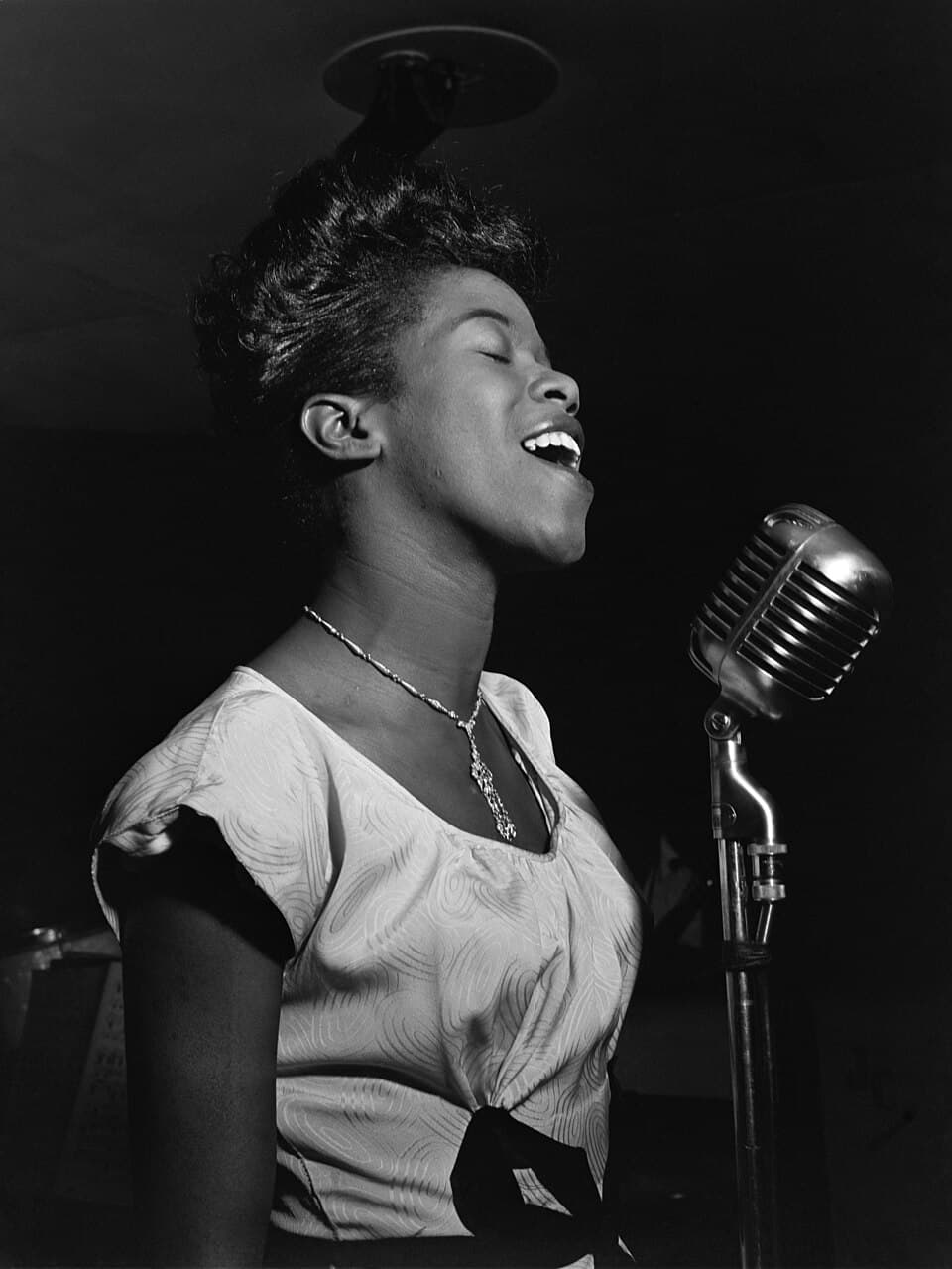
American · Arts
Sarah Vaughan
March 27, 1924 – April 3, 1990
Early Life and Background
Sarah Lois Vaughan was born on March 27, 1924, in Newark, New Jersey, into a working-class African American family deeply rooted in church life and music.[3][7][8] She was the only child of Ada Vaughan and Asbury "Jake" Vaughan, a carpenter and amateur guitarist. The family attended New Mount Zion Baptist Church, where music formed an integral part of worship and community.
Vaughan’s parents were amateur musicians, and her exposure to church music began early. Around the age of eight she started studying piano and organ, and by about twelve she was serving as the church organist, accompanying hymns and leading congregational singing.[7][8] These responsibilities demanded a high level of musical literacy and discipline, fostering her sophisticated sense of harmony and rhythm long before she entered the professional jazz world.
Outside church, Vaughan listened to radio broadcasts and recordings of popular and jazz music, absorbing the sounds of swing-era bands and vocalists. She attended school in Newark through her junior year of high school, but her growing involvement in music eventually led her to leave formal education early to pursue performing.[8] As a teenager, she began playing piano and singing in local nightclubs and ballrooms, including venues in Newark, where she developed a reputation for her rich contralto voice and assured keyboard skills.
These formative years took place against the backdrop of the Great Depression and Jim Crow segregation. For an African American girl in the 1930s and early 1940s, church and local entertainment spaces were among the few platforms available for serious musical development. Vaughan’s transition from church organist to club performer reflected both her ambition and the limited institutional pathways open to Black women musicians at the time.
Career Beginnings and Development
Vaughan’s professional career began decisively in the early 1940s. In 1942 she traveled from Newark to Harlem to compete in the famous Amateur Night at the Apollo Theater, a crucial proving ground for emerging Black talent.[3][7] On October 21, 1942, she sang "Body and Soul," winning first prize and impressing both the audience and professionals in attendance. This victory became a turning point, bringing her to the attention of major bandleaders and marking her entry into the national jazz scene.
Following the Apollo triumph, Vaughan was hired by Earl Hines to sing with his big band, joining in 1943.[3][4][8] The Hines orchestra at that time included several musicians associated with the nascent bebop movement, notably Dizzy Gillespie. Vaughan initially served both as vocalist and second pianist, a rare dual role for a woman in a prominent touring ensemble. Working nightly with such advanced players accelerated her musical maturation and exposed her to cutting-edge harmonic and rhythmic innovations.
In 1944, Gillespie left Hines to form a new big band under the leadership of vocalist Billy Eckstine, often considered the first bebop-oriented big band. Vaughan joined Billy Eckstine’s orchestra, where she continued to refine her approach to singing amidst a roster that included Gillespie, Charlie Parker, and other leading modernists.[3][8] Her time with Eckstine coincided with her earliest recording opportunities.
On May 11, 1944, Vaughan made her first commercial recording, "I’ll Wait and Pray," as vocalist with Eckstine’s orchestra for Continental Records.[3][11] This session effectively launched her career as a recording artist. Over the next year she increasingly recorded under her own name, cutting sides that showcased her ability to handle ballads and uptempo material with equal authority.
Vaughan left Eckstine’s band in the mid‑1940s to pursue a solo career. On May 24, 1945, she recorded "Lover Man" with Dizzy Gillespie and Charlie Parker for Continental, a performance that has been cited as an early document of bebop-influenced vocal phrasing.[3][9] Later that year, on October 25, 1945, she recorded Tadd Dameron’s "If You Could See Me Now," which quickly became one of her signature songs and a jazz standard.[3][9]
By the late 1940s and early 1950s, Vaughan was a prominent figure on the club and concert circuit, appearing in major venues and touring nationally. In 1946, she signed with Musicraft Records, recording influential sides like "Tenderly" and "It’s Magic," which broadened her appeal beyond strictly jazz audiences, although specific contract dates are not consistently documented.[3][8] In 1949 she moved to Columbia Records, where she recorded more pop‑oriented material designed for radio play and jukeboxes.[3][8]
Major Works and Accomplishments
Vaughan’s discography from the 1950s onward is extensive, but several recordings and career milestones stand out as historically significant. Her association with Mercury Records and its jazz imprint EmArcy began in 1954, marking a new phase in which she balanced jazz sophistication with commercial reach.[3][8]
On January 6, 1954, Vaughan recorded "Shulie a Bop" in New York for EmArcy, an early showcase of her virtuosic scat singing and bebop‑infused vocal style.[3][11] The track demonstrated her ability to improvise fluently over complex chord changes using nonlexical syllables, treating her voice like a horn and solidifying her reputation as one of the foremost modern jazz vocalists.
Just weeks later, on January 27, 1954, she recorded her celebrated version of "Lullaby of Birdland" for EmArcy in New York.[3][11] The single became a major hit and one of Vaughan’s most recognizable recordings. It offered a perfect vehicle for her lush tone, rhythmic subtlety, and dramatic sense of phrasing, and it helped introduce bebop-informed singing to a broad international audience.
Another peak in Vaughan’s career came with the March 18, 1957 recording session in New York that produced the album "Sarah Vaughan", featuring the Clifford Brown Quintet.[3][11] This collaboration, released by EmArcy, is widely regarded as one of the finest jazz vocal albums ever recorded. Paired with Brown’s warm, articulate trumpet and a superb ensemble, Vaughan delivered definitive interpretations of standards such as "Embraceable You" and "September Song." Her performances on this record are often cited by critics and scholars as evidence of her unparalleled command of pitch, timbre, and emotional nuance.
Throughout the 1960s, Vaughan continued to record and tour widely. In 1969, she performed at the Montreux Jazz Festival in Switzerland. Her concert on May 4, 1969 became the first Montreux Jazz Festival performance to be recorded and released commercially as "Sarah Vaughan – Live at the Montreux Jazz Festival".[3] The album documented her late‑1960s artistry and helped establish Montreux’s reputation for producing important live jazz recordings.
Across these decades Vaughan also made numerous television appearances, performed with orchestras, and embraced diverse material ranging from jazz standards to pop songs and Brazilian music. Her technical resources—an exceptionally wide range, from deep contralto lows to ringing highs; perfect or near‑perfect intonation; and the ability to sustain and shape long phrases—underpinned her success in both intimate jazz club settings and large concert halls.[2][3]
Awards, Honors, and Recognition
Sarah Vaughan’s achievements were recognized with many awards and honors. She received multiple Grammy nominations, beginning in 1958, and ultimately won two Grammy Awards, including a prestigious Lifetime Achievement Award, although the specific calendar dates of these presentations are not consistently documented in the sources consulted.[2][3][12]
In 1981, Vaughan was awarded an Emmy for a televised tribute to composer George Gershwin, highlighting her impact beyond the jazz world into mainstream American entertainment.[10] In 1983 she received a Grammy for Best Jazz Vocal Performance, recognizing her continued excellence into the later stages of her career.[10]
She was inducted into the Jazz Hall of Fame by DownBeat magazine in 1988, affirming her status among musicians and critics as one of the central figures in jazz history.[8] In 1989, the National Endowment for the Arts named her a NEA Jazz Master, the United States’ highest honor in jazz, acknowledging her lifetime contribution to the art form.[1][6][12] This designation placed her among a select group of artists considered fundamental to the development of jazz.
Posthumously, Vaughan’s legacy has continued to be honored. In 2012 she was inducted into the New Jersey Hall of Fame, recognizing her lasting significance to her home state.[1] Numerous festivals and institutions have dedicated concerts and programs to her memory, and her recordings remain central to jazz curricula worldwide.
Personal Life
Vaughan’s personal life was intertwined with her professional career, particularly through her marriages. In 1946, she married George Treadwell, a trumpeter who became her manager.[8][10] Under his guidance, she developed an international career that included tours, recordings, and engagements that expanded her audience. The couple’s relationship, however, was marked by tensions related to finances and control, and they divorced in 1958.[8]
Vaughan later married Clyde Atkins, although specific dates and details are less consistently documented across sources.[8] By the 1960s she was in a relationship with trumpeter Waymon Reed, whom some sources identify as a later husband; together they raised a daughter, Debra, whom Vaughan adopted.[3][8] Her role as a mother coexisted with the demands of constant touring and recording, illustrating the balancing act faced by many women in the performing arts.
Beyond formal relationships, Vaughan cultivated long‑standing friendships with fellow musicians and collaborators. She was known for a personality that combined warmth, humor, and directness—traits reflected in nicknames like "Sassy" and "Sailor", the latter referencing her salty language.[14] These nicknames, along with "The Divine One", speak to both her personal charisma and the reverence with which audiences and colleagues regarded her.
Legacy and Historical Impact
Sarah Vaughan is widely considered one of the greatest jazz vocalists of the twentieth century. Critics and historians often place her alongside Billie Holiday and Ella Fitzgerald as part of a triumvirate of preeminent women jazz singers.[1][2][13] Her influence stems from several interrelated aspects of her work: extraordinary vocal technique, sophisticated musical understanding, and a capacity to integrate jazz improvisation with popular song forms.
Musically, Vaughan was renowned for her wide vocal range, frequently described as covering three octaves, and for her rich, flexible timbre.[2][6] She could move effortlessly from chest voice to head voice, execute complex ornamentation, and sustain long, arching lines with impeccable control. Her improvisational approach—including subtle reharmonization, rhythmic displacement, and scat singing—helped elevate the role of the jazz vocalist to one comparable with instrumental soloists. Some sources credit her as the first jazz singer to incorporate bop-style phraseology so thoroughly into her vocals, though they do not provide specific dates for this innovation.[11]
Historically, Vaughan’s career illustrates the challenges and possibilities for African American women artists in the mid‑twentieth century. She navigated a segregated industry that often marginalized Black performers and restricted women to decorative roles. Yet she achieved international stardom, long‑term recording contracts, and artistic autonomy, influencing not only jazz but also pop and classical‑inflected vocal performance.[8][13] Her success contributed to a broader redefinition of the vocalist’s place in jazz ensembles, encouraging later singers to demand equal creative footing.
Vaughan’s recordings continue to serve as pedagogical models for singers across genres. Her renditions of songs like "Lullaby of Birdland," "Misty," "If You Could See Me Now," and "Tenderly" are frequently analyzed for their phrasing, tone, and interpretive insight. Jazz education programs and conservatories regularly cite her work, and her voice remains a touchstone in discussions of vocal artistry.
Institutionally, her legacy is preserved through honors such as the NEA Jazz Masters designation and her presence in halls of fame.[1][6][8] Cultural institutions, including the New Jersey Performing Arts Center, have established competitions and programs in her name, such as the Sarah Vaughan International Jazz Vocal Competition, which supports emerging vocalists and keeps her influence alive for new generations.[1]
Later Life and Death
In her later years, Vaughan remained active as a performer and recording artist. She continued to tour internationally through the 1970s and 1980s, appearing at major festivals and prestigious venues. Her work during this period included collaborations with orchestras and explorations of diverse repertoires, demonstrating that her creative energy and technical skill remained strong well into her sixties.[2][3]
In 1989, Vaughan was diagnosed with lung cancer, a development that led her to reduce her performance schedule.[3][8] Nevertheless, she continued to appear on stage, and on September 17, 1989, she gave her last documented public performance at the Blue Note jazz club in New York City.[3][11] The engagement offered a poignant coda to a career that had begun with her Apollo win in New York nearly half a century earlier.
On April 3, 1990, Sarah Vaughan died of lung cancer at her home in the Los Angeles area, often identified as Hidden Hills, California, at the age of 66.[2][3][11][12] Her passing was widely mourned by the jazz community and the broader public. Obituaries and tributes emphasized both her technical mastery and the emotional power of her singing, acknowledging her as one of the central figures in twentieth‑century music.
In the years since her death, Vaughan’s recordings have been reissued and newly curated in box sets and digital collections, helping to introduce her work to younger listeners. Biographies and scholarly studies, including detailed works by authors such as Leslie Gourse and Elaine M. Hayes, have explored her life and artistry in depth.[15][18] These publications, along with radio and documentary features, continue to deepen understanding of her contributions.
From her beginnings as a church organist in Newark to her status as the "Divine One" of jazz, Sarah Vaughan’s life traces a remarkable arc of artistic achievement and cultural impact. Her story encapsulates the experience of a Black woman musician who, despite structural barriers, reshaped the sound and status of jazz singing, leaving a legacy that remains central to the history of women in music and to the broader narrative of twentieth‑century art.
Dated achievements
11 indexed.
- Mar271924Arts
Birth in Newark, New Jersey
Sarah Lois Vaughan was born on March 27, 1924, in Newark, New Jersey, starting a life of immense jazz vocal influence.
View details Wikipedia - Sarah Vaughan - Oct211942Arts
Wins Amateur Night at the Apollo Theater
Vaughan won first prize at the Apollo Theater's Amateur Night, launching her professional career.