← All women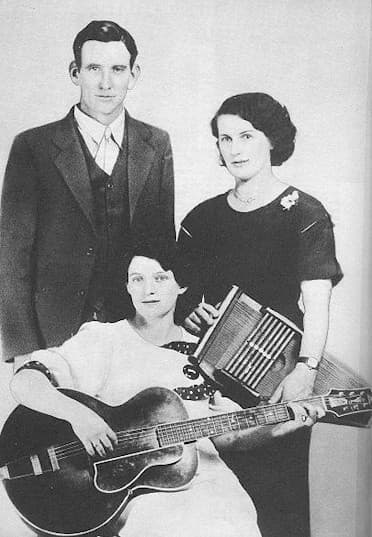
American · Arts · Literature
Sara Carter
July 21, 1898 – January 8, 1979
Early life and background
Sara Elizabeth Dougherty (later Sara Carter, and after remarriage often styled Sara Carter Bayes) was born on July 21, 1898, near Flatwoods close to Coeburn in Wise County, in the Clinch Mountain region of southwestern Virginia. She was the daughter of William Sevier Dougherty, a sometime sawmill operator and farmer, and Elizabeth (Nancy) Kilgore Dougherty. The family lived in a rural, economically modest environment typical of Appalachian mountain communities at the turn of the twentieth century, where subsistence farming, timber work, and small‑scale industry provided precarious livelihoods.
Sara grew up in a culturally rich world shaped by Anglo‑American ballads, hymn singing, and local fiddle and banjo tunes. Like many girls in the region, she learned songs in the home and at church rather than through formal musical training. Family members, neighbors, and itinerant singers all contributed to her repertoire. The Clinch Mountain area, near the Tennessee and Kentucky borders, was a crossroads for oral tradition, and Sara absorbed a wide range of material—religious songs, narrative ballads, and sentimental pieces—that later formed the backbone of the Carter Family catalog.
Little is recorded about her formal schooling; like many rural children, her education was likely intermittent and balanced with farm chores and domestic responsibilities. What is well documented is her early passion for singing and her facility with simple accompanying instruments, particularly the autoharp, a chorded zither that enjoyed popularity in Appalachian homes and schools. This combination of a strong, unadorned contralto voice and autoharp accompaniment would become her signature sound on record.
Marriage to A.P. Carter and musical beginnings
On June 18, 1915, at seventeen, Sara married Alvin Pleasant "A.P." Carter, who came from nearby Scott County, Virginia. The couple initially lived in the small community of Maces Spring (later called Hiltons), where they farmed and, like their neighbors, faced the economic uncertainties of rural life in the southern Appalachians. They would have three children together.
Music was woven into the daily life of their household. A.P. was an avid song hunter who traveled through southwestern Virginia, eastern Tennessee, and surrounding areas collecting songs from family, friends, and acquaintances. Sara’s deep repertoire of traditional material and her talent for remembering and reshaping songs made her an essential partner in this informal collecting enterprise. She sang at home, in church, and at local gatherings, developing the calm, measured, and emotionally penetrating vocal style that would later distinguish the Carter Family from other recorded acts.
By the mid‑1910s and 1920s, the couple’s musical life overlapped with that of Maybelle Addington Carter, who married A.P.’s brother Ezra. Maybelle was a gifted guitarist whose thumb‑lead picking style became as distinctive as Sara’s voice. Informal music‑making among these relatives provided the template for the trio—Sara, A.P., and Maybelle—that would eventually be known professionally as the Carter Family.
The Bristol Sessions and the "Big Bang" of country music
In 1927 the newly emerging recording industry was eager to capture so‑called "hillbilly" music for a growing market of rural and urban consumers. Talent scout and producer Ralph Peer, working for Victor Records, organized field recording sessions in Bristol, a town on the Tennessee‑Virginia border. The sessions, held in late July and early August, would later be mythologized as the "Big Bang" of commercial country music.
On August 1, 1927, Sara, A.P., and Maybelle traveled from Maces Spring to Bristol in a Model T Ford to audition. Late that afternoon or early evening, around 6:30 p.m., they performed before Victor’s microphone in a makeshift studio. Sara led the group on the song "Bury Me Under the Weeping Willow," accompanying herself on autoharp while Maybelle played guitar and A.P. supported with harmony and arrangements. Peer later recalled that when he heard Sara’s voice, he immediately recognized that the group had something special and commercially promising.
The Bristol recordings, released in 1927, introduced national audiences to the Carter Family’s austere and deeply affecting sound. Sara’s contralto—steady, unornamented, and emotionally contained—offered a striking contrast to the more theatrical vocal styles common in popular music of the day. The success of their early releases helped Victor understand the potential of rural southern genres and set the stage for the Carter Family’s extensive recording career.
Recording career and artistic development
Following the Bristol breakthrough, the Carter Family quickly became one of the most important acts in the emerging field of country music. On May 10, 1928, Sara participated in a Victor recording session that yielded some of their first major commercial successes. Across the late 1920s and early 1930s, the group recorded numerous titles, including sacred songs, secular ballads, and sentimental pieces. Sara sang lead on the majority of them, often providing autoharp accompaniment, while Maybelle’s driving guitar and A.P.’s harmonies and organizational skills completed the sound.
Among the songs associated with Sara’s lead vocals are enduring classics such as "Keep On the Sunny Side," "Will the Circle Be Unbroken," "Wildwood Flower," and many lesser‑known but influential pieces. Some songs were traditional numbers that A.P. and Sara adapted; others were copyrighted arrangements built from older materials. Whatever their origin, Sara’s voice gave them a distinctive identity that resonated with record buyers even as the Great Depression strained consumers’ resources.
Throughout the early 1930s, the Carter Family balanced recording sessions with live performances and radio work. They became familiar to listeners across the South and beyond through radio broadcasts that carried their sound far beyond the Appalachian region. By 1930, they were widely recognized as a leading act in hillbilly and country music, influencing repertoire and performance practice for countless string bands and vocal groups.
Crucially, Sara’s presence as a woman singing lead while accompanying herself on autoharp made her stand out in a field where women were more commonly heard as duet partners or novelty acts. Her serious, unsentimental stage demeanor and vocal delivery challenged stereotypes about female performers and helped normalize the centrality of women’s voices in country music ensembles.
Personal crisis and continued collaboration
Despite professional success, Sara’s personal life grew increasingly strained. A.P.’s frequent absences on song‑collecting trips, combined with the pressures of touring and family obligations, eroded their marriage. On August 15, 1936, Sara and A.P. legally separated. The separation was painful for both and caused tension within their tight‑knit community.
Notably, the separation did not immediately end their musical collaboration. Sara continued to perform and record with the Carter Family, including in later sessions for labels such as Decca and Columbia. This required a difficult emotional balancing act: she remained the group’s primary lead vocalist and a key artistic presence while negotiating a changed personal relationship with A.P.
On October 18, 1939, Sara married Coy Bayes, a cousin of A.P., and moved to California. The relocation physically distanced her from the group’s Virginia base, but she still traveled back east at times to participate in recording sessions and special appearances. By the early 1940s, however, the original Carter Family configuration wound down as changing musical tastes and wartime conditions reshaped the industry.
Later recordings, reunions, and the folk revival
After moving to California, Sara largely withdrew from the rigors of a full‑time music career. She devoted much of her energy to family life, working outside music when necessary. Nevertheless, she remained willing to re‑engage with performance and recording when opportunities arose to revisit the Carter Family repertoire.
In the mid‑1950s and early 1960s, the rise of the folk revival sparked renewed interest in early country recordings. In 1956, Sara returned from California to participate in reunion recording sessions with Maybelle and other family members, helping to reintroduce classic material to a new audience. Additional reunion projects and appearances in the early 1960s further solidified the Carter Family’s status as progenitors of modern folk and country music.
A pivotal moment came on March 18, 1963, when Sara and Maybelle performed at Carnegie Hall in New York City. For many urban folk fans, this concert offered a first chance to see and hear the original voice behind songs they knew from records and songbooks. Sara’s presence at a venue associated with high culture affirmed the artistic value of Appalachian and country traditions and symbolized their entry into the American musical canon.
On September 3, 1966, Sara appeared at the Newport Folk Festival, another central site of the 1960s folk movement. There she performed Carter Family standards for an audience of enthusiasts and fellow performers. Her understated stage manner, in marked contrast to the showmanship of some revival acts, underscored the music’s origins in home and church rather than commercial show business. These high‑profile appearances helped bridge the gap between early commercial country music and the contemporary folk scene.
Musical style and major contributions
Sara Carter’s voice was central to the Carter Family sound. Her contralto was low, even, and largely free of ornament, conveying emotion through subtle phrasing rather than dramatic vocal effects. This restrained style lent songs an air of gravity and sincerity that resonated across religious and secular repertories. It also differentiated the Carter Family from other early country acts whose vocals were more nasal, comic, or overtly sentimental.
Instrumentally, Sara is best known for her autoharp playing. She used the instrument both as a rhythmic and harmonic foundation, strumming chords to support her singing and Maybelle’s guitar. At a time when the autoharp was still widely considered a parlor or school instrument, Sara’s use of it on major commercial recordings helped legitimize it as a serious tool in country and folk performance.
Her song choices and interpretations were equally influential. Many of the songs she sang derived from older Anglo‑American ballads and gospel pieces, which she and A.P. adapted for commercial recording. Others were newly written but within a traditional idiom. By recording this material in the late 1920s and 1930s, the Carter Family preserved a large body of repertoire that might otherwise have remained localized or been lost as oral traditions shifted.
Awards, honors, and institutional recognition
Sara Carter’s influence began to be formally recognized even before her death. With the Carter Family, she was inducted into the Country Music Hall of Fame in 1970, an honor that signaled the group’s canonical status in the genre. The induction underscored the continuing impact of their recordings on modern country performers and songwriters.
After her death, additional institutional honors followed. On August 1, 1993, she was posthumously inducted into the Autoharp Hall of Fame, which celebrated her role in bringing the autoharp to a mass audience through her 1920s and 1930s recordings. The Hall of Fame’s proclamation explicitly described her as "the first woman to make a commercial success by recording with the autoharp," acknowledging her barrier‑breaking achievement in a field where women’s instrumental contributions had often been marginalized.
On the same date, that proclamation effectively established her as a landmark figure for women autoharpists, linking their work directly to her pioneering recordings. Later, on October 4, 2001, the International Bluegrass Music Hall of Fame (now the Bluegrass Music Hall of Fame & Museum) inducted the Carter Family, thereby honoring Sara as a progenitor of the bluegrass repertoire and vocal style. Although the Carters predated bluegrass as a named genre, their influence on song selection, harmony singing, and emotional tone was so extensive that the bluegrass community claimed them as foundational.
Personal life and relationships
Sara’s personal life was marked by both close family ties and significant upheaval. Her marriage to A.P. Carter in 1915 created not only a nuclear family but also an extended network of musical kin, including Maybelle and Ezra Carter and their children. Domestic life in Maces Spring revolved around farming, child‑rearing, church, and music‑making. The demands of recording and touring added strain to this already demanding existence.
The marital breakdown that culminated in the couple’s legal separation in 1936 had ramifications for the entire Carter clan. Nevertheless, the family maintained working relationships and continued to collaborate musically, a testament to both pragmatism and shared artistic commitment. Sara’s 1939 marriage to Coy Bayes gave her a new domestic base in California, where she spent most of her later years, though she returned to Virginia for visits and occasional musical projects.
Accounts from family and associates describe Sara as a reserved, serious woman, more comfortable with the music itself than with publicity or show business. She avoided the limelight in later life and did not cultivate a solo career after the original Carter Family’s heyday, preferring instead to support family and participate selectively in musical events that honored the group’s legacy.
Later life and death
In her later decades, Sara lived primarily in California with Coy Bayes, leading a comparatively quiet life far from the Nashville‑centered country music industry. She experienced declining health in the 1970s, including circulatory and respiratory problems. Despite these challenges, she remained an object of deep respect among musicians, folklorists, and dedicated fans of early country and Appalachian music.
On January 8, 1979, Sara Carter died in Lodi, California, at the age of eighty. Her body was returned to Virginia and interred at Mount Vernon United Methodist Church Cemetery in Maces Spring, not far from the Carter Family’s home place and just two rows from A.P. Carter’s grave. The location of her burial has since become a place of pilgrimage for admirers of the Carter Family and students of American roots music.
Legacy and historical impact
Sara Carter’s legacy is central to the history of country, folk, and bluegrass music. As lead singer and autoharpist of the Original Carter Family, she helped define what early commercial country music sounded like and what it could be about. Her recordings preserved a large corpus of Appalachian religious and secular songs that have since entered the standard repertoire of multiple genres.
Her influence on later musicians is extensive. Artists ranging from Johnny Cash and Emmylou Harris to bluegrass and folk revival performers have drawn on Carter Family songs that Sara first recorded. Many of these artists explicitly acknowledged the Carters as inspirations, and Sara’s interpretations continue to serve as reference points for vocal phrasing and emotional tone.
From a women’s history perspective, Sara’s career is especially important. In an era when the commercial music industry often relegated women to supporting roles, she stood at the center of one of the genre’s most influential acts. She not only sang lead but also accompanied herself, participated in shaping arrangements, and provided a model of a serious, non‑theatrical female stage presence. Her later recognition as the first woman to achieve commercial recording success with the autoharp further underscores her role in expanding possibilities for women as instrumentalists as well as vocalists.
Institutional honors, including inductions into the Country Music Hall of Fame, the Autoharp Hall of Fame, and the International Bluegrass Music Hall of Fame, have enshrined her contributions. Scholarship, reissue programs, and documentary work have likewise reinforced her status as a foundational figure. At the same time, the very understatedness of her public persona has left room for ongoing exploration of her life and work, particularly around questions of gender, regional identity, and the commercialization of traditional music.
Today, Sara Carter is remembered not only as the voice of the Carter Family but also as a key architect of American roots music. Her recordings remain in circulation, her songs continue to be sung, and her influence is audible wherever country, folk, or bluegrass musicians turn to the foundational repertoire of the southern Appalachians.
Dated achievements
12 indexed.
- Jul211898Arts
Birth of Sara Dougherty (Sara Carter)
Sara Dougherty (later Carter) was born in Wise County, Virginia.
View details Encyclopedia Virginia: Carter, Sara (1898-1979) - Jun181915